AI SDK Sandbox Tool just-bash Releases 1.0.191 Patch
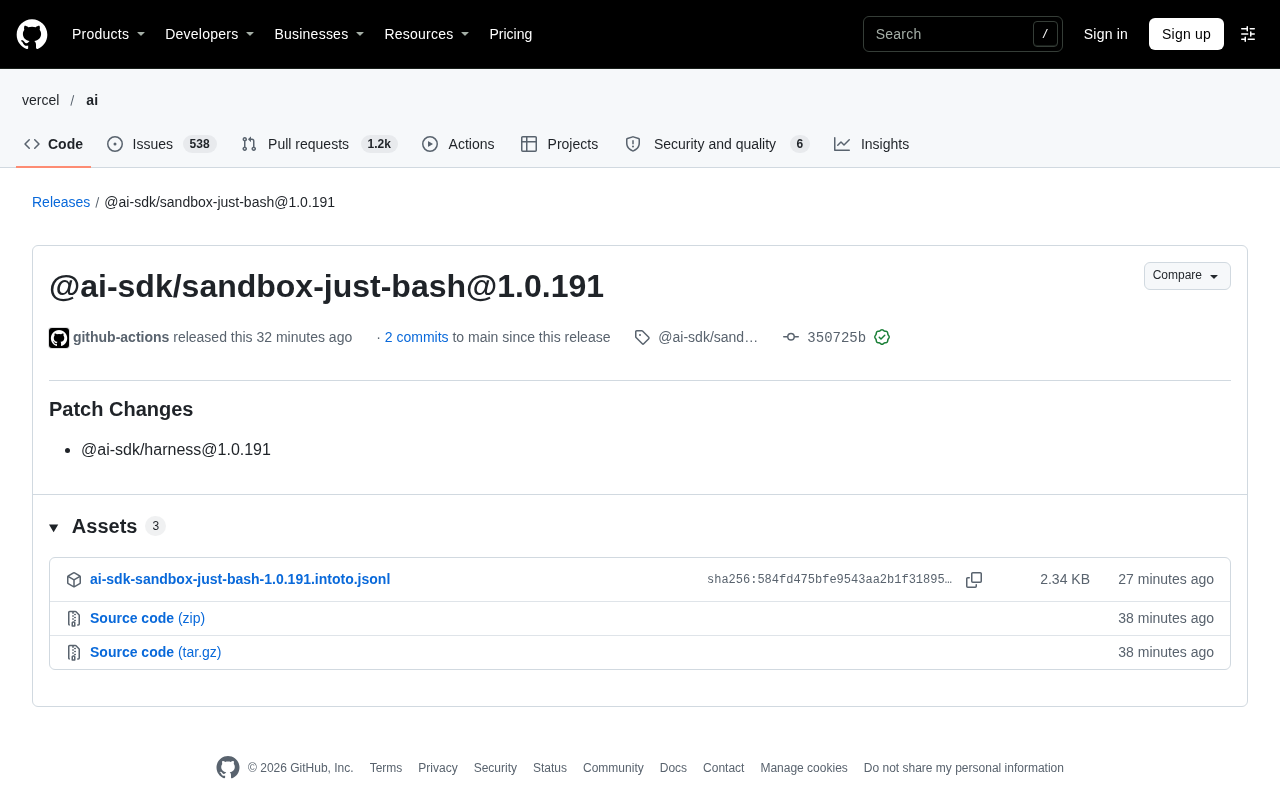
AI SDK sandbox component just-bash releases 1.0.191 patch, centered on syncing the harness package.
The AI SDK ecosystem's sandbox execution component @ai-sdk/sandbox-just-bash has released version 1.0.191, a primarily patch-focused update whose only change record is the companion package @ai-sdk/harness syncing to the same version. This main-package-follows-dependency release pattern aims to keep the sandbox layer and orchestration layer version-aligned, reducing version mismatch during combined installation. The release includes 2 commits with verified GPG signatures, a practical plus for enterprise supply chain review. The article notes that the sandbox + bash combination provides AI agents with a controlled command execution environment, isolating model-generated commands from real system resources. Due to limited public change details and resource loading issues on the release page, regression validation against your own use cases after upgrading is recommended.
The sandbox execution component in the AI SDK ecosystem, @ai-sdk/sandbox-just-bash, has shipped version 1.0.191. This is a primarily patch-oriented release, with the core change pointing to the companion package @ai-sdk/harness. For developers relying on the AI SDK to build code execution, command simulation, or agent toolchains, these small version updates often determine environment consistency and reproducibility.
What Changed in This Update
The release notes contain only one Patch Changes entry: @ai-sdk/harness@1.0.191. This means the adjustments in this release are not centered on new functionality in just-bash itself, but rather on synchronizing the underlying harness package version to ensure dependency alignment.
This "main package follows the dependency package" release pattern is not uncommon in modular toolchains like the AI SDK. The sandbox execution layer provides an isolated bash environment, while the harness handles coordination and orchestration. Keeping the two version numbers in sync reduces version mismatch issues developers encounter when installing them together.
Interestingly, this release includes 2 commits, and GitHub shows verified signatures on the submission (GPG key ID: B5690EEEBB952194). For teams introducing third-party AI toolchains in enterprise environments, verifiable signatures are a practical plus in supply chain security reviews.
Why the Sandbox + Bash Combination Deserves Attention
One of the most commonly requested capabilities when AI agents invoke external tools is command execution. The name just-bash directly states its positioning: providing a near-real bash experience within a controlled sandbox. For code generation agents, automated testing agents, and LLM applications that need to read the filesystem or run scripts, this is an infrastructure-level capability.
The value of sandboxed execution lies in isolating "model-generated commands" from "real system resources." Commands may come from model output or user input, and executing them directly on the host machine introduces uncontrollable risk. Through sandbox encapsulation, developers can preserve bash semantics while controlling the boundaries of accessible resources.
The companion @ai-sdk/harness package, judging by its name, plays a "mounting and orchestration" role. The synchronized release of both indicates that this combination is being maintained as a whole rather than evolving independently.
A sandbox in AI execution environments typically refers to a restricted runtime container or process isolation mechanism. Common implementations include OS-level virtualization (such as Linux namespaces, cgroups), lightweight virtual machines (such as Firecracker), or pure user-space emulation layers. Its core goal is to ensure untrusted commands can only see and operate on an explicitly authorized subset of resources—for example, read-only mounted directories, capped memory and CPU, and disabled network egress. Compared to full virtual machines, sandboxes emphasize startup speed and low overhead, making them suitable for high-frequency, short-lived execution scenarios like model-generated commands. The key to understanding sandbox boundaries lies in clarifying the "isolation granularity": whether it's process-level, filesystem-level, or network-level isolation directly determines how much impact a single bash command can have.
The term harness in @ai-sdk/harness typically refers to a "test/run framework" in software engineering, responsible for loading the object under test or execution unit into a controlled environment, driving its operation, and collecting results. In the AI SDK context, it can be understood as the orchestration layer between the sandbox and upper-level agent logic: receiving command requests initiated by the agent, forwarding them to the sandbox for execution, and then returning stdout, exit codes, and error information to the model or caller. The benefit of layering the harness and sandbox is separation of concerns—the sandbox only handles isolation and execution, while the harness manages lifecycle, session state, and result organization. This is also why the two need version synchronization: once the interface contract changes, both sides must be upgraded together.
Practical Impact of the Patch Release on Users
Judging from the version number, 1.0.191 is a product of high-frequency small-step iteration. Such releases typically do not introduce breaking changes, but developers should still confirm two things when upgrading: first, whether the @ai-sdk/harness version has been correctly aligned; second, whether existing code has implicit dependencies on internal harness behavior.
This release does not list feature changes or fix details, and some resources on the release page also show loading errors. Therefore, it's impossible to determine from public information alone which edge cases were specifically fixed. If your project relies on this sandbox to handle complex bash command flows, it's recommended to run a round of regression validation against your own use cases after upgrading, rather than assuming the patch version can be swapped in seamlessly.
Consistency Issues Behind Version Numbers
just-bash and harness are both at 1.0.191. This strict alignment is friendly for dependency management, but it also means the release cadences of the two packages are bound together. For users who want to upgrade only one of the packages, version constraints may introduce additional friction. This kind of design trade-off is common in modular SDKs, essentially a choice between "dependency determinism" and "upgrade flexibility."
Semantic versioning (SemVer) specifies version numbers in the form major.minor.patch, where an increment in the patch number indicates backward-compatible bug fixes that introduce no new features or breaking changes. However, this convention relies on maintainers' voluntary compliance, and in practice patch versions can occasionally still change behavioral details, especially at the internal implementation level. Therefore, "patch version = safe upgrade" is only a statistical expectation, not a guarantee. For packages at the 1.0.x stage with high iteration frequency, a more prudent approach is to pin exact versions or use lock files, and review the commit diff before upgrading, rather than relying on the version number itself to judge risk.
Editorial Perspective
A single patch release carries limited information on its own, but the signal it conveys is worth noting: the AI SDK's sandbox execution stack is still being continuously refined through high-frequency small versions. For teams building AI coding agents or automated execution environments, tracking version changes in these components can help surface compatibility risks earlier than waiting for a major version feature announcement.
This release information comes from the GitHub Releases page, which had resource loading issues, so some details could not be fully presented. In the absence of a complete changelog, it's advisable to cross-check against the repository's commit history.
Related articles

Zero-Code Replication of a $10,000 3D Website with Claude Code: A Six-Tool Breakdown
Bilibili creator Yomi used Claude Code plus five free tools to build a 3D product landing page quoted at $10,000 overseas—zero code. Breakdown of the six-tool division of labor, image-to-3D workflow, and the core collaboration method: "give AI a reference, not 'make it look better.'"
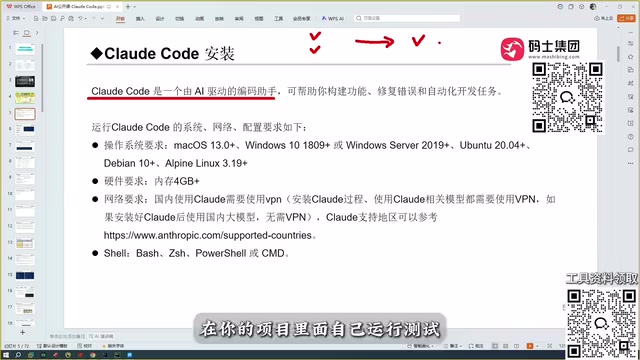
Claude Code in Practice: Install, Connect Models, Calculate Tokens, and Ship a Full-Stack Project with a Single Document
Based on a Bilibili public course demo, this covers Claude Code installation, model connection, token cost calculation, and the practical path of shipping a full-stack project with a single document, plus comparisons with Copilot, Cursor, Trae, and other coding assistants.
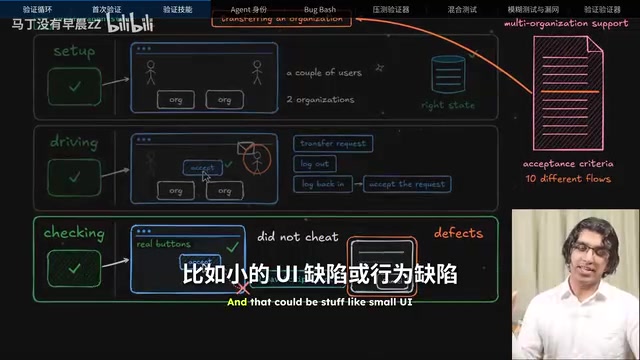
Who Accepts AI-Written Code? A 25-Minute Deep Dive into Verification Loops and the New Code Review Paradigm
After AI writes lots of code, how should Code Review verify it? This article breaks down the Claude Code team's verification loop framework: surface-level end-to-end verification, setup/drive/check three-stage skills, hybrid end-to-end testing and reliability checklists, and how to tighten the loop when issues slip through.