AI SDK Svelte 4.0.326 Release Analysis
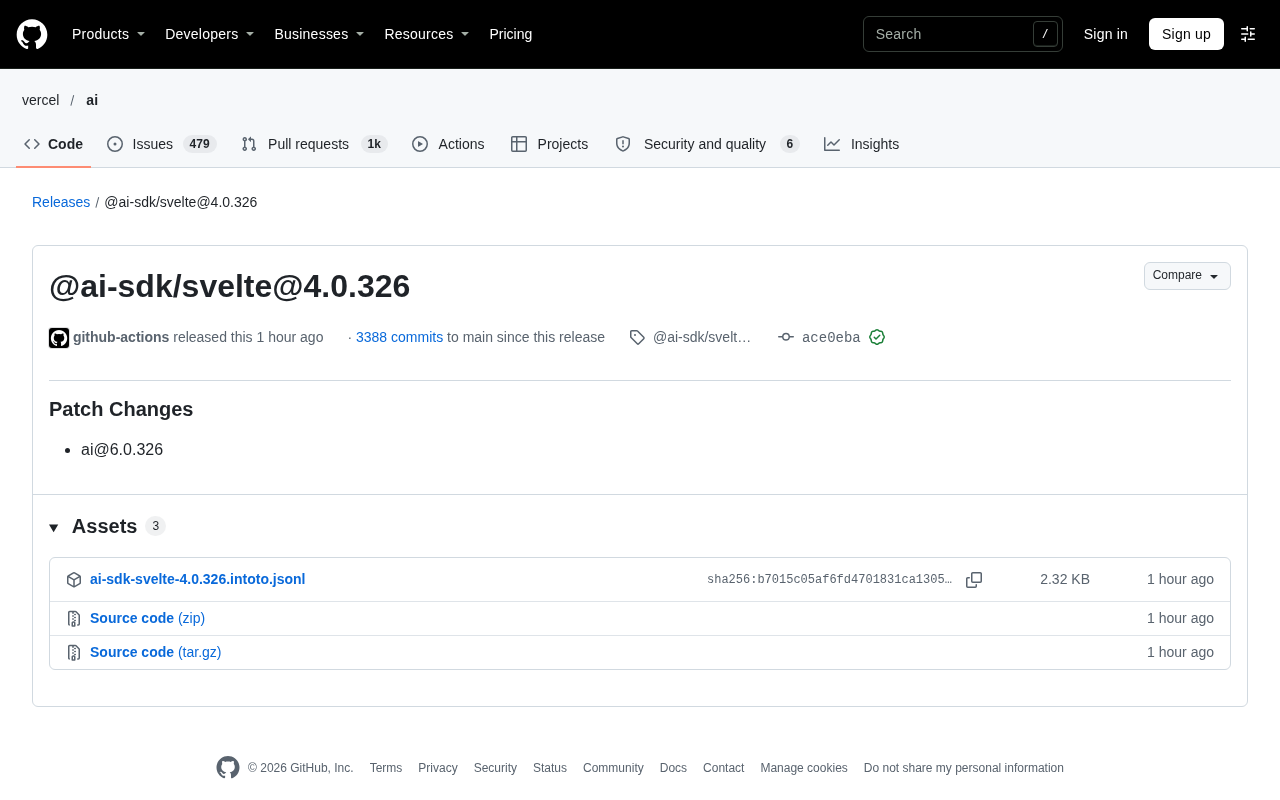
@ai-sdk/svelte releases patch 4.0.326, syncing the ai core package to 6.0.326.
The article covers the release of AI SDK's Svelte adapter package @ai-sdk/svelte version 4.0.326. This version was automatically published by github-actions with 3388 cumulative commits, representing a low-risk patch-level iteration that primarily syncs the dependency on the ai core package to 6.0.326, maintaining version linkage between the adapter and core packages. The article notes that the Svelte adapter package lets developers on that framework directly use AI capabilities like streaming responses and tool calling without writing their own request wrapping logic. For production projects, it's recommended to verify version consistency between the core package and adapter package in the dependency lock file before upgrading, and to run regression tests on custom streaming logic. Overall, this is a routine update, but it reflects the project's active development rhythm.
AI SDK's Svelte adapter package @ai-sdk/svelte has quietly released version 4.0.326. At first glance, this looks like a routine patch release, but with its dependency on the ai core package also upgraded to 6.0.326, it's still worth developers' attention.
Release Overview
According to the release records on GitHub, @ai-sdk/svelte@4.0.326 was automatically published by github-actions, with commit hash ace0eba and 3388 commits accumulated since the previous version. The release notes indicate Patch Changes and reference the ai@6.0.326 update. 
Based on the version numbering convention, this is a patch-level iteration, meaning no breaking changes are introduced and the focus is mainly on bug fixes and minor optimizations. For Svelte developers already using AI SDK in their projects, the upgrade risk is low.
Why the Svelte Adapter Package Matters
AI SDK is an open-source toolkit from Vercel for building AI applications, providing a unified interface for calling different large language models. It started primarily in the React ecosystem and gradually expanded to frameworks like Vue and Svelte. The emergence of @ai-sdk/svelte allows Svelte developers to integrate AI capabilities in a way that follows the framework's conventions.
Svelte is known for its compile-time optimization and concise reactive syntax, giving it unique advantages when building lightweight frontend applications. AI SDK providing an adapter layer for it means developers don't need to write their own request wrapping logic and can directly use capabilities like streaming responses and tool calling.
AI SDK's Framework Adapter Layer Design
The AI SDK core package (ai) itself is UI-framework-agnostic. It provides low-level capabilities such as model invocation, streaming response parsing, and the tool-calling protocol. To make these capabilities ergonomic in a specific framework, an adapter layer is needed: converting streaming data chunks into the framework's reactive state and providing Hooks or APIs that follow that framework's conventions. @ai-sdk/svelte is exactly this layer.
This layering means adapter packages typically contain relatively thin logic, with the main work being state bridging and type definitions. Therefore, when the core package releases a patch, the adapter package often only needs to sync the version number or make minor adjustments — which is why its version number advances in lockstep with the ai package. Understanding this explains why an adapter package update itself carries limited information; the changes truly worth tracking usually happen in the core package.
The Practical Significance of Patch Updates
Looking at 4.0.326 alone, it's hard to glean much detail — the release notes only say Patch Changes without listing specific fixes. But from an engineering practice perspective, these high-frequency patch releases typically contain several categories of content: synchronized adaptation to upstream ai core package changes, type definition corrections, and bug fixes in edge cases.
You may not have noticed that this update syncs the dependency on the ai package to version 6.0.326. AI SDK's framework adapter packages maintain version linkage with the core package. This strategy reduces the effort developers spend manually aligning versions and also lowers runtime issues caused by version mismatches.
For production environment projects, it's recommended to check the project's dependency lock file before upgrading to confirm version consistency between the ai core package and the svelte adapter package. If the project has custom streaming logic, a quick regression test should be performed after upgrading to confirm that response stream behavior hasn't changed.
Semantic Versioning and What Patch Numbers Mean
Under Semantic Versioning (SemVer) conventions, version numbers take the form major.minor.patch. An incrementing patch number indicates only backward-compatible bug fixes, with no breaking changes and (strictly speaking) no new features. In 4.0.326, the third segment, 326, is the patch number — so the author's assessment of low upgrade risk is well-founded.
However, note that AI SDK's patch numbers are very large, indicating an extremely high release frequency. Automated continuous publishing causes patch numbers to accumulate rapidly. Under this high-frequency release model, the actual scope of changes in a single patch number may be very small, sometimes just dependency version alignment. So for developers, rather than tracking every patch number, it's better to watch the minor version (the middle segment) — that's where new features and potential behavior adjustments concentrate.
Iteration Rhythm from an Ecosystem Perspective
AI SDK uses an automated release process, with version releases triggered by github-actions — increasingly common in open-source projects. The benefit of automated releases is a stable cadence and fewer human errors; the cost is that release notes tend to be brief, requiring developers to dig into commit history for change details.
The cumulative 3388 commits show that this project is in active development. For teams that depend on it, establishing a mechanism to follow version updates is necessary — you don't need to upgrade for every patch immediately, but you should pay attention to major version changes in the core package and assess migration costs in advance.
Dependency Linkage and Version Drift Risk
When multiple packages share the same internal protocol (such as the data chunk format for streaming responses or the message structure for tool calls), version mismatches can lead to type mismatches or runtime parsing failures. AI SDK's strategy of synchronized version linkage between adapter packages and the core package is essentially using version number alignment to avoid such protocol inconsistency issues.
In practice, package managers may install multiple versions of the ai core package due to transitive dependencies, creating duplicate instances and thereby causing type conflicts or state-sharing issues. Checking the lock file during upgrades and using overrides/resolutions to force a unified version when necessary are common techniques for avoiding version drift. This is also the technical background behind the article's recommendation to verify dependency consistency.
Summary
@ai-sdk/svelte@4.0.326 is a routine patch update, with the key information being version synchronization with ai@6.0.326. For AI application developers on the Svelte stack, staying aware of such updates helps you get fixes and optimizations promptly while avoiding the hidden risks of version drift.
One-line Summary
@ai-sdk/svelte releases patch 4.0.326, syncing the ai core package to 6.0.326.
Paragraph Summary
The article covers the release of AI SDK's Svelte adapter package @ai-sdk/svelte version 4.0.326. This version was automatically published by github-actions with 3388 cumulative commits, representing a low-risk patch-level iteration that primarily syncs the dependency on the ai core package to 6.0.326, maintaining version linkage between the adapter and core packages. The article notes that the Svelte adapter package lets developers on that framework directly use AI capabilities like streaming responses and tool calling without writing their own request wrapping logic. For production projects, it's recommended to verify version consistency between the core package and adapter package in the dependency lock file before upgrading, and to run regression tests on custom streaming logic. Overall, this is a routine update, but it reflects the project's active development rhythm.
Related articles

Seven Years of Evolution: How Far Has the Foldable Come From the First Generation?
From the first foldable to today's latest models, what has seven years changed? Shallower creases, higher brightness, thinner bodies, and smoother software migration—has the foldable crossed the chasm from enthusiasts to ordinary users? This article discusses the question based on a video comparison.

When Did Humans Start Eating Salt? A 10,000-Year History of Salt
When did humans start eating salt? From salt use at the dawn of agriculture 11,000 years ago to ancient seawater evaporation and rock salt mining, and on to the salt trade, salt taxes, and Gandhi's Salt March, this article traces salt's key role in human civilization.
Microsoft Paza Research: How African Language Speech Recognition Breaks Through Architecture and Data Bottlenecks
Microsoft's Paza research evaluates 53 speech models across 39 African languages, revealing architecture choice matters more than pre-training coverage, 200-300 hours is the practical data threshold, and language typology deeply influences recognition performance.