@ai-sdk/svelte 5.0.140 Released: Dependency Upgrade and Ecosystem Significance

@ai-sdk/svelte 5.0.140 is a patch update that only synchronizes the underlying ai@7.0.140.
Vercel's @ai-sdk/svelte has released patch version 5.0.140, with only one commit as the core change, namely synchronizing the underlying dependency ai@7.0.140. The article points out that aligning the patch number of framework adapter packages with the core package is AI SDK's consistent version management strategy, making compatibility easy to judge intuitively. The reason the adapter layer needs separate releases is that it must adapt to internal interface changes in the core package, and explicit releases make the dependency relationship clear and traceable. The patch number 140 also reflects AI SDK's maintenance philosophy of high-frequency minor versions and controllable risk. For Svelte developers, the upgrade is simple: raise the adapter package to 5.0.140 and ensure the ai package is 7.0.140; at patch level, there are theoretically no breaking changes. This update also conveys a signal of Vercel's parallel multi-framework support and continued investment in the Svelte ecosystem.
A Low-Key Patch Update
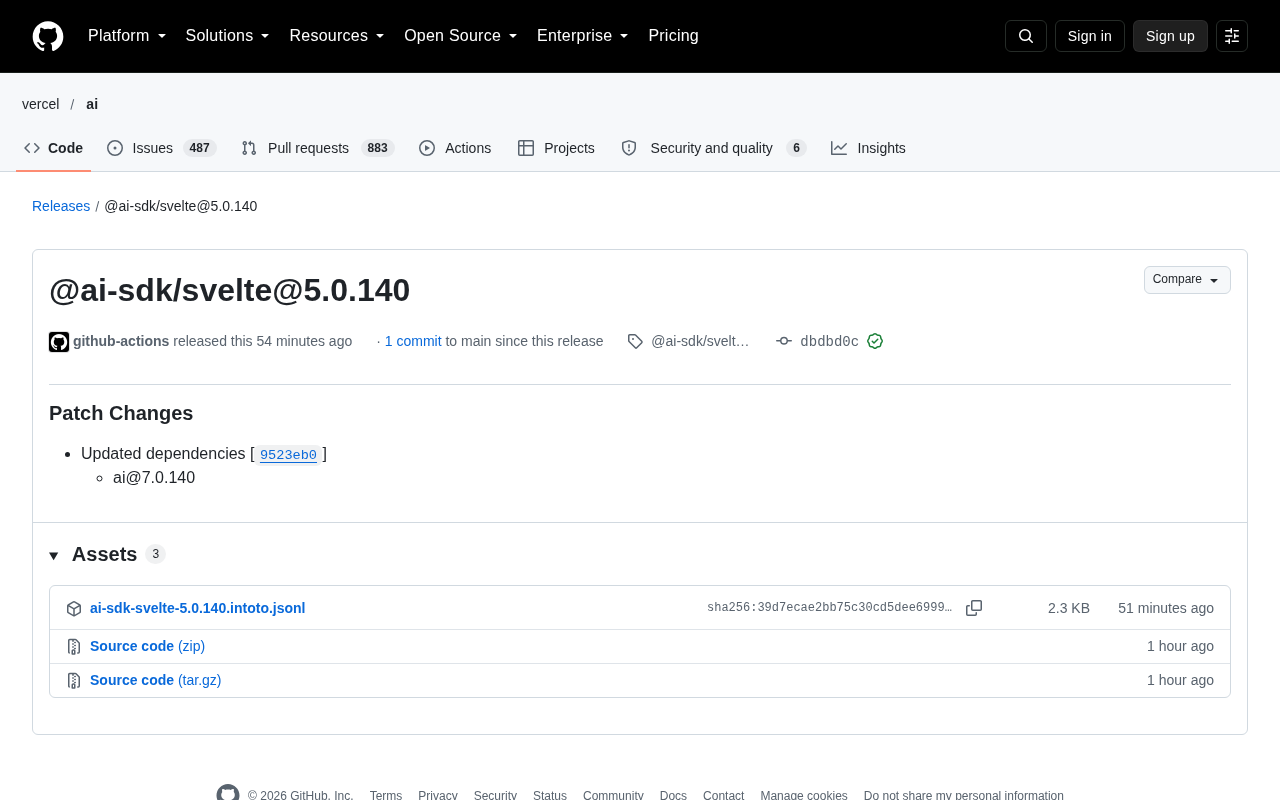
The AI SDK ecosystem under Vercel has seen another minor version iteration. @ai-sdk/svelte has released version 5.0.140, and judging from the GitHub release record, this is a standard patch update: it contains only 1 commit (dbdbd0c), with the core change being the synchronized upgrade of the underlying dependency ai@7.0.140.
For developers unfamiliar with this package, @ai-sdk/svelte is the official adapter layer that AI SDK provides for the Svelte framework, allowing Svelte applications to integrate large model capabilities in a way that follows the framework's conventions. The patch number 140 indicates that it has already gone through a large number of rapid, small-step releases on the 5.x branch, making it a product of the mature maintenance phase.
Dependency Locking: The Binding Logic Between the Svelte SDK and the Core SDK
Consistency Maintenance Behind a Patch Update
The entire content of this update is "Updated dependencies [9523eb0]" — bumping the ai package to 7.0.140. This may seem unremarkable, but it actually reflects the version management strategy that AI SDK has consistently followed: framework adapter packages stay aligned with the core package in version numbers.
When the ai core package releases 7.0.140, @ai-sdk/svelte follows suit to 5.0.140, keeping the same patch number. The benefit of this approach is that developers can intuitively judge compatibility — if your project uses ai@7.0.140, then pairing it with the 5.0.140 Svelte adapter package is the safest choice.
Semantic Versioning and Patch Numbers: In the SemVer (Semantic Versioning) specification followed by the npm ecosystem, version numbers take the form major.minor.patch. An increment in the patch number typically includes only backward-compatible bug fixes or dependency synchronization, without introducing new features or breaking existing APIs; an increment in the minor version represents backward-compatible new features; and an increment in the major version means potentially breaking changes may be included. Therefore, the "patch-level" update repeatedly emphasized in this article is the type of change with the lowest upgrade risk for users — in theory, it can be directly replaced without modifying business code. However, SemVer is only a convention rather than a mandate, especially when dependencies are upgraded indirectly, behavioral differences may still be introduced, so even for patch updates, running the test suite once is still a prudent practice.
Dependency Locking and Version Alignment: The "patch number alignment" mentioned in the article is a common release practice in monorepos. The core package ai and the various framework adapter packages (such as @ai-sdk/svelte, @ai-sdk/vue) are located in the same repository, and releases are driven uniformly through tools (such as changesets), so that the adapter packages' dependency on the core package is precisely locked to the same patch number. This way, developers only need to compare version numbers to infer mutual compatibility, without having to consult a complex compatibility matrix. The cost is that every change to the core package triggers releases of multiple adapter packages, making the release records appear dense.
Why the Framework Adapter Layer Deserves Its Own Release
Some may ask: if the core package is updated, can't the adapter package simply reuse it? In fact, the framework adapter layer often needs to adapt to changes in the core package's internal interfaces. Even if this time it is only a patch, the Vercel team still chose to explicitly publish a new version, with the purpose of making the dependency relationship clear and traceable — when developers upgrade the ai package, they can simultaneously lock the matching Svelte package version, avoiding unexpected compatibility issues at runtime.
The Role of the Framework Adapter Layer (adapter / binding): The core package ai of AI SDK provides underlying capabilities that are independent of UI frameworks — a unified model invocation interface, streaming responses, tool calling, structured output, and so on. But different frontend frameworks differ greatly in state management, reactivity mechanisms, and rendering approaches: React relies on Hooks and immutable state, Svelte relies on compile-time reactive declarations, and Vue relies on its reactivity system. The responsibility of the adapter layer is to "translate" the core package's general APIs into interfaces that conform to each framework's idiomatic usage, for example, providing Svelte with reactive wrappers based on stores or runes. Therefore, the adapter layer is not a simple forwarder; it needs to be aware of subtle changes in the core package's internal interfaces. When the core package adjusts its internal data structures or type definitions, the adapter layer must follow up with modifications and deliver them externally through an independent release. This is precisely the reason why "the core package is updated, and the adapter package is released separately along with it."
Looking at AI SDK's Maintenance Philosophy from Its Release Cadence
High-Frequency Minor Versions: Another Expression of Stability
The number 140 itself speaks volumes. AI SDK adopts a high-frequency minor version release strategy, and almost every change to the core package triggers a synchronized update of the adapter packages. This model is not uncommon in the open-source ecosystem — peripheral libraries for mainstream frameworks such as React and Vue often adopt similar practices.
The cost of high-frequency minor versions is that the release page appears "trivial," but the benefit is that the risk of each change is controllable. For teams that rely on AI SDK in production environments, locking specific patch numbers and upgrading as needed is more in line with engineering practice than chasing major versions.
AI SDK / Vercel AI SDK: This is an open-source toolkit launched by Vercel for integrating large language models into JavaScript/TypeScript applications. It is designed with "model provider agnosticism" as its goal — through a unified abstraction layer, developers can invoke models from different vendors such as OpenAI, Anthropic, and Google with almost identical code, and switch providers without rewriting business logic. Its common capabilities include streaming text generation, generative UI (rendering model output directly as components), tool calling, and multi-step agent orchestration. The core package ai carries these capabilities and is accompanied by a set of packages prefixed with @ai-sdk/, including both integration implementations for various model providers and UI adapter layers for frameworks such as React, Svelte, Vue, and Solid, thus forming an ecosystem that runs in parallel across multiple frameworks and multiple providers.
Practical Impact on Svelte Developers
If you are building AI applications with Svelte, the operation for this update is very simple: upgrade @ai-sdk/svelte to 5.0.140 in package.json, and make sure the ai package is also 7.0.140. Since it is patch-level, there should theoretically be no breaking change, but it is still recommended to run your existing tests after upgrading.
Svelte's positioning in AI application development is somewhat special — it is known for compile-time optimization and concise reactive syntax, making it suitable for building lightweight AI interaction interfaces. AI SDK's continuous maintenance of Svelte means that Svelte developers do not need to encapsulate request logic themselves and can directly use officially provided capabilities such as streaming responses and tool calling.
Ecosystem Signal: Continued Investment in AI SDK's Multi-Framework Coverage
The continuous releases of @ai-sdk/svelte convey a clear signal: Vercel adopts a multi-framework parallel support approach for AI SDK, rather than betting only on React or Next.js. Frameworks such as Svelte, Vue, and Solid all have corresponding adapter packages, and they iterate in sync with the core package.
For developers, this means that framework choice does not have to become a barrier to integrating AI capabilities. You can use a unified AI SDK API within the framework you are familiar with, reducing learning and migration costs. This small 5.0.140 update is essentially another routine execution of this ecosystem strategy.
Summary
@ai-sdk/svelte 5.0.140 is a typical dependency synchronization update, with no new features and no breaking changes. Its value lies not in "what was updated," but in proving that AI SDK's maintenance of the Svelte ecosystem is still progressing steadily. For developers building AI applications with Svelte, simply keep versions aligned and upgrade as needed.
Related articles

DeepCell: One-Click AI Generation of Documents, Spreadsheets, and Slides
DeepCell tops Product Hunt with one-click generation of documents, spreadsheets, and slides, using the .deepcell format for linked updates, designed for System 2 tasks like modeling and sales reviews.

Doneas: 15-Minute Daily Accountability Calls That Keep Indie Developers From Procrastinating
Doneas is a daily accountability tool for indie developers: plan tasks on Monday, join a 15-minute call with five builders each day, and log deliveries on a public progress page. This article analyzes its core mechanics, effectiveness, and potential issues around retention and matching.

Fastlane 2.0: Fully Automated AI Ad Campaigns, From Creative to Optimization
Fastlane 2.0 is an AI ad automation tool: enter your website and it learns your brand, generates video and image ads, and runs and optimizes them on Meta, TikTok, Instagram, and YouTube.