AI SDK Svelte 5.0.151 Released: The Evolution of the AI Toolchain Behind a Minor Version Update

@ai-sdk/svelte releases patch 5.0.151, aligned with the ai@7.0.151 core package.
The article covers the release of @ai-sdk/svelte 5.0.151. It's a patch update auto-generated by GitHub Actions with only 2 commits, synchronizing the core package ai@7.0.151 with no new APIs or breaking changes. The author notes that AI SDK patch updates often include key fixes for model adaptation, streaming stability, and tool-call parsing—low upgrade cost but real benefits. The article also analyzes Svelte's position in AI app development: compile-time optimization and concise reactive syntax suit streaming chat interfaces, but ecosystem examples and community discussion lag behind React. Finally, upgrade advice: check the ai package version, review commit history, and verify in a test environment before following up.
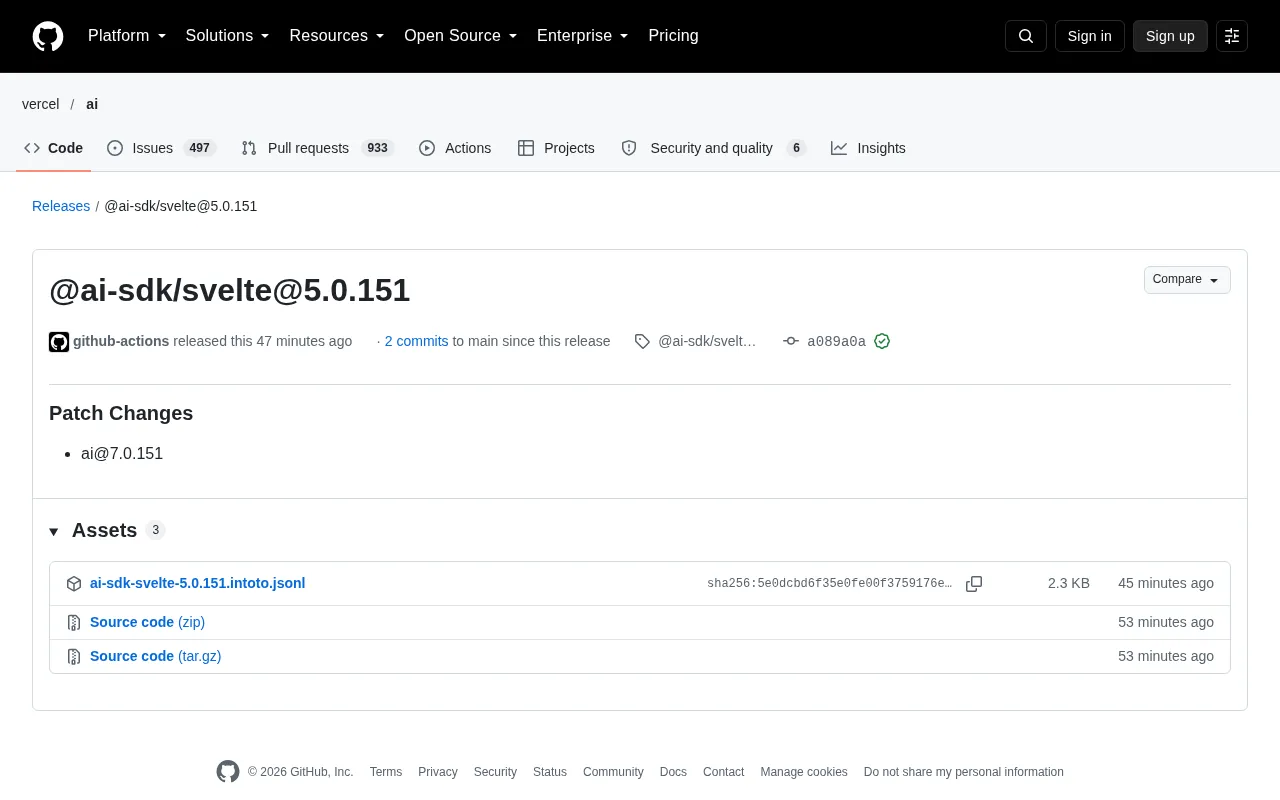
The AI SDK ecosystem has maintained a steady release cadence, and recently @ai-sdk/svelte shipped version 5.0.151. Judging from the GitHub release record, this is a standard patch update, primarily involving synchronized changes to the core package ai@7.0.151. Although only the last three digits of the version number changed, for developers building AI applications with Svelte, this kind of continuous maintenance signal is still worth paying attention to.
Basic Release Information
This release was auto-generated by GitHub Actions. The commit record shows 2 commits merged into the main branch, carrying GitHub's verified signature (GPG key ID: B5690EEEBB952194). The release time was October 23 at 17:24.
In terms of content, the release notes are very concise: the Patch Changes section only lists ai@7.0.151. This means @ai-sdk/svelte itself introduces no new APIs or breaking changes; the version bump is mainly to keep dependency alignment with the underlying ai core package.
In the npm ecosystem, this kind of coordinated release is common. AI SDK is maintained by the Vercel team. The ai package provides core capabilities such as streaming responses, tool calling, and multi-model adaptation, while @ai-sdk/svelte is the binding layer for the Svelte framework. Keeping the two version numbers in sync helps developers quickly identify the corresponding core dependency version when troubleshooting.
Semantic Versioning (SemVer) and patch updates: The npm ecosystem generally follows the semantic versioning specification, with version numbers in the form major.minor.patch (e.g., 5.0.151). An increment to the patch number is conventionally reserved for backward-compatible bug fixes, a minor version increment indicates new features while maintaining compatibility, and a major version increment may include breaking changes. However, this convention is a community practice rather than an enforced constraint—in real projects, patch releases can still slip in behavioral adjustments, so checking the changelog before upgrading remains a prudent practice.
GitHub Actions and automated releases: GitHub Actions is GitHub's built-in CI/CD service, where workflows can define tasks such as build, test, and release. AI SDK uses tools like changesets to automatically calculate version numbers, generate release notes, and publish to npm after a PR is merged. That's why release records commonly show "auto-generated" and a fixed commit count—these are products of the automation pipeline.
Why Patch Updates Are Still Worth Noticing
Many developers habitually focus only on minor or major versions, but AI SDK patch updates often contain critical bug fixes and model adaptation adjustments. During the 7.x phase, the ai package has continuously improved compatibility with various model providers, including streaming stability, fault tolerance in JSON parsing for tool calls, and token counting accuracy.
For Svelte applications in production, the benefit of upgrading to 5.0.151 may not be new features but avoiding known edge cases in older versions. Since patch versions theoretically contain no breaking changes, the upgrade cost is low—it's recommended to verify in a test environment before following up.
Streaming responses and tool calling: LLM applications typically use streaming, where the server returns content token by token via SSE or chunked responses, and the frontend renders as it receives, thereby reducing time-to-first-token. Tool calling refers to the model outputting structured function names and arguments, which the application executes and then passes the results back to the model for continued reasoning. These two pipelines involve a large number of edge cases—incremental text concatenation, JSON fragment parsing, and interruption recovery—which are also frequent sources of fixes in AI SDK patch versions.
Token counting: A token is the smallest unit of text processed by a model, and both billing and context length limits are measured in tokens. Different vendors implement different tokenizers, so the SDK needs to map the corresponding counting logic per model. Counting discrepancies directly affect cost estimation and context truncation strategies.
Svelte's Position in AI Application Development
Svelte is known for compile-time optimization and concise reactive syntax, giving it certain advantages when building lightweight AI chat interfaces and streaming output components. Utility functions like useChat provided by @ai-sdk/svelte let developers integrate streaming conversations with less boilerplate code.
However, compared with the React ecosystem, the Svelte version of AI SDK has relatively fewer surrounding examples and community discussions. This patch release came with no documentation updates or new examples, which also indicates that the maintenance team's current strategy is to keep the binding layer stable while core capability iteration is concentrated in the ai package. If you're evaluating a combination of frontend framework and AI SDK, the Svelte approach is viable, but you should be prepared to figure out some integration details on your own.
Svelte 5's reactive model and useChat: Svelte uses compile-time transformation to compile declarative reactive statements into fine-grained DOM update code, resulting in a smaller runtime footprint. Svelte 5 introduced runes (such as $state, $derived, $effect) as new reactive primitives, replacing the implicit let reassignment mechanism of earlier versions. Utility functions like useChat in @ai-sdk/svelte essentially wrap streaming message state into a subscribable reactive object and handle connection cleanup when the component unmounts, thereby reducing boilerplate for hand-written event listeners and state synchronization. Understanding this layer of wrapping helps determine whether an issue during streaming rendering originates in the SDK state layer or the component rendering layer.
Upgrade Recommendations and Caveats
When upgrading to @ai-sdk/svelte@5.0.151, it's recommended to also check that the ai package version matches. Since the release notes do not list specific fixes, you can compare the changelog or review the commit history to understand the actual changes in ai@7.0.151.
Additionally, the GitHub release page showed an error when loading assets ("There was an error while loading"). Some resources may be temporarily unavailable, but this does not affect npm installation. If you rely on the automated release process, keep an eye out for any follow-up clarifications.
Overall, this is a routine maintenance release with no fanfare, but for teams pursuing dependency stability, promptly following up on patch versions remains an effective way to reduce production risk.
One-line Summary
@ai-sdk/svelte releases patch version 5.0.151, aligned with the ai@7.0.151 core package.
Paragraph Summary
The article covers the release of @ai-sdk/svelte version 5.0.151. This is a patch update auto-generated by GitHub Actions, containing only 2 commits, with the change being synchronization with the core package ai@7.0.151 and no new APIs or breaking changes. The author notes that AI SDK patch updates often include key fixes for model adaptation, streaming stability, and tool-call parsing—low upgrade cost with practical benefits. The article also analyzes Svelte's position in AI application development: compile-time optimization and concise reactive syntax suit building streaming chat interfaces, but ecosystem examples and community discussion lag behind React. Finally, upgrade advice: check the ai package version, review commit history, and verify in a test environment before following up.
Related articles

PPO Algorithm Cracks the Moving Sofa Problem, Reconstructing Gerver's Optimal Solution
Developer uses PPO reinforcement learning to reconstruct Gerver's optimal solution to the Moving Sofa Problem, showcasing AI's potential in geometric optimization and its limitations.

PPO Algorithm Cracks the Moving Sofa Problem, Reconstructing the Classic Gerver Sofa
Explore how the PPO algorithm uses reinforcement learning to reconstruct the classic Gerver sofa solution to the moving sofa problem, showcasing AI's potential and limits in geometric optimization and mathematical discovery.

Qwen4-27B Accidentally Exposed: vLLM PR Leaks Clues About New Model
Reddit community discovers vLLM XPU repository PR #22 potentially leaking clues about Qwen4-27B, involving KV cache specs and Intel platform adaptation; this article reviews PR information, community reaction, and reference value for developers.