AI SDK Svelte Package Releases 5.0.166 Patch Update
@ai-sdk/svelte releases 5.0.166 patch, synced with core ai package 7.0.166 to maintain compatibility.
The @ai-sdk/svelte package in Vercel's AI SDK ecosystem has released version 5.0.166, with the core ai package upgraded to 7.0.166 in sync. This is a standard Patch Changes release with no named new features or API changes, focused on maintaining compatibility between the framework binding layer and core package. The article explains the AI SDK's layered architecture: the core package handles model invocation, streaming responses, and tool calling, while the binding layer adapts these to Svelte's reactive system—particularly needing to keep up with Svelte 5's runes model. For teams using this package, it's recommended to update the core package simultaneously and run regression tests on custom streaming message concatenation and interruption handling logic; since release log information is limited, projects with high stability requirements can check the corresponding commit or diff to confirm specific changes.
Vercel's AI SDK ecosystem is iterating again. The @ai-sdk/svelte package on GitHub has released version 5.0.166, a patch-level update, with the corresponding core dependency ai package upgraded to 7.0.166 in sync.
For frontend developers building AI applications with Svelte, this rapid version number churn is worth watching—it reflects the AI SDK's ongoing investment in fixing issues and maintaining the stability of its multi-framework adaptation layers.
What Changed in This Update
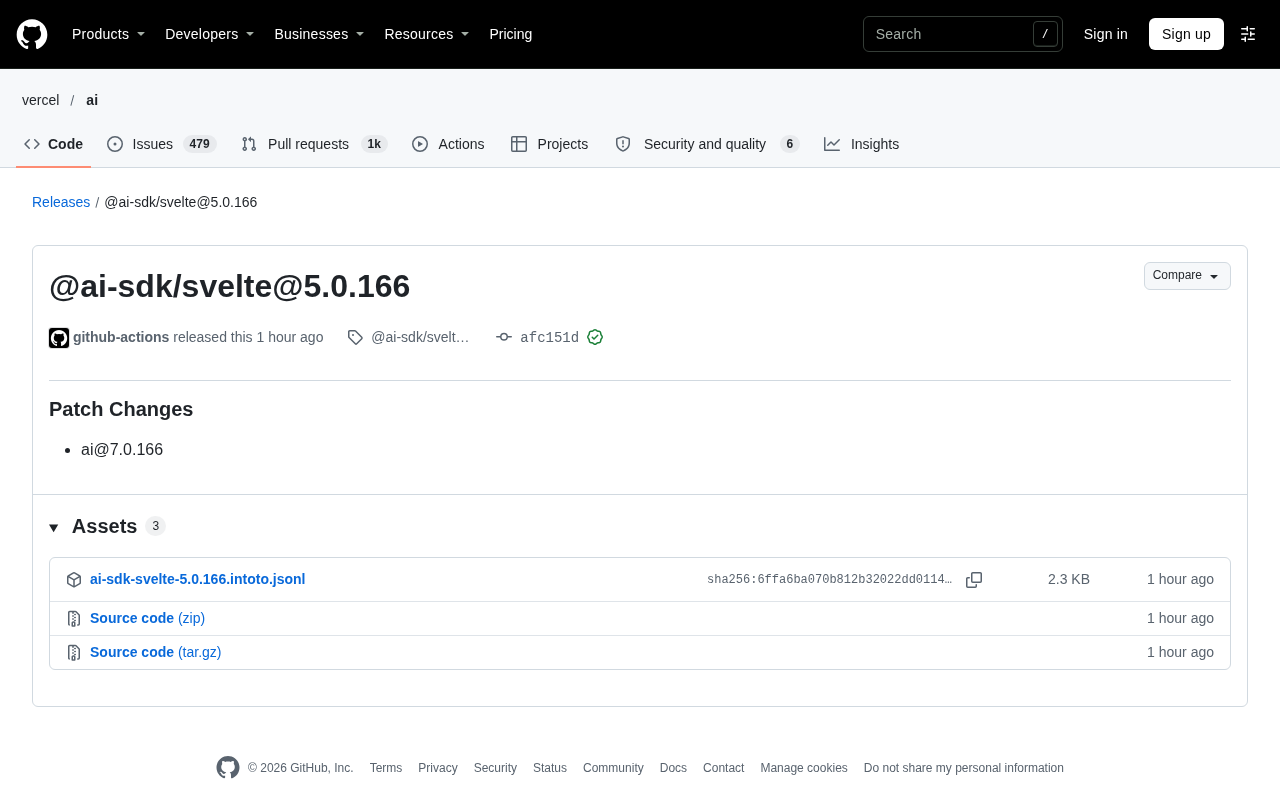
From the release notes, this is a standard Patch Changes release. The official description lists no named API changes or new feature announcements, and the changes keep pace with the dependency package ai@7.0.166.
This synchronized release mechanism is standard practice for the AI SDK: the core ai package handles unified model invocation, streaming responses, tool calling, and other underlying capabilities, while @ai-sdk/svelte serves as the framework binding layer that adapts the core capabilities to Svelte's reactive system. Although the two have different version numbers (5.x and 7.x), they are released in pairs each time to ensure behavioral compatibility between the binding layer and the core layer.
So the value of 5.0.166 isn't in visible new features, but in eliminating potential compatibility friction. For projects depending on this package, the upgrade cost is low, and the benefit is getting the latest fixes synchronized with the core package.
Why the Svelte Binding Layer Deserves Attention
In the AI SDK's official support matrix, Svelte is a first-class citizen alongside React, Vue, and Solid. Compared to the vast array of AI integration solutions in the React ecosystem, the Svelte community has relatively limited mature AI tooling options, and @ai-sdk/svelte is essentially one of the most hassle-free paths for connecting to mainstream large models in this framework.
Its capabilities include declaratively managing chat state within Svelte components, handling streaming text deltas, and completing tool-calling loops in conjunction with server-side routes. These capabilities are encapsulated in the binding layer, so developers don't need to handle stream parsing and state synchronization boilerplate themselves.
Frequent patch versions indicate the maintenance team is actively keeping up with the evolution of Svelte's own language features—especially after Svelte 5 introduced the runes reactive model, which requires the binding layer to carefully adapt to the new reactive primitives. The continuous rolling of version numbers is itself a signal of active maintenance.
What Are Framework Bindings
A binding layer is adapter code that sits between a general-purpose core library and a specific UI framework. The AI SDK's ai core package only handles framework-agnostic logic such as communicating with model providers, parsing streaming responses, and managing tool call state; packages like @ai-sdk/svelte wrap the core capabilities into Svelte's store or runes interfaces, allowing components to directly subscribe to chat state and render text deltas chunk by chunk. The React ecosystem's @ai-sdk/react and Vue's @ai-sdk/vue belong to the same category. The binding layer's version number is independent of the core package but must be compatible with a certain core version range, so the official team uses paired releases to lock down dependency relationships—which is also why both should be updated together during upgrades.
Svelte 5's Runes Reactive Model
Svelte 5 introduced runes (such as $state, $derived, $effect), replacing Svelte 4's implicit let reactive declarations and store subscriptions with explicit compile-time primitives. This change has a major impact on the binding layer: chat state previously based on writable stores needs to be redesigned into a form trackable by runes, and streaming text delta updates must also ensure they trigger the correct fine-grained re-renders. The consecutive patch versions of @ai-sdk/svelte are largely about keeping up with runes semantics and fixing reactive edge cases, so the rolling version numbers themselves can serve as a signal that this binding layer is still actively adapting to Svelte 5.
Upgrade Recommendations and Considerations
For teams already using @ai-sdk/svelte in their projects, patch versions can generally be followed with confidence, but there are still a few things worth noting.
First, confirm that the ai core package version is in sync. Since the binding layer and core package are released in pairs, it's recommended to update both together during upgrades to avoid situations where the binding layer calls interfaces that don't exist in the core package.
Second, pay attention to how streaming responses behave within the Svelte component lifecycle. Patch updates sometimes fine-tune stream processing logic, so if your project has custom message concatenation or interruption handling, you should run a round of regression testing in the development environment after upgrading.
Third, this type of RSS release log has limited information on its own. The GitHub Release page only notes Patch Changes and dependency relationships; specific code-level changes require checking the corresponding commit (in this case afc151d) or comparing version differences to confirm. For projects with high stability requirements, spending a few minutes to review the diff is worthwhile.
What Patch Means in Semantic Versioning
Under the SemVer specification, an increment in the third segment of version number 5.0.166 represents a patch release, conventionally defined as backward-compatible bug fixes that introduce no new APIs and don't change existing behavioral contracts. For users, patch upgrades carry the lowest theoretical risk and typically only require running the test suite before merging. But note two things: first, the AI SDK's binding layer and core package version numbers are not synchronized (5.x vs. 7.x), and the "patch" only describes the change level of the binding layer itself; the specific changes in the core package's 7.0.166 release still need to be confirmed separately. Second, if a project has locked the ai version range and only upgrades the binding layer, there may be cases where interfaces expected by the binding layer don't exist in the old core package—this is the technical basis for recommending paired upgrades.
Summary
@ai-sdk/svelte@5.0.166 is a low-key maintenance update with no new features, but it keeps the Svelte ecosystem in sync with the AI SDK's core capabilities. In AI application frontend development, stable updates to framework binding layers often attract less attention than model capability upgrades, but they are the foundation of long-term project maintainability.
One-line Summary
@ai-sdk/svelte releases 5.0.166 patch, synced with core ai package 7.0.166 to maintain compatibility.
Paragraph Summary
The @ai-sdk/svelte package in Vercel's AI SDK ecosystem has released version 5.0.166, with the core ai package upgraded to 7.0.166 in sync. This is a standard Patch Changes release with no named new features or API changes, focused on maintaining compatibility between the framework binding layer and the core package. The article explains the AI SDK's layered architecture: the core package handles model invocation, streaming responses, and tool calling, while the binding layer adapts these to Svelte's reactive system—particularly needing to keep up with Svelte 5's runes model. For teams using this package, it's recommended to update the core package simultaneously during upgrades and run regression tests on custom streaming message concatenation and interruption handling logic; since release log information is limited, projects with high stability requirements can check the corresponding commit or diff to confirm specific changes.
Related articles

Seven Years of Evolution: How Far Has the Foldable Come From the First Generation?
From the first foldable to today's latest models, what has seven years changed? Shallower creases, higher brightness, thinner bodies, and smoother software migration—has the foldable crossed the chasm from enthusiasts to ordinary users? This article discusses the question based on a video comparison.

When Did Humans Start Eating Salt? A 10,000-Year History of Salt
When did humans start eating salt? From salt use at the dawn of agriculture 11,000 years ago to ancient seawater evaporation and rock salt mining, and on to the salt trade, salt taxes, and Gandhi's Salt March, this article traces salt's key role in human civilization.
Microsoft Paza Research: How African Language Speech Recognition Breaks Through Architecture and Data Bottlenecks
Microsoft's Paza research evaluates 53 speech models across 39 African languages, revealing architecture choice matters more than pre-training coverage, 200-300 hours is the practical data threshold, and language typology deeply influences recognition performance.