@ai-sdk/tool-web-fetch 1.0.27 Patch Release: Dependency Chain Update

@ai-sdk/tool-web-fetch releases patch 1.0.27, syncing dependencies to ai@7.0.177 with no functional changes.
@ai-sdk/tool-web-fetch has released version 1.0.27, a patch-level update with no new features or API changes. This release contains only two dependency syncs, chiefly advancing the reference to the upstream main package ai to 7.0.177, auto-published by github-actions with a GitHub-verified signature. For teams already using the toolkit, upgrading requires no business code changes, but version alignment with the ai main package should be checked to avoid peer dependency warnings; developers who haven't adopted it are advised against upgrading solely to stay current. The article also analyzes AI SDK's high-frequency, small-step release strategy, recommending that developers lock versions, watch for breaking changes, and limit automatic upgrades to the patch range.
Vercel's AI SDK ecosystem has rolled out another small iteration. @ai-sdk/tool-web-fetch has released version 1.0.27, a typical patch-level update whose core changes center on dependency synchronization rather than new features.
What This Package Does
@ai-sdk/tool-web-fetch is one component of the AI SDK toolset, and its positioning is clear from the name: it provides a wrapper tool that gives AI applications web fetch capabilities. When building agents capable of web retrieval and page content extraction, toolkits like this handle the underlying job of "getting external web information to the model."
It is packaged within the unified release cadence of the AI SDK, with version numbers evolving independently from the main package — hence the situation where the toolkit is at 1.0.x while the core package has already reached 7.x.
AI SDK is an open-source TypeScript toolkit from Vercel designed to give developers a unified interface for calling different large language models (such as OpenAI, Anthropic, Google, etc.) and to handle common needs like streaming responses, tool calling, and structured output. Its core design philosophy is "model-agnostic," keeping application code from being tied to a specific vendor. AI SDK uses a modular architecture: the main ai package provides the core runtime and abstraction layer, while the @ai-sdk/* series of packages separately wrap specific model providers (such as @ai-sdk/openai), tools (such as @ai-sdk/tool-web-fetch), or auxiliary features. This split allows each module to iterate independently with versions that don't affect one another — so the coexistence of toolkit 1.0.x and main package 7.x is normal.
Breaking Down This Update
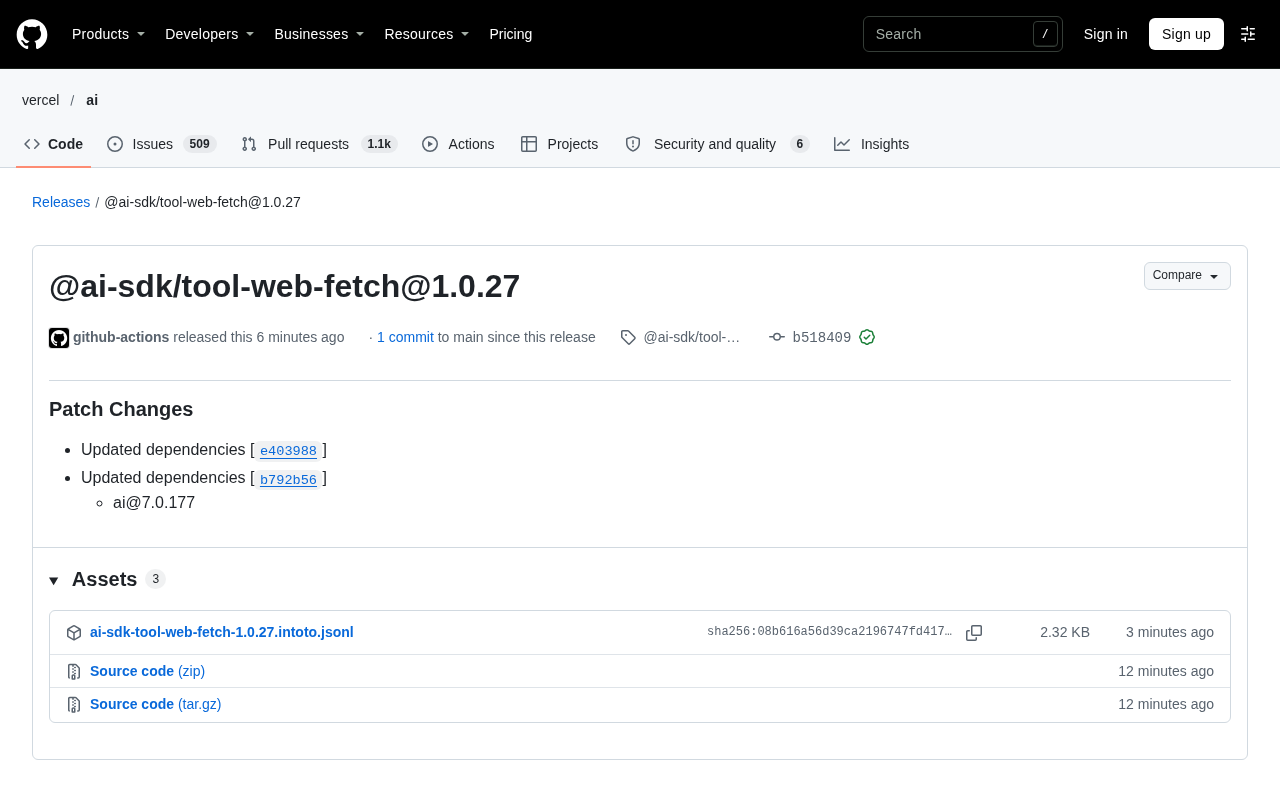
According to the GitHub Release page, the changes in 1.0.27 fall under Patch Changes, specifically containing two dependency updates:
- Updated the dependency reference for the commit corresponding to
e403988 - Updated the dependency reference for the commit corresponding to
b792b56, involvingai@7.0.177
In other words, this release did not change the tool's API or behavioral logic; it mainly advanced the dependency version of the upstream core package ai to 7.0.177. For projects with strict dependency locking, upgrading ensures consistency with the main package version and avoids type or runtime issues caused by version mismatches.
The Release was automatically published by github-actions, and the commit carries a GitHub-verified signature (GPG key ID: B5690EEEBB952194), indicating that the release process goes through the repository's built-in automated pipeline rather than manual operations.
Patch version follows Semantic Versioning (SemVer) in the format major.minor.patch. An increment in the patch number indicates a backward-compatible bug fix or internal adjustment, containing no new features and not breaking existing APIs. By contrast, an increment in the minor number indicates new features that are backward-compatible, while an increment in the major number may contain breaking changes. In dependency management, ^1.0.27 allows automatic upgrades to the latest 1.x.x version (without changing the major version), while ~1.0.27 only allows upgrades to the latest patch of 1.0.x. The article recommends limiting automatic upgrades to the patch range — using the ~ prefix or pinning exact versions — to reduce the risk of unexpected breakage.
Practical Impact on Developers
For teams already using this toolkit, the operational cost of this upgrade is very low — no business code changes are needed; you only need to advance the version number in your dependency declaration to 1.0.27. What really deserves attention is version alignment: if your project also depends on the ai main package, you should confirm the main package version is also 7.0.177 or a compatible version, otherwise peer dependency warnings may appear.
For developers who have not yet introduced this package, this version brings no functional increment, so upgrading solely to "stay current" is not recommended. Whether to adopt it should still come back to the requirements themselves: does your AI application need a structured web fetch tool, and can you accept the release cadence of the AI SDK ecosystem?
Understanding AI SDK's Frequent Small Releases
The AI SDK ecosystem adopts a high-frequency, small-step release strategy, and it is normal for toolkits to be patched individually. The benefit of this model is that fixes and dependency synchronization can quickly reach downstream users; the cost is that the version number list becomes quite lengthy — as can be seen from the loading state of "Choose a tag to compare" on this Release page, the number of tags has grown large enough to require filtering.
For users, the pragmatic approach is: lock versions, watch for breaking change markers in the changelog, and limit automatic upgrades to the patch range. An update like 1.0.27 is essentially a footnote to a healthy ecosystem in operation — no dramatic changes, but the dependency chain is continuously kept in sync.
Additional Background
Peer dependency is a type of dependency in npm package management used to declare that the current package needs to share the same dependency instance with the host project, typically for plugins, utility libraries, or framework adapters. Unlike regular dependencies, a peer dependency is not installed automatically; instead, it requires users to explicitly install a compatible version in their own project, otherwise npm will output a warning (npm 7+ attempts automatic installation by default but may still warn due to version conflicts). In the AI SDK ecosystem, @ai-sdk/tool-web-fetch very likely declares the ai main package as a peer dependency to ensure the toolkit and the main package use the same runtime, avoiding type mismatches or state isolation issues caused by multiple ai instances. Therefore, when upgrading the toolkit, be sure to check whether the main package version satisfies its peer range.
Related articles

Can You Go to Jail for Buying an Ethernet Cable? Revisiting the Absurd 1999 Law
Revisiting a 1999 Hacker News story: buying a cable modem to bypass paid subscriptions could mean jail time. Exploring the early clash between tech access and legal boundaries, and lessons for today's developers.
Scientist Arrested by ICE Despite Complete Documentation, Sparking Fear
Hacker News discussion: a scientist was arrested by ICE despite a complete paper trail, sparking enormous fear. This article analyzes the background, why arrest occurred despite complete documents, and the potential impact on the tech talent environment.

Braised Meat Shop Forced Out by Rent Hike: A Life-and-Death Contest Between Craft and Location
Braised meat shop owner forced out by a 100,000 yuan rent hike moves overnight; landlord's daughter takes over with seasoning packets and overnight meat sickens customers. A tale of location versus craft.