AI SDK Toolkit Update: @ai-sdk/tool-web-fetch 1.0.16 Released
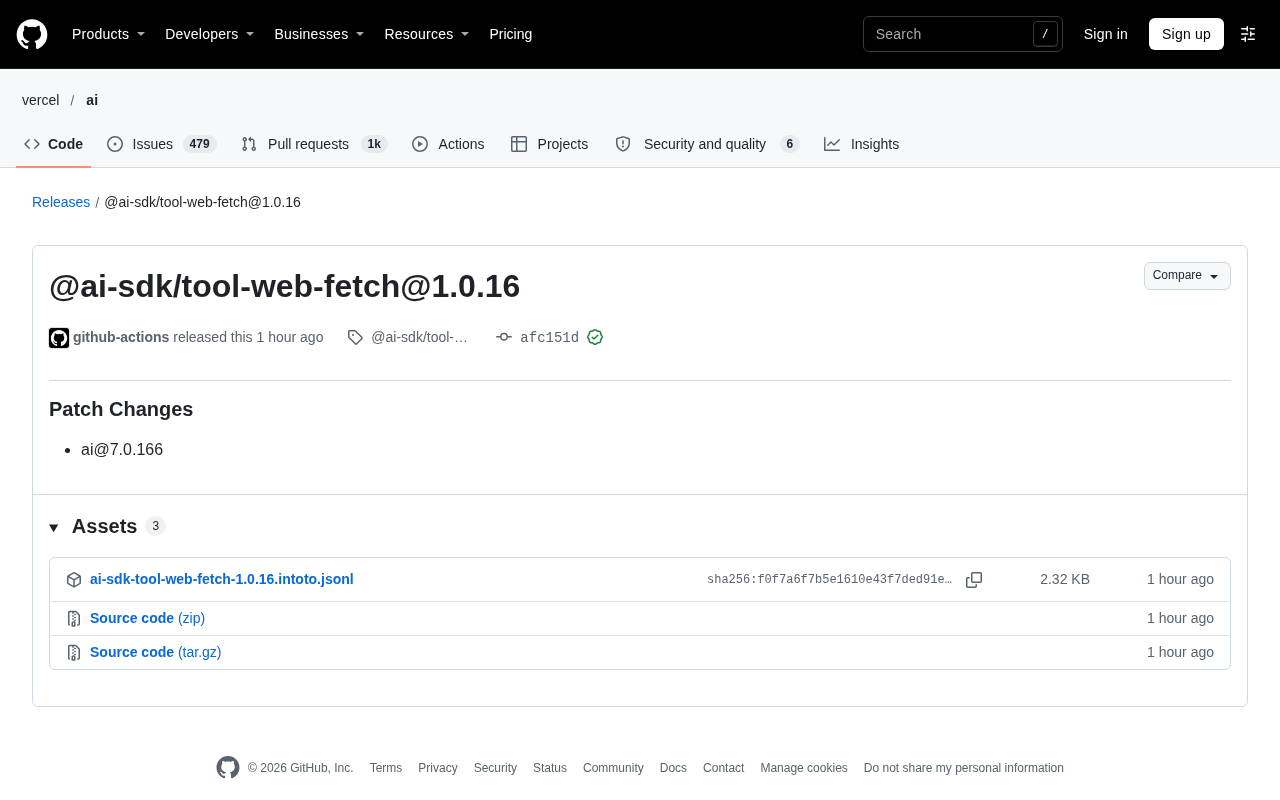
AI SDK's web fetch tool releases patch 1.0.16, focusing on stability and alignment with the core package.
Vercel's AI SDK project released @ai-sdk/tool-web-fetch 1.0.16, auto-published by GitHub Actions and signature-verified, tied to core package ai@7.0.166. The toolkit gives LLMs web content fetching capability as a standard component of the agent tool-calling ecosystem. Under SemVer, patch updates usually only fix backward-compatible stability issues, so upgrade risk is low. Developers should check dependency versions, run relevant tests, and confirm consistency with the ai core package.
Why a Small Version Update Is Worth Noticing
In the world of AI application development, subtle changes in the toolchain often signal the pace of ecosystem evolution. Recently, Vercel's AI SDK project released version 1.0.16 of @ai-sdk/tool-web-fetch. According to the release notes on GitHub, this is a patch version (Patch Changes), primarily tied to an update of the core package ai@7.0.166. For developers who rely heavily on AI SDK to build agents or tool-calling features, these version iterations—though they may seem insignificant—can fix critical issues or optimize underlying logic.
Interpreting the Release Details
Based on information captured from the GitHub Releases page, this release was automatically completed by the github-actions bot on 09 Nov 02:56, with commit hash afc151d. The commit carries a verified GitHub signature (GPG key ID: B5690EEEBB952194), ensuring the reliability of the code source. The release notes explicitly list a "Patch Changes" section and point to ai@7.0.166. This indicates that the update to @ai-sdk/tool-web-fetch is likely intended to adapt to or depend on this specific version of the core ai package.
@ai-sdk/tool-web-fetch is a tool module in the AI SDK ecosystem specifically designed for web content fetching. It allows developers to give large language models (LLMs) the ability to "retrieve web page information" directly, enabling models to read real-time web content and answer questions or perform tasks based on it. This tool-calling pattern is one of the core paradigms for building advanced AI applications today, such as autonomous agents and research assistants.
The Technical Logic Behind a Patch Update
Why should developers pay attention to a patch version? In semantic versioning (SemVer), patch versions are typically used for backward-compatible bug fixes. For a toolkit like tool-web-fetch, possible changes include fixing parsing errors for specific web page encodings, improving handling of redirects or timeouts, or optimizing alignment logic with the core ai package version. Although the official release notes do not detail the specific code changes, the "Patch Changes" label suggests that this update aims to improve stability rather than introduce new features.
For developers who have already integrated this tool, upgrading to version 1.0.16 is a low-risk operation. However, because it is a patch version, after upgrading you should monitor the success rate of web fetching, whether the response format meets expectations, and whether it is compatible with the ai core package version used in your project (7.0.166). The modular design of AI SDK allows such toolkits to be updated independently, so developers can flexibly choose whether to follow up.
Semantic Versioning (SemVer) is widely adopted by mainstream package managers such as npm, with version numbers in the form MAJOR.MINOR.PATCH: the major version increments for incompatible API changes, the minor version for backward-compatible feature additions, and the patch number only for backward-compatible bug fixes. This convention lets developers judge upgrade risk from the version number alone—a patch-level change theoretically does not alter public interfaces and only corrects internal behavior. In practice, however, two points deserve attention: first, dependencies are version-linked; for example, this toolkit has an adaptation relationship with the core ai package, so upgrading one piece alone may introduce mismatches. Second, semantic versioning is a convention rather than an enforcement; if maintainers misjudge, a patch version can still bring behavioral changes. Therefore, even for a patch upgrade, it is still advisable to pin versions via lockfiles and control risk through CI regression testing.
Signals of Evolution in the Tool-Calling Ecosystem
AI SDK, launched by Vercel, aims to provide developers with a unified, concise interface for calling various large models, with built-in support for advanced features such as streaming responses, tool calling, and structured output. As part of its official toolset, @ai-sdk/tool-web-fetch embodies the design philosophy of "standardizing and encapsulating external capabilities." Developers do not need to write complex web scraping logic themselves; they only need to import the tool and register it in model calls, allowing the model to decide autonomously when to fetch a web page and which link to fetch.
Although the release of version 1.0.16 is just a tiny commit record in the code repository, it reflects the AI SDK team's continuous maintenance of the toolchain. As AI applications move from demos to production, this kind of attention to detail is crucial. For practitioners focused on AI programming and agent development, tracking the version dynamics of such toolkits helps them obtain stability improvements in a timely manner and avoid potential production environment issues.
Tool Calling (Function Calling) is a key mechanism that allows large language models to break beyond pure text generation. Its basic flow is as follows: developers describe the names, purposes, and parameters of available tools with a structured schema; during inference, if the model determines that external information is needed, it outputs a structured call request instead of answering directly; the application layer captures that request, actually executes the function (such as sending an HTTP request to fetch a web page), and then sends the execution result back to the model as a new message, whereupon the model continues reasoning until it gives a final answer. Thanks to wrappers like AI SDK, details such as multi-turn call loops, parameter validation, and streaming output are handled by the framework, and developers only need to declare tools. It is worth noting that a "web fetching" tool essentially injects untrusted external content into the model context, so developers should be mindful of prompt injection risks and perform necessary filtering on fetched content.
Recommended Actions for Developers
If you are building applications with AI SDK, it is advisable to check the version number of @ai-sdk/tool-web-fetch in package.json. If the current version is lower than 1.0.16, consider upgrading (for example, using npm update @ai-sdk/tool-web-fetch). After upgrading, run your existing test cases, especially scenarios involving web fetching and tool calling, to confirm that behavior meets expectations. At the same time, check whether the ai core package also needs to be updated synchronously to 7.0.166 to maintain dependency consistency.
For developers who have not yet used this tool, it can be regarded as a lightweight web fetching solution. It removes the burden of maintaining scraping logic yourself and integrates seamlessly with the AI SDK calling paradigm. Note, however, that the tool's specific capability boundaries (such as whether it supports JavaScript-rendered pages or handles anti-scraping restrictions) should be checked against the official documentation; this article does not speculate on them.
Conclusion
The release of @ai-sdk/tool-web-fetch@1.0.16 is a microcosm of the AI SDK ecosystem's continuous iteration. Although the patch update is small, it concerns the reliability of the tool in production environments. For developers building agent applications, keeping an eye on such dependencies is a necessary habit for ensuring project stability. This article is based on publicly available release information on GitHub and does not involve undisclosed details of code changes.
One-line Summary
AI SDK's web fetching tool releases patch 1.0.16, focusing on stability and alignment with the core package.
Paragraph Summary
Vercel's AI SDK project has released the patch version @ai-sdk/tool-web-fetch 1.0.16, automatically published by GitHub Actions, signature-verified, and tied to the core package ai@7.0.166. This toolkit gives LLMs the ability to fetch web content and is a standard component of the agent tool-calling ecosystem. The article notes that under semantic versioning conventions, patch updates usually only make backward-compatible stability fixes, such as encoding parsing, redirect and timeout handling, and alignment with the core package version, so upgrade risk is low. The author recommends that developers check dependency versions, upgrade via npm update when necessary, and run tests involving fetching and tool calling while confirming consistency with the ai core package version to ensure production stability.
Related articles

Seven Years of Evolution: How Far Has the Foldable Come From the First Generation?
From the first foldable to today's latest models, what has seven years changed? Shallower creases, higher brightness, thinner bodies, and smoother software migration—has the foldable crossed the chasm from enthusiasts to ordinary users? This article discusses the question based on a video comparison.

When Did Humans Start Eating Salt? A 10,000-Year History of Salt
When did humans start eating salt? From salt use at the dawn of agriculture 11,000 years ago to ancient seawater evaporation and rock salt mining, and on to the salt trade, salt taxes, and Gandhi's Salt March, this article traces salt's key role in human civilization.
Microsoft Paza Research: How African Language Speech Recognition Breaks Through Architecture and Data Bottlenecks
Microsoft's Paza research evaluates 53 speech models across 39 African languages, revealing architecture choice matters more than pre-training coverage, 200-300 hours is the practical data threshold, and language typology deeply influences recognition performance.