AI SDK Toolkit Update: tool-web-fetch 1.0.20 Released
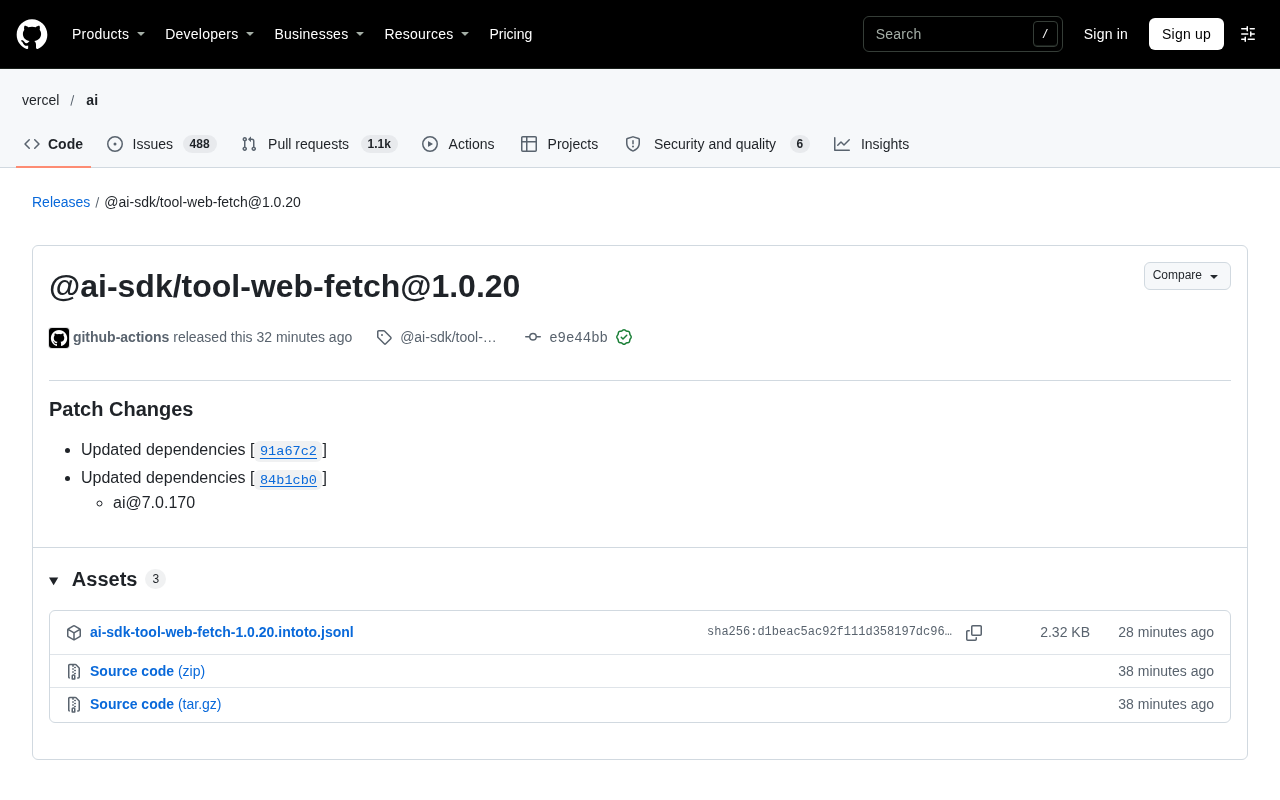
AI SDK's tool-web-fetch releases 1.0.20 patch, syncing dependencies to ai@7.0.170.
@ai-sdk/tool-web-fetch in the AI SDK ecosystem has released version 1.0.20, a patch update whose core content is syncing upstream dependencies and bumping the core ai package to 7.0.170. Such dependency-driven releases are common in toolchain ecosystems, and their value lies in version consistency rather than new features, helping avoid compatibility issues like mismatched type definitions and inconsistent tool-calling protocols. The toolkit provides web-fetch capability for the AI SDK; its version is independent but bound to the core package through dependency declarations. Upgrading is low-risk; run tests afterward to confirm the tool-calling chain works. Releases are automated via GitHub Actions with verified signatures, reflecting high-frequency iteration.
The @ai-sdk/tool-web-fetch package in the AI SDK ecosystem has released version 1.0.20. Judging from the GitHub release record, this is a typical patch update whose core content is syncing upstream dependencies.
Breaking Down the Version Update
According to the commit records on GitHub, version 1.0.20 is labeled as Patch Changes and mainly includes two dependency updates, corresponding to commits 91a67c2 and 84b1cb0 respectively, ultimately bumping the core ai package to version 7.0.170.
This kind of dependency-driven patch release is common in toolchain ecosystems. As a tool extension of the AI SDK, tool-web-fetch directly depends on the interface definitions and runtime capabilities of the core ai package. When the upstream fixes defects or adjusts internal implementations, downstream tool packages need to follow up with a release to ensure that the version combinations users pull are verified.
Why Dependency Updates Are Worth Noticing
For developers who directly use @ai-sdk/tool-web-fetch, the value of such patch updates lies not in new features but in version consistency. The AI SDK iterates quickly, and if the ai version locked by the tool package lags behind, problems such as mismatched type definitions and inconsistent tool-calling protocols may arise.
Aligning the dependency to ai@7.0.170 means the tool package stays in sync with the current core version. When developers upgrade the AI SDK in their projects, they can avoid the cost of troubleshooting compatibility issues caused by a lagging tool package.
The Toolkit's Position in the AI SDK
@ai-sdk/tool-web-fetch is part of the AI SDK's tool set extension. The design philosophy of the AI SDK is to provide a unified abstraction for model invocation and, through the tool mechanism, enable models to perform external operations. The web-fetch tool gives models the ability to fetch web page content, which is one of the foundational capabilities when building retrieval-augmented and information-aggregation applications.
The tool package's version management is independent of the core package but bound to it through dependency declarations. This split approach lets developers bring in tools on demand and avoids bloating the core package. The trade-off is a more complex version matrix, requiring attention to compatibility relationships among packages.
The AI SDK's tool mechanism: In the AI SDK, a tool is a description of an external function that the model can call, typically including a name, a parameter schema, and execution logic. When generating a response, the model decides based on context whether to call a tool, and returns the call parameters to the application layer in a structured form; the application executes them and passes the results back to the model to continue reasoning. tool-web-fetch encapsulates "fetching a web page" as exactly such a tool, enabling the model to proactively obtain external information across multi-turn interactions. Tool definitions and calling protocols are uniformly specified by the core ai package, so tool packages must match the core package version; otherwise, schema validation failures or incompatible call formats may occur.
Upgrade Recommendations
If your project already uses this tool package, upgrading to 1.0.20 is a low-risk operation. Patch versions contain no breaking changes, and the main benefit is dependency alignment. It is recommended to run your existing tests after upgrading to confirm that the tool-calling chain works properly.
If you have not yet introduced this tool package, what needs evaluation is whether the web-fetch capability fits your application scenario. Fetching external web pages involves network requests, content parsing, and context injection; the actual results depend on the accessibility and content structure of the target sites. It is recommended to validate with a small-scale scenario first before deciding whether to include it as a production dependency.
Semantic versioning and Patch Changes: 1.0.20 is the patch position in semantic versioning, which by convention should only contain backward-compatible bug fixes and dependency adjustments, without introducing new APIs or breaking changes. "Patch Changes" in the release record is usually generated by tools such as changesets, used in a monorepo to automatically aggregate changes across packages and determine version numbers. This is also why the article judges the upgrade risk to be low: a patch-position change means the public interface remains unchanged, and the impact is mainly concentrated on dependency resolution results. However, if your project has strict version locking on the core ai package, upgrading the tool package may indirectly raise the core package version, so the lock file still needs to be checked.
Observations on the Release Cadence
From the release record, the package is automatically published by GitHub Actions, and the commits carry GitHub verified signatures. The automated release process reduces the probability of human error and allows patch updates to reach users quickly. For open-source projects maintaining multiple packages, this mechanism is the infrastructure that sustains iteration efficiency.
Dependency-update releases carry limited information, but they reflect a fact: the AI SDK ecosystem is still iterating at high frequency. Developers need to build the habit of version tracking; especially when a project depends on multiple interrelated packages, regularly checking the dependency tree is more cost-effective than passively responding to compatibility issues.
Related articles

Anthropic Goes Public: AI Bubble or Buying Opportunity?
Anthropic lists on Nasdaq, opening about a third above its IPO price. We break down the $81.3B raise, $1.5T offering valuation, and $2T market valuation, plus Claude's growth and $567M quarterly operating loss.

Why the FBI's AI Hacker Warning Hinges on a Single Word from Microsoft
FBI says AI tool Artex attacked 2,250+ organizations, but the citation trail leads to Microsoft's wording of "attempted sign-ins." The gap between attempts and breaches reveals the attack's true scale.
Fable 5.2 Powers the Creation of Getsumen Express: A Browser-Based Lunar and Martian Exploration Game
A developer used Fable 5.2 to build Getsumen Express, a browser game where players explore the Moon and Mars, scan real landmarks, shoot aliens, and ride an interstellar train. Built on Three.js and WebGPU for about $730, it showcases AI-assisted development.