AI SDK Toolkit Update: tool-web-fetch 1.0.30 Patch Analysis

AI SDK's web fetch toolkit releases patch 1.0.30, syncing with core package ai@7.0.180.
Vercel's AI SDK project released version 1.0.30 of `@ai-sdk/tool-web-fetch`, with the `ai` core package moving up to 7.0.180 in tandem. The package wraps web fetching into a tool that large models can call directly — once mounted, the model can proactively fetch specified URLs during reasoning, reflecting AI SDK's "lightweight core + split tool packages" architecture. This release contains only one Patch Changes entry, essentially a dependency-alignment maintenance update tracking the core package, with no new APIs or behavior changes, completed automatically by github-actions across 2 commits. The article recommends upgrading the tool package and core package in sync to avoid version misalignment, and running tests first in production; it also reminds readers that patches don't change external constraints like anti-scraping policies and content formats — fetch success rates still depend on the target page itself.
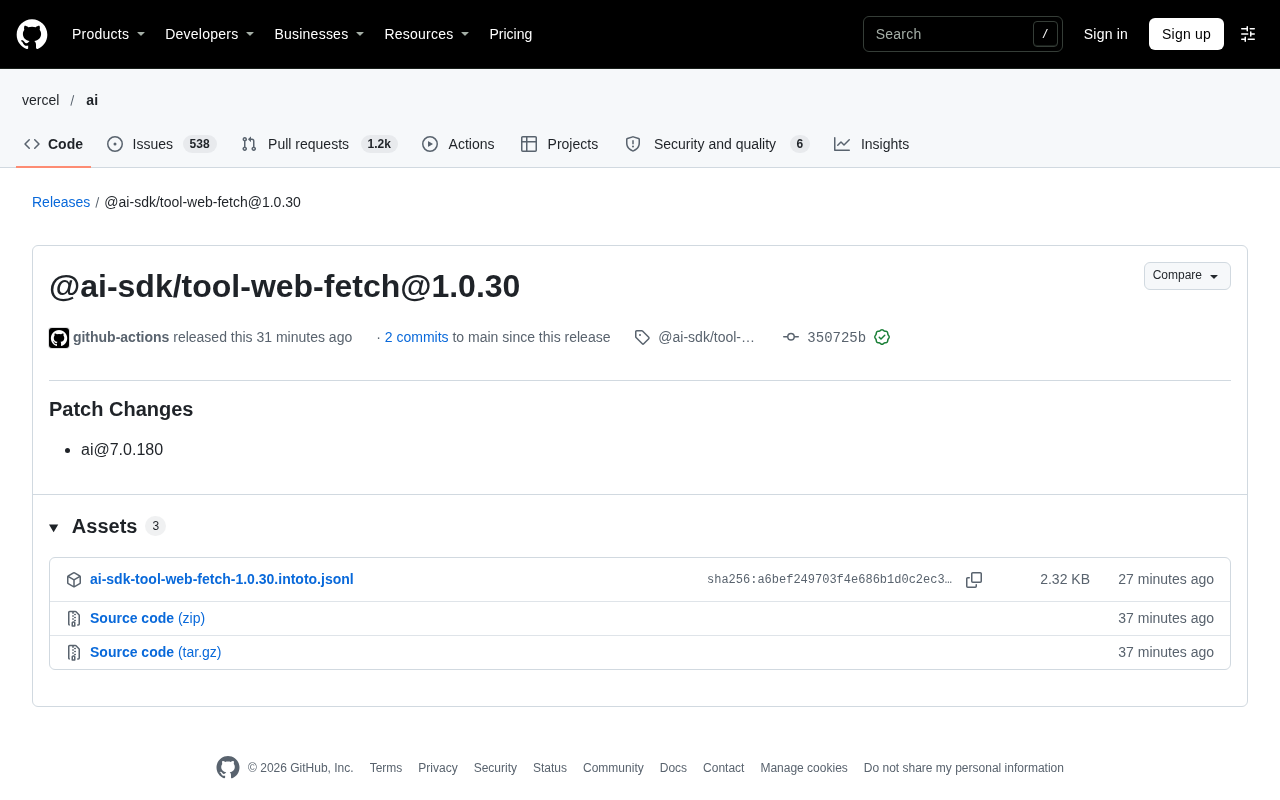
Vercel's AI SDK project recently released version 1.0.30 of @ai-sdk/tool-web-fetch for its toolkit family. This is a minor update marked as Patch Changes, accompanied by the ai core package moving up to 7.0.180. For developers building web-enabled applications with AI SDK, this kind of version bump often hides compatibility signals worth paying attention to.
What This Package Does
@ai-sdk/tool-web-fetch is a standalone package in the AI SDK ecosystem dedicated to the "web fetch tool." It wraps web fetching into a tool that large models can call directly. Developers don't have to write fetch logic, content cleaning, and error handling from scratch — they simply mount the tool onto the model call chain, and the model can proactively fetch content from a specified URL during reasoning.
Splitting tools into independent npm packages is a clear direction AI SDK has taken recently: the core ai package stays lightweight, while specific capabilities are imported on demand. This design keeps bundle size under control and lets each tool iterate on its own version cadence without being tied to the core package's schedule.
Tool Calling is the prerequisite for understanding this design. In LLM applications, tool calling means the model does not directly output a final answer during reasoning, but first outputs a structured "call request" (such as {name: "webFetch", arguments: {url: "..."}}), which the host program executes by calling the corresponding function and passing the result back to the model, which then continues reasoning based on that result. AI SDK uses the tool() helper function and Zod schemas to describe parameter structures, automatically generating JSON Schema for the model to understand, and handles parsing the model's call intent, executing the function, and feeding back results. @ai-sdk/tool-web-fetch is exactly such a tool instance with a pre-configured parameter schema and execution logic — once mounted, the model can autonomously decide when to fetch which URL, with no need for developers to hand-write scheduling logic.
Semantic Versioning rules directly determine upgrade decisions here. SemVer specifies the version number MAJOR.MINOR.PATCH: a MAJOR change indicates an incompatible API break, MINOR indicates backward-compatible feature additions, and PATCH indicates only backward-compatible bug fixes. Therefore a PATCH-level bump like 1.0.30 conventionally means the public API is unchanged, no new capabilities were added, and there are no breaking changes — caller code needs no adjustments. However, SemVer only constrains "a package's public interface" and does not guarantee that the internal behavior of other packages in the dependency tree remains unchanged — which is exactly why the original emphasizes upgrading in sync with the ai core package: the tool package depends on the core package's type definitions and runtime contracts, and version misalignment between the two may trigger type mismatches, a risk that falls outside SemVer's promises.
What Changed in 1.0.30
From the GitHub Releases page, this release contains only one Patch Changes entry, pointing to ai@7.0.180. In other words, the change in 1.0.30 is essentially tracking a patch version of the core package — a dependency-alignment maintenance update rather than the introduction of new APIs or behavior changes.
The release was completed by the github-actions automation workflow, the commits are GitHub-verified signatures, and it involves 2 commits. Under Semantic Versioning, a PATCH-level change means existing code should theoretically upgrade without modification, with risk mainly lying in "whether the new core package behaves consistently with the old tool package."
According to the GitHub release record, this update came without detailed changelog notes or migration guidance — a typical dependency-upgrade type of release.
Practical Impact on Users
Upgrade Recommendations
If your project uses @ai-sdk/tool-web-fetch together with the ai core package, it's recommended to upgrade both in sync to avoid type mismatches or runtime behavior differences caused by version misalignment. Patch-level updates can usually be merged directly, but in production environments it's still advisable to run the existing test cases first.
Boundaries to Note
Web fetch tools are inherently affected by target sites' anti-scraping policies and content formats (HTML/PDF/dynamic rendering), and version patches do not change these external constraints. The tool package solves the "unified interface" problem; fetch success rates still depend on the target page itself. This point should not be conflated when evaluating the benefits of upgrading.
Summary
1.0.30 is a restrained maintenance release: no new features, no breaking changes, with its core value being version synchronization with ai@7.0.180. For most teams, this is a low-risk upgrade to follow; for developers watching the AI SDK tool ecosystem, it once again confirms the project's "lightweight core + split tool packages" architectural approach.
Related articles

Prompt Engineering for Beginners: From Writing Prompts to Engineering Thinking
Starting from the essence and four functions of prompts, this article systematically explains the six-step process, four success criteria, learning value, and practical limitations of prompt engineering to help you build a complete understanding.

Anthropic Launches Nasdaq IPO: AI Giant's Listing and Risk Disclosures
Anthropic officially launches its Nasdaq IPO under ticker ANT, with market valuation expected to potentially exceed SpaceX's record. The prospectus devotes nearly 100 pages to AI risks, while first-half revenue grew over 14x but net losses widened sharply, reigniting the AI bubble debate.

Rust cURL Clone Uses 4,832 unsafe Blocks—Is the Memory Safety Myth Broken?
A Rust cURL clone uses 4,832 unsafe keywords, challenging Rust's memory safety narrative. We analyze what unsafe really means, compare Fil-C, and examine rewrite motives.