@ai-sdk/tui 1.0.130 Released: A Dependency-Sync Patch Update

@ai-sdk/tui 1.0.130 is a low-risk dependency-sync patch with zero breaking changes.
`@ai-sdk/tui` 1.0.130 is a routine maintenance patch focused solely on syncing upstream dependencies and upgrading the core `ai@7.0.129` package, with no new features or breaking changes. The package targets Node.js terminal UI scenarios and is tightly coupled with Vercel AI SDK. Its high patch frequency reflects the rapid maintenance cadence of the AI SDK ecosystem. The release was auto-published via GitHub Actions with GPG signature verification. For developers, upgrade risk is minimal — handle it in your next routine dependency update window while ensuring version alignment with the core `ai` package.
@ai-sdk/tui 1.0.130 Release Notes
A release notification from GitHub Releases announces that @ai-sdk/tui has published version 1.0.130 as a patch update. This is a typical dependency synchronization release with no significant functional changes. However, for developers building Terminal User Interfaces (TUI) on the AI SDK ecosystem, keeping the toolchain up to date remains a routine — and important — practice.
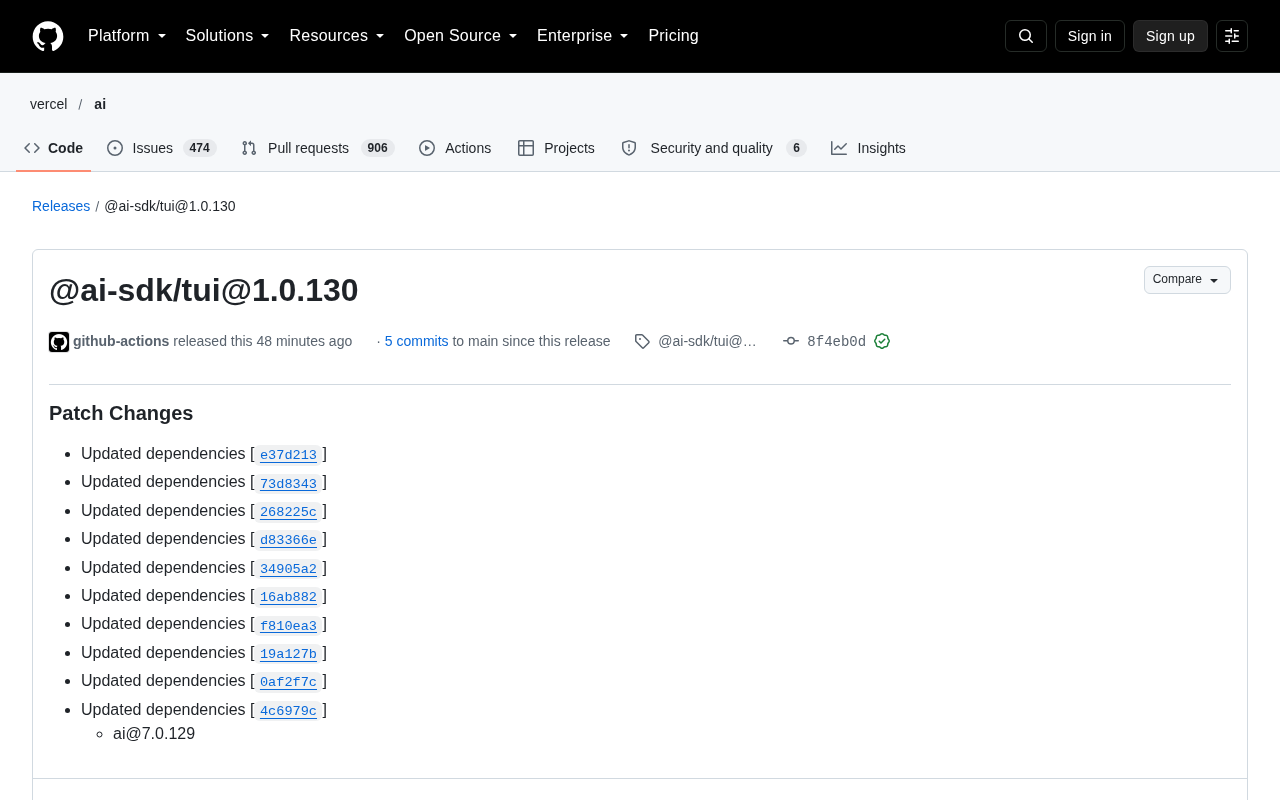
What's in This Update
According to the release record automatically published by GitHub Actions, @ai-sdk/tui@1.0.130 falls under Patch Changes. The changes are focused entirely on dependency upgrades. The release lists up to ten upstream dependency update references and syncs the core package to ai@7.0.129.
Patch releases like this typically introduce no breaking changes. Their primary purpose is to keep the TUI components aligned with the underlying AI SDK core library, ensuring API compatibility and runtime stability. For teams that have already integrated this package, the upgrade cost is minimal.
What @ai-sdk/tui Is For
@ai-sdk/tui is a component of the AI SDK tooling ecosystem, targeting Terminal UI scenarios. As more AI applications shift from purely web-based experiences toward command-line and terminal interactions, TUI-related libraries continue to evolve. This package is tightly coupled with the core ai package, and the rapid versioning cadence — with a patch number already reaching 1.0.130 — reflects the fast-paced maintenance rhythm of the broader AI SDK project.
This release was published automatically by the github-actions bot and verified with a GitHub GPG signature (key ID: B5690EEEBB952194), demonstrating the automated and security-conscious release pipeline typical of mature open-source projects.
TUI (Terminal User Interface) refers to a style of interface that runs in a command-line environment and renders interactive UI elements using character graphics. Unlike a CLI (Command-Line Interface) with its one-directional command input, TUIs support keyboard navigation, real-time refresh, scrollable lists, and other rich interaction patterns. Popular implementations include Python's textual and Rust's ratatui. In AI application contexts, TUIs are particularly well-suited for locally running AI assistants, streaming conversation windows, and real-time log monitoring — all without needing to deploy a web service. @ai-sdk/tui exists to fill this gap in the Node.js ecosystem, combining Vercel AI SDK's streaming AI capabilities with terminal rendering.
How Developers Should Approach These Updates
For developers relying on this SDK, the following strategies are recommended when dealing with high-frequency patch releases:
- Lock version ranges: Set appropriate version constraints in
package.jsonto avoid accidentally pulling in incompatible changes. - Watch core package alignment: Since
@ai-sdk/tuidepends on theaicore package, pay attention to version compatibility between the two when upgrading. - Track the changelog: While this release is a pure dependency update, staying on top of release notes helps you catch functional changes in future versions early.
Overall, 1.0.130 is a low-risk maintenance release with no noteworthy new features. It's best handled as part of a routine dependency upgrade cycle.
Semantic Versioning (SemVer) provides the foundational framework for understanding this kind of update frequency. Following the MAJOR.MINOR.PATCH convention, a patch version is reserved for backward-compatible bug fixes or dependency synchronization — it should not introduce new APIs or breaking changes. A patch number of 130 indicates that the project has gone through a large number of small-increment iterations since the stable 1.0 release. This is common in sub-packages tightly bound to a core library: whenever the upstream ai package releases a new version, downstream sub-packages typically need to follow suit to maintain peer dependency compatibility. Using a caret constraint like ^1.0.130 in package.json allows you to automatically receive future patch updates while shielding against potentially breaking minor version changes.
Related articles

Amphibious Transforming Drone: Beyond 100x Power Savings, What Are the Real Needs?
Is the amphibious transforming drone just a gimmick? Starting from the 100x power difference of the M4 Morphobot, explore real application scenarios and thesis topic ideas, analyzing boundary conditions where pure drones and pure ground robots both fail.

Warhound Raises $200 Million: Genetically Engineered "War Dogs" Paired with Anduril Gear
Warhound raises $200M, backed by Ben Lamm and Palmer Luckey, to genetically engineer dogs for military and law enforcement use and equip them with Anduril gear. This article analyzes its technology direction, funding logic, and ethical controversy.

Claude API Comes to Google Cloud: IAM Integration and SDK Access Guide
Anthropic hosts the full Claude API on Google Cloud with IAM-controlled permissions and unified billing. This guide covers the Vertex AI and Anthropic-hosted entry points, IAM role configuration, and SDK access.