AI SDK TUI 1.0.152 Patch Released: Terminal AI Development Tools Iterate Again

@ai-sdk/tui releases patch version 1.0.152, syncing core ai package to 7.0.151.
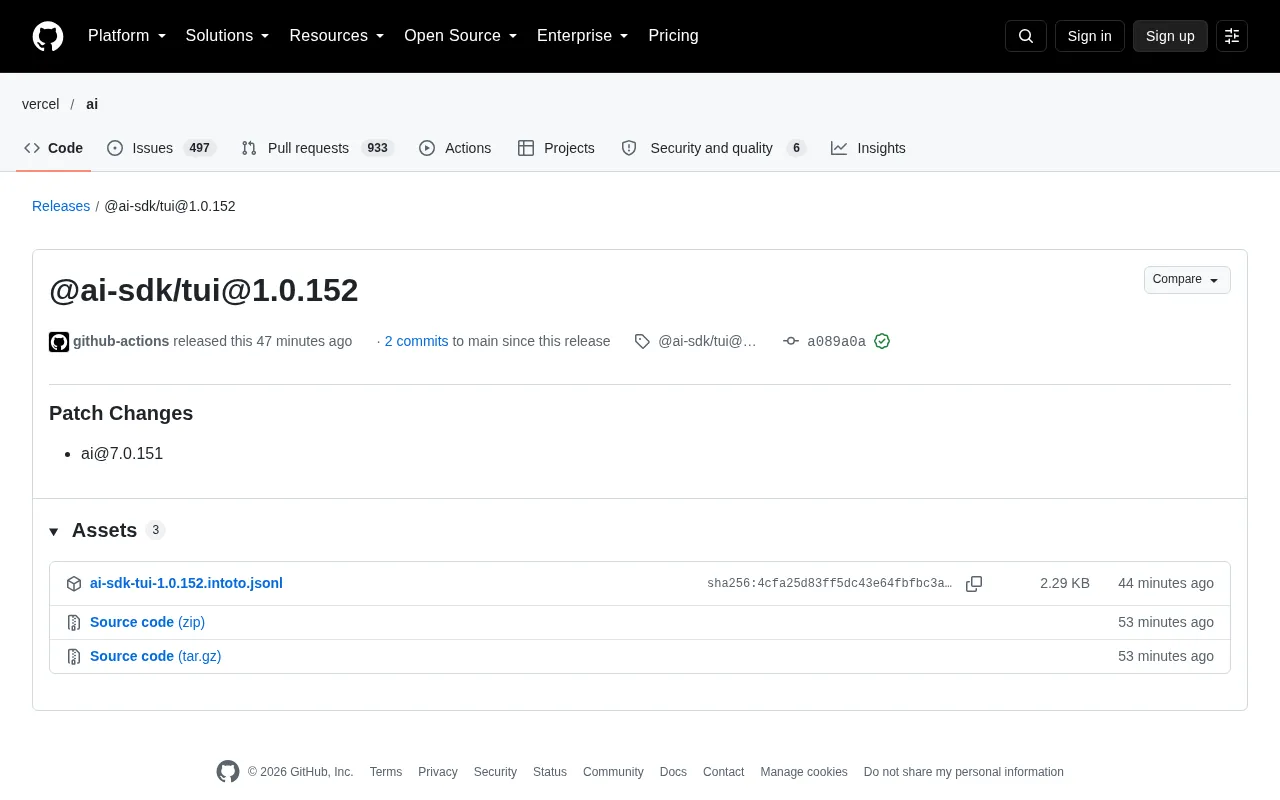
@ai-sdk/tui has released patch version 1.0.152, primarily released in sync with the core SDK's ai@7.0.151. This update includes 2 commits and falls under bug fixes and dependency alignment, with no breaking changes. The package targets scenarios for building and debugging AI applications in terminal environments, encapsulating common interactions such as streaming responses, message rendering, and state management into components. The version number 1.0.152 indicates that the package has undergone over a hundred iterations, with a high-frequency, small-step release cadence reflecting stable maintenance and feedback loops. The release process is automated by github-actions with commit signature verification. For developers already using this package, the upgrade cost is very low, but attention should be paid to version matching between the TUI package and the core ai package to avoid introducing hard-to-troubleshoot problems from cross-version mixing.
The AI SDK's terminal user interface (TUI) component @ai-sdk/tui has released version 1.0.152. This is a patch update, primarily released in sync with the core SDK's ai@7.0.151 version.
The Positioning and Significance of the Patch Update
From the release records, @ai-sdk/tui@1.0.152 is a routine patch version (Patch Changes), with commit records showing 2 commits merged into the main branch. Patch versions typically focus on bug fixes, dependency synchronization, and minor adjustments rather than major feature-level changes.
This update synchronized the core package ai@7.0.151. For users of the AI SDK ecosystem, keeping the TUI component version-aligned with the core SDK is key to ensuring compatibility. Terminal interface interaction logic, streaming output rendering, tool call display, and other capabilities all depend on the interface stability of the underlying ai package.
Semantic Versioning (SemVer) splits version numbers into three parts: major version.minor version.patch version. The patch version corresponds to the third segment incrementing, with the convention that it only contains backward-compatible bug fixes, introduces no new APIs, and does not change existing behavior. The npm ecosystem generally follows this convention, so range constraints like ^1.0.152 allow automatic upgrades of patch versions, while ^2.0.0 implies possible breaking changes. Understanding this helps determine: 1.0.152 can be smoothly upgraded from any 1.0.x version without modifying calling code.
It's worth noting that when one package tightly depends on another (such as the TUI component depending on the core ai package), it may release a version to align dependencies even if its own code hasn't changed. Such "synchronized version" releases are particularly common in monorepos, and release notes typically only mention Patch Changes without listing specific fixes.
Demand for AI Development in the Terminal Is Rising
The AI SDK provides a TUI component targeting a specific scenario: developers who want to build and debug AI applications directly in a terminal environment. Compared to graphical interfaces, terminal tools are more lightweight in scenarios such as remote servers, CI pipelines, and rapid prototype validation.
@ai-sdk/tui encapsulates common terminal interaction requirements such as streaming responses, message rendering, and state management into components, reducing the cost of developers reinventing the wheel. The continued release of patch versions indicates that this package has a stable feedback loop in actual use—fix issues when they arise, synchronize dependencies when needed.
TUI (Terminal User Interface) builds interactive interfaces with layouts, borders, and scrollable regions in pure text terminals using mechanisms such as ANSI escape sequences, cursor control, and full-screen redrawing. Typical examples include htop, vim, and lazygit. Its difference from CLI (Command-Line Interface) is that CLI typically outputs results once and exits, while TUI maintains a continuously refreshing screen state, can respond to keystrokes, and performs partial redraws.
For AI applications, the value of TUI lies in its ability to present streaming token output, multi-turn conversation history, expanded/collapsed states of tool calls at low cost, and maintain full interaction in SSH remote sessions. Most TUI libraries adopt declarative component models (such as Ink based on React, Bubble Tea based on Elm architecture), and @ai-sdk/tui takes the approach of encapsulating message rendering and state management as reusable components.
Release Cadence Reflects Maintenance Status
The version number 1.0.152 indicates that this package has undergone over a hundred iterations. This high-frequency, small-step release cadence is relatively common in open-source tool libraries; the benefit is that bug fixes can quickly reach users, while the downside is that users need to pay attention to changelogs to avoid dependency conflicts.
The commits in this release carry GitHub verified signatures, and the release was automatically completed by github-actions, following a standardized CI/CD process. From an engineering perspective, automated releases reduce the probability of human error.
The "GitHub verified signature" mentioned in the release records refers to commits or tags automatically signed by GitHub-hosted GPG keys, allowing others to verify on the platform that the commit was indeed produced by a repository collaborator or a designated automation process and that the content has not been tampered with. Combined with releases executed by github-actions, this forms a traceable chain from code merge to artifact publication: each npm package version can be traced to a specific commit and specific workflow run record.
This supply chain verifiability is increasingly valued in open-source dependencies, as "poisoned releases" caused by malicious tampering or credential leaks occur from time to time. For users, signatures and automated releases do not themselves guarantee code quality, but they can significantly reduce the risk of untrustworthy sources and make it easier to trace back to the exact changeset when problems arise.
Practical Impact on Developers
If you are using @ai-sdk/tui in your project, upgrading to 1.0.152 is low-cost, mainly involving pulling the patch and confirming that it works properly with ai@7.0.151. If your project is locked to an older version and is currently running stably, there's no need to rush to follow up—patch updates typically do not involve breaking changes.
What's worth paying attention to is the version alignment issue: the TUI package and the core ai package versions need to match, and mixing versions across releases may introduce hard-to-troubleshoot problems. It's recommended to use reasonable version range constraints in package.json.
One-line Summary
@ai-sdk/tui releases patch version 1.0.152, synchronizing core ai package to 7.0.151.
Paragraph Summary
@ai-sdk/tui has released patch version 1.0.152, primarily released in sync with the core SDK's ai@7.0.151. This update includes 2 commits and falls under bug fixes and dependency alignment, with no breaking changes. The package targets scenarios for building and debugging AI applications in terminal environments, encapsulating common interactions such as streaming responses, message rendering, and state management into components. The version number 1.0.152 indicates that the package has undergone over a hundred iterations, with a high-frequency, small-step release cadence reflecting stable maintenance and feedback loops. The release process is automated by github-actions with commit signature verification. For developers already using this package, the upgrade cost is very low, but attention should be paid to version matching between the TUI package and the core ai package to avoid introducing hard-to-troubleshoot problems from cross-version mixing.
Related articles

WorkBuddy Agent in Action: From AI Q&A to Automated Office Work
WorkBuddy is Tencent's AI agent desktop workbench that reads local files, operates office software, executes multi-step tasks, and runs on schedules. This article explains its core features, key differences from traditional AI tools, and use cases.

Anthropic Research: LLMs Make Formal Software Verification at Scale Possible
Anthropic Frontier Red Team research shows LLMs can generate formal proofs at the RISC-V assembly level for over 100 real open-source libraries, covering 123 OSS-Fuzz libraries and 239 entry points, totaling about 180 million lines of Rocq proofs and finding hundreds of bugs. The article analyzes specification generation, the proof pipeline, trust boundaries, and cost reduction paths.

Prompt Engineering for Beginners: From Writing Prompts to Building AI Collaboration Skills
From the four functions of prompts to the six-step prompt engineering process, this article systematically covers core concepts, business value, and three layers of limitations to help beginners build a complete cognitive framework for prompt engineering.