@ai-sdk/tui 1.0.178 Patch Released: Dependency Upgraded to ai@7.0.177

@ai-sdk/tui releases patch 1.0.178, only syncing dependency ai@7.0.177, with no feature changes.
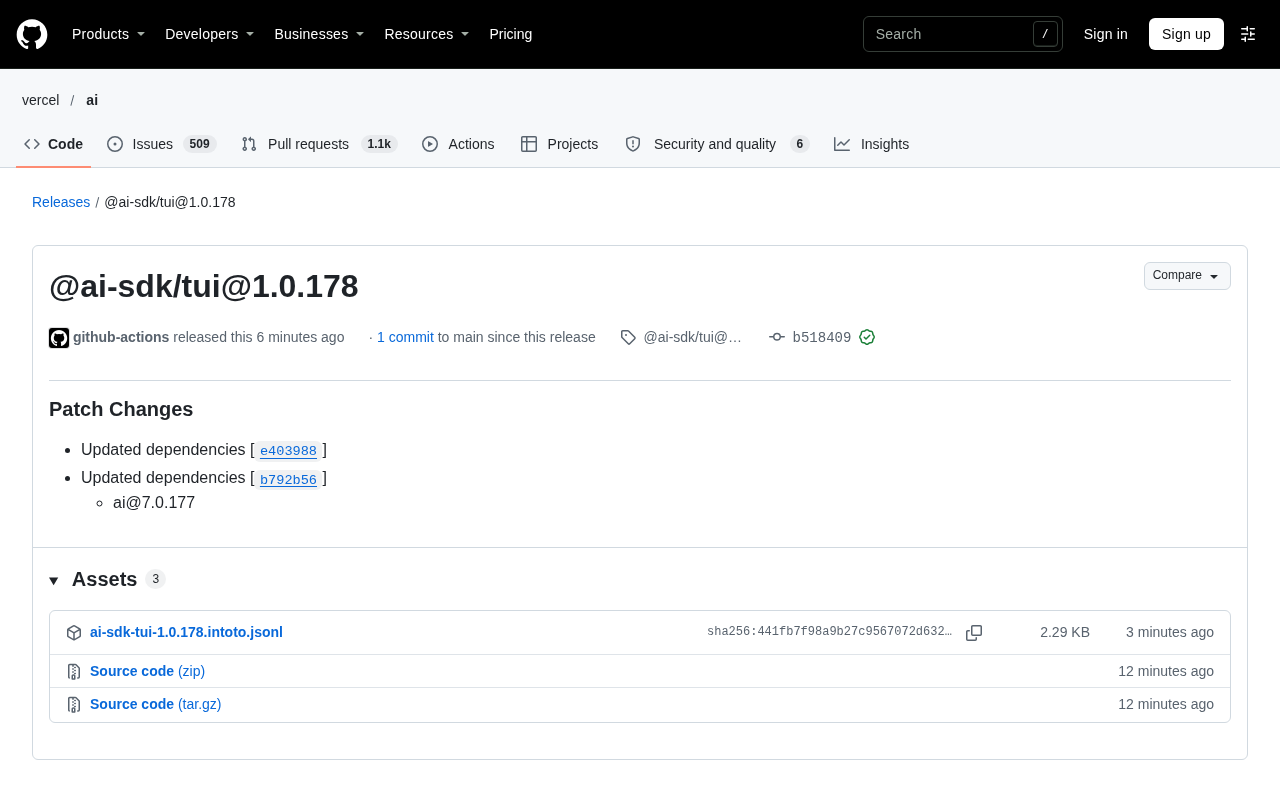
`@ai-sdk/tui` 1.0.178 is a dependency-only patch release with a single commit upgrading the core `ai` package to 7.0.177. The library handles terminal interfaces in the AI SDK ecosystem for command-line AI apps. Since the release log provides no feature or breaking-change details, verify compatibility with the core `ai` package before upgrading to avoid peer dependency conflicts. High-frequency patches show active toolchain maintenance but also call for automated dependency checks.
A Seemingly Routine Patch Release
The terminal UI library in the Vercel AI SDK ecosystem, @ai-sdk/tui, has released version 1.0.178. According to the GitHub release record, this is a standard patch release containing only a single commit, with the core change being a dependency update: upgrading the ai package to 7.0.177, involving two internal commits (e403988 and b792b56).
For readers unfamiliar with this package, @ai-sdk/tui is the component in the AI SDK system responsible for the Terminal User Interface (TUI). It lets developers build interfaces for interacting with AI models in command-line environments, making it part of the infrastructure for AI application development.
The Dependency Chain Logic Behind the Version Number
Patch versions typically don't introduce new features, but dependency synchronization isn't meaningless mechanical work. In a multi-package monorepo architecture like the AI SDK, a version number change in the core ai package may carry underlying API fixes, type definition adjustments, or internal bug fixes. By pinning ai@7.0.177, @ai-sdk/tui ensures its behavior is consistent with the latest state of the core package.
This update lists two dependency commits, suggesting upstream changes may have been merged in batches. For developers using this library, the reason to upgrade isn't to enjoy new features but to avoid type mismatches or runtime behavior differences caused by version drift. In a fast-iterating AI toolchain, keeping up with patch versions is a low-cost habit for maintaining project stability.
monorepo is a project management strategy that stores multiple related software packages in the same code repository. In large toolchains like the AI SDK, a monorepo allows the core package (such as ai) and surrounding packages (such as @ai-sdk/tui) to share tooling, unify version numbers, and implement local dependency linking through a workspace mechanism. The benefit is that when the core package updates, all dependent packages can quickly synchronize, reducing cross-repository coordination costs. But it also brings complex version management challenges—each package can be released independently, but they must remain mutually compatible. As a result, patch versions like @ai-sdk/tui@1.0.178 often merely reflect minor changes in the upstream core package rather than changes to the terminal library's own functionality.
What It Means for Terminal AI Application Developers
The role of terminal interfaces in AI development workflows is changing. In the past, TUIs were mostly used for monitoring and debugging; now more and more developers use them to run lightweight AI agents locally, view streaming output, and manage context. The ongoing patch maintenance of @ai-sdk/tui shows that this usage path has real user support and isn't an experimental orphan.
However, it should be noted objectively: this release comes with no feature descriptions, breaking change announcements, or migration guides, so the information content is quite limited. From the release log, one can only confirm the dependency version number change and cannot determine what ai@7.0.177 actually fixed. If developers encounter related issues, they still need to trace back to the upstream ai package changelog.
TUI (Terminal User Interface) is a text-based command-line interaction interface that presents information in the terminal through characters and colors. Compared with GUI (Graphical User Interface), TUI is lightweight, uses fewer resources, and is easy to use remotely, making it especially suitable for developers working in server environments or local terminals. In AI development scenarios, TUIs are often used for real-time monitoring of model output streams, debugging agent behavior, and managing conversation context. For example, developers can use a TUI to build a local AI assistant and ask questions directly in the terminal while viewing streaming responses, without launching a browser or desktop application. @ai-sdk/tui is a library designed to simplify the development of such terminal-based AI interaction interfaces.
How to View These High-Frequency Patches
AI toolchain projects generally have dense release cadences, and a version number like 1.0.178 already speaks for itself. High-frequency patches have two sides: on one hand, they reflect active maintenance and fast issue response; on the other hand, they add noise to dependency management. Teams should establish automated dependency update checks during integration rather than manually following each version.
For ordinary users, whether to upgrade immediately depends on how sensitive the project is to the version of the core ai package. If the project is pinned to an older version of ai, blindly upgrading @ai-sdk/tui may cause peer dependency conflicts—it is recommended to confirm the version compatibility matrix before upgrading.
peer dependency is a concept in npm package management that refers to a package requiring the host project to provide a specific version of a dependency rather than installing it directly itself. For example, @ai-sdk/tui may declare ai as a peer dependency, indicating that it needs to work with the ai package in the project. If the version of ai used in the project does not match the version expected by @ai-sdk/tui, npm will issue a warning and may even cause runtime errors. In monorepos, peer dependency conflicts are especially common because different packages may depend on different versions of the same core package. Therefore, when upgrading @ai-sdk/tui, you must check whether its peer dependency range is compatible with the ai version in the project; otherwise, you may run into dependency hell.
Conclusion
@ai-sdk/tui@1.0.178 is a patch release purely for dependency synchronization. Its technical significance is limited, but it reflects the ongoing maintenance status of the AI SDK terminal toolchain. It is more appropriate to view it as a signal of ecosystem health than as a feature update.
One-line Summary
@ai-sdk/tui releases 1.0.178 patch, only syncing dependency ai@7.0.177, with no feature changes.
Paragraph Summary
@ai-sdk/tui 1.0.178 is a patch version purely for dependency synchronization, containing only one commit that upgrades the core ai package to 7.0.177. This library is the component responsible for terminal interfaces in the AI SDK ecosystem, serving command-line AI application development. Because the release log provides no feature descriptions or breaking change information, version compatibility with the core ai package must be confirmed before upgrading to avoid peer dependency conflicts. High-frequency patches reflect the ongoing maintenance status of the toolchain, but they also require teams to establish automated dependency check mechanisms rather than manually following each version.
Related articles
DevWorkflow 5.0: From Idea to Launch with the AI Five-Step Method
DevWorkflow 5.0 is a Claude Code plugin that uses a five-step process to take AI-assisted development from idea to launch. It asks you before every decision, preventing AI from adding tables and fields on its own, keeping docs and code consistent, and stopping merges before tests are written. Supports multiple platforms and languages, for individual developers and small teams.

How Do Hermes Agent's .md Files Work? A Breakdown of the Core Mechanism
Explaining Hermes Agent's .hermes directory mechanism: user.md stores personal info, memory.md records details worth remembering, soul.md defines the Agent's personality. Learn how these pure Markdown files keep the Agent consistent across sessions.

UN "Killer Robot" Talks Stall Again: Why Autonomous Weapons Regulation Is Hard to Break Through
UN Geneva talks on autonomous weapons ("killer robots") ended a week of consultations with little progress; delegates only agreed to "begin discussing options." This article analyzes the definitional disputes, conflicting security demands, and limits of multilateral mechanisms behind the stalemate.