@ai-sdk/tui 1.0.181 Patch Release: Syncing ai@7.0.180

@ai-sdk/tui releases patch 1.0.181, syncing dependency ai@7.0.180 with no breaking changes.
Vercel's `@ai-sdk/tui` has released patch version 1.0.181, with the core change being syncing the dependent `ai` package to 7.0.180. It was automatically published by github-actions and verified via GitHub signature. The article notes that such patch updates aim to maintain version alignment with the main SDK rather than introduce new features, to avoid compatibility issues in streaming parsing, tool calling, or type definitions when users mix different versions. The automated release pipeline enhances the credibility and traceability of version records, but users still need to check the corresponding content of the `ai` package themselves. For projects that have integrated this package, it is recommended to upgrade and check the `ai` version in the lockfile, while also running terminal interaction smoke tests; temporarily locking to an older version is also acceptable, with the main risk being type or runtime inconsistencies when mixed with newer `ai` versions. Frequent small-step releases reflect the team's emphasis on responsiveness to feedback.
A Low-Key but Important Patch Update
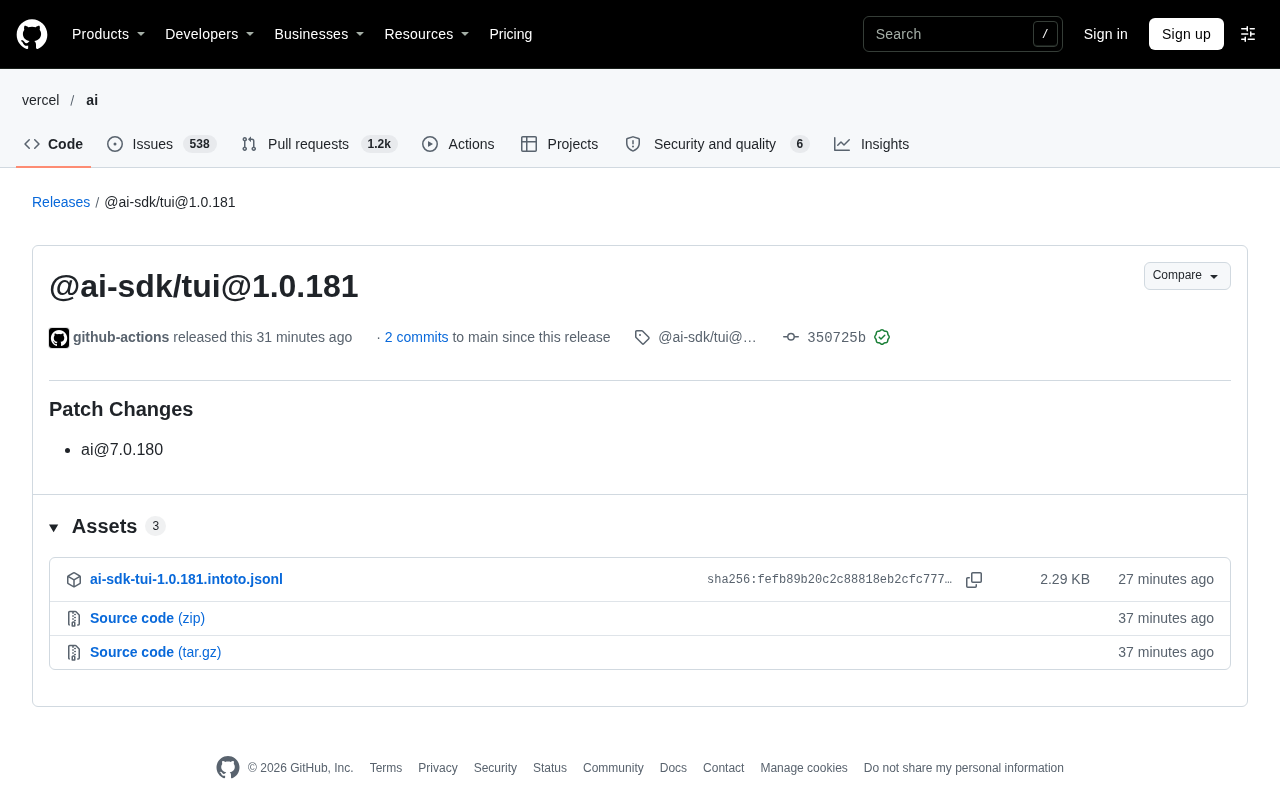
Vercel's @ai-sdk/tui has released version 1.0.181. According to the GitHub Release record, this update is a patch-level change (Patch Changes), with the core content being syncing the dependent ai package to version 7.0.180. It was automatically published by github-actions, and the commit has been verified and signed by GitHub.
For developers unfamiliar with this package, @ai-sdk/tui is the component in the AI SDK ecosystem responsible for terminal interface (TUI) interactions. It encapsulates terminal interactions that would otherwise require manual handling—such as streaming output, message rendering, and status prompts—allowing developers to quickly build conversational AI-like interfaces in the command line. The patch version number change is minor, but dependency syncing often implies consistency fixes for underlying behavior.
TUI in @ai-sdk/tui stands for Terminal User Interface, as opposed to GUI (Graphical User Interface), referring to an interactive interface that runs entirely within a command-line terminal. In AI application scenarios, TUIs typically need to handle details such as streaming token-by-token rendering, cursor control, ANSI escape sequences, inline refresh, and scroll region management. Compared to manually assembling output with console.log, TUI components abstract these underlying capabilities into reusable rendering primitives, allowing developers to focus on message structure and interaction logic without repeatedly dealing with terminal compatibility and redraw flickering issues.
What the Patch Update Actually Means
Dependency Alignment Takes Priority Over New Features
The version number staying at 1.0.181 indicates that the maintenance team adopts a high-frequency, small-step release strategy. Patch Changes only mentions ai@7.0.180 without any feature descriptions or breaking change notes, which sends a clear signal: the goal of this release is to stay aligned with the main SDK version, not to introduce new capabilities.
This approach is common in SDK ecosystems. When the core package ai fixes issues in streaming parsing, tool calling, or type definitions, peripheral packages need to keep up with versions; otherwise, users mixing different versions can easily encounter hard-to-diagnose compatibility issues. For projects that have already integrated @ai-sdk/tui, upgrading to 1.0.181 is mainly about getting consistent underlying behavior rather than expecting interface-level changes.
Semantic Versioning (SemVer) dictates that version numbers follow the form MAJOR.MINOR.PATCH: a major version change indicates incompatible API modifications, a minor version increase indicates backward-compatible feature additions, and a patch number increase indicates backward-compatible bug fixes. Therefore, the change from 1.0.180 to 1.0.181 should not contain breaking changes by contract. Note that SemVer only constrains the public API level; dependency version syncing and internal implementation adjustments can still indirectly change runtime behavior, which is why the article recommends running smoke tests after upgrading.
Maturity of the Automated Release Pipeline
The Release page shows the publisher as github-actions, with the commit carrying a GitHub verified signature and a GPG key ID. These details indicate that the repository's release pipeline is highly automated: after changes are merged into main, CI triggers version increment, changelog generation, signing, and publishing.
For users, this process means version records have higher credibility and traceable origins. Compared to manual releases, which are prone to issues like missing tags or version number confusion, automated pipelines offer more stability for small patches. However, note that automated releases do not replace human-written change descriptions; Patch Changes only lists one line about the dependency version, so users still need to check the update content of the corresponding ai package version themselves to assess the impact.
The GitHub verified signature and GPG key ID mentioned in the article are part of the Git commit signing mechanism. Developers can sign commits and tags with GPG or SSH keys, and GitHub verifies the signature and displays a Verified badge in the interface, proving that the commit indeed comes from the claimed author and that the content has not been tampered with. In automated release scenarios, CI signing commits with a controlled bot identity (such as github-actions) makes version origins auditable and reduces the risk of supply chain poisoning and impersonation.
How Developers Should Handle This Update
If you use @ai-sdk/tui in your project, it is recommended to upgrade directly to 1.0.181 and confirm that the ai version in your lockfile also falls within 7.0.180 or a compatible range. Since this is a patch version, according to semantic versioning conventions there should theoretically be no breaking changes, but it is still recommended to run smoke tests related to terminal interactions after upgrading, focusing on whether streaming output renders correctly and whether long text wrapping and scrolling behave abnormally.
If your project is temporarily locked to an older version, there is no need to rush to upgrade. Patch updates do not include new features, and the main risk of delaying the upgrade is potential type or runtime inconsistencies when mixed with newer versions of the ai package. Waiting to upgrade together with the next version that has actual feature changes is also a reasonable strategy.
The lockfile (such as package-lock.json, pnpm-lock.yaml, yarn.lock) records the exact resolution of the dependency tree, ensuring that different machines and CI environments install exactly the same versions. When @ai-sdk/tui internally depends on the ai package, if the project itself also directly depends on ai, the package manager may hoist multiple copies or keep only one version that satisfies all range constraints, causing the actual runtime version to differ from expectations. Checking the resolved version of ai in the lockfile after upgrading is precisely to confirm that the dependency deduplication result meets expectations and to avoid misalignment between type definitions and the actual runtime version.
AI SDK's Maintenance Philosophy as Seen from Release Cadence
Frequent patch releases reflect the maintenance team's emphasis on responsiveness to feedback. Compared to accumulating large batches of changes before releasing, small, rapid steps allow fixes to reach users faster and reduce the regression risk of each upgrade. The cost is rapid version number growth and fragmented changelogs, requiring developers to monitor dependency version changes more actively.
In light of this update, @ai-sdk/tui is positioned as a companion component that closely follows the evolution of the main SDK. It does not undergo major feature iterations independently of the ai package but instead adjusts the terminal interaction layer in sync with changes in core capabilities. For teams planning to integrate AI conversation capabilities into command-line tools, this package is worth including in the technology selection list, while also accepting its fast iteration pace that follows the main version.
Frequently Asked Questions
Does this update contain breaking changes?
According to semantic versioning conventions, patch versions do not include breaking changes. The Release record also has no related notes, so it can be handled as a regular minor version upgrade.
Is upgrading mandatory?
Not mandatory. Patch updates mainly sync dependency versions; not upgrading will not immediately cause problems, but staying on an old version for a long time may lead to compatibility deviations with newer versions of the ai package.
How can I confirm the impact scope after upgrading?
Check the changelog for the corresponding ai@7.0.180 version and assess based on the APIs used in your project. After upgrading, running an interactive smoke test in the terminal environment will cover most risks.
Related articles

VP ≠ VNP: A Major Breakthrough in Computational Complexity Theory
A study claiming to prove VP ≠ VNP over every field sparks heated discussion on Hacker News. This article analyzes the algebraic complexity background of VP and VNP, the proof approach, community controversy, and its potential impact on computational complexity theory.

Developer Naming Woes: The Technical Names That Drive Us Crazy
Why is technical naming so maddening? From Nginx and Vite to Qt and Sudo, a YouTube creator rants about the chaos of developer naming and pronunciation, revealing the tug-of-war between creators' intentions and community habits, and the cultural roots behind spelling traps like PyPI and GNOME.

Figma Workplace Scandal: Employee Sues CEO for Forcing Confrontation with Harasser
Figma and its CEO are sued by a current employee alleging sexual harassment and discrimination, and forcing the victim to confront her harasser. This article outlines the background, potential impact, and industry reflection.