AI SDK Type-Safe Package 3.0.34 Released: Batch Dependency Updates
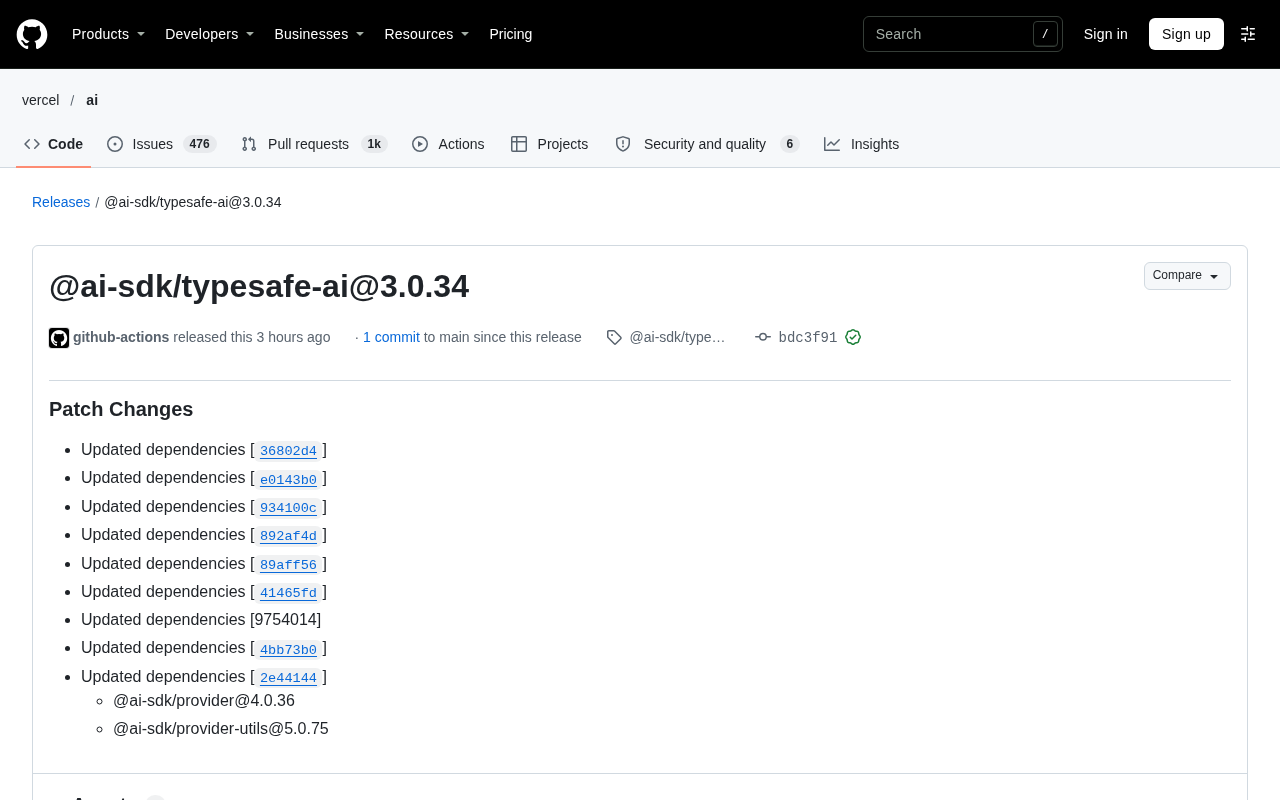
AI SDK type-safe wrapper package 3.0.34 patch update—all upstream dependency syncs.
`@ai-sdk/typesafe-ai` released patch version 3.0.34, with changes entirely focused on dependency upgrades: `@ai-sdk/provider` bumped to 4.0.36 and `@ai-sdk/provider-utils` to 5.0.75, covering nine upstream commits. Since this package is a type-safe wrapper layer on top of the AI SDK, its type definitions must sync with upstream provider behavior, giving substantive meaning to the batch dependency update. Published automatically by GitHub Actions with GPG-verified signatures, it reflects a standardized release pipeline. The article recommends developers with pinned versions follow the upgrade and run a type check afterward to confirm that upstream type declaration changes haven't introduced new compilation errors. Overall, this is a maintenance release with no new features and no breaking changes.
A Low-Key Patch Update
The @ai-sdk/typesafe-ai package in the AI SDK ecosystem has released version 3.0.34. As the version suffix suggests, this is a patch-level update, automatically published by GitHub Actions, with commit hash bdc3f91 and a GitHub-verified signature.
For developers who use this package daily, such updates typically don't introduce API-breaking changes, but the push itself indicates that the upstream dependency chain is being continuously maintained.
What's Changed: Nothing But Dependency Upgrades
According to the release notes, the core changes in 3.0.34 are entirely focused on dependency updates, covering nine upstream commits (36802d4, e0143b0, 934100c, 892af4d, 89aff56, 41465fd, 9754014, 4bb73b0, 2e44144). Meanwhile, @ai-sdk/provider was updated to 4.0.36, and @ai-sdk/provider-utils was updated to 5.0.75.
Why Is It All Dependency Updates?
This package is positioned as a type-safe wrapper layer on top of the AI SDK. Its value lies in exposing the underlying provider's interfaces to callers in a strongly-typed manner. Therefore, every adjustment to the underlying provider and utility functions propagates through the dependency chain to this layer. A batch dependency update doesn't mean there are no substantive changes—it means the type definitions need to stay in sync with upstream behavior.
Semantic Versioning (SemVer) provides the background for understanding the nature of this update. @ai-sdk/typesafe-ai follows the MAJOR.MINOR.PATCH versioning convention: a major version change means breaking API changes, a minor version represents backward-compatible new features, and a patch number corresponds only to backward-compatible bug fixes and internal adjustments. 3.0.34 only bumped the patch position, so from the version number alone it can be inferred that there are no breaking changes to the public API.
In the npm ecosystem, patch versions are often used to sync upstream dependencies, especially for low-level packages like @ai-sdk/provider that are in rapid iteration. Since such packages haven't yet reached 1.0 stability, their own minor version upgrades may also include interface adjustments. Downstream wrapper layers propagating these changes by bumping the patch number is a common maintenance approach.
Practical Impact on Developers
If you've pinned the version of @ai-sdk/typesafe-ai in your project, this upgrade falls into the category of recommended follow-up. The provider and provider-utils in the dependency chain advancing together usually corresponds to upstream fixes to interface details or completion of type declarations.
For projects that rely on type safety, it's worth running a type check after upgrading to confirm that no new compilation errors have been exposed due to changes in upstream type definitions. The release notes don't list specific behavioral changes, so this kind of verification can only be backed by the project's own tests and type system.
Automation Signals in the Release Process
This release was completed by the github-actions bot account, with commits carrying GPG-verified signatures (key ID: B5690EEEBB952194), indicating that the repository's release pipeline is standardized. For users, this provides a layer of supply-chain credibility: build artifacts come from an automated process rather than manual pushes.
GPG Signatures and Supply Chain Trustworthiness: Git allows commits and tags to be digitally signed with GPG keys. Recipients can use the public key to verify whether the signature was generated by the key holder and whether the content has been tampered with. GitHub displays a "Verified" badge for signed commits, where the key ID identifies the signing key.
In the context of open-source dependencies, the significance of signature verification is that it elevates "who pushed this version" from the account-password level to the cryptographic level. Combined with GitHub Actions' automated publishing, it means build artifacts are generated by a fixed pipeline in a controlled environment, reducing the risk of omissions from manual releases or forgery after account compromise. However, signatures can only prove origin and integrity—they don't equate to the code having undergone security auditing. They still need to be evaluated alongside dependency pinning and vulnerability scanning.
Type Checking and Type-Safe Wrapper Layers: TypeScript type checking runs at compile time and incurs no runtime overhead, so it's often used as the first line of verification after dependency upgrades. When the upstream @ai-sdk/provider adjusts the parameter types or return structure of an interface, if the downstream wrapper layer's type declarations aren't synced, callers will see type errors in tsc --noEmit or in the IDE—rather than having problems surface at runtime.
This is precisely the design intent of typesafe-style packages: surfacing interface mismatches at compile time. Therefore, running a full type check after upgrading a patch version is low-cost but quickly confirms whether upstream type changes affect existing calling code. For projects that have configured strict mode in CI, this step is usually already included in the pipeline, requiring no additional action.
Summary
3.0.34 is a patch version primarily focused on dependency syncing, with no new features or breaking changes. Its significance lies in keeping the type-safe layer aligned with upstream AI SDK components. For teams focused on AI SDK type-safety practices, this update reminds us that wrapper layers need to continuously follow the evolution of underlying protocols.
About the Package's Positioning
@ai-sdk/typesafe-ai is a peripheral tool in the AI SDK ecosystem, aimed at developers who want compile-time type guarantees when interacting with models. Such packages don't directly provide model capabilities but improve the calling experience, so their version cadence often follows changes in upstream providers.
Related articles

Soul Glo's Diaspora Problems: An Inimitable Hardcore Manifesto
Why is Soul Glo's Diaspora Problems considered an inimitable hardcore record? This article analyzes its stylistic collage, structural ruptures, and textual counterpoint, and looks ahead to the new album NA I'M GON GRAB ALLAT.

Jensen Huang's Internal Memo Leaked: Nvidia Launches Investigation
Nvidia's board announces an investigation into CEO Jensen Huang's relationship with AI executive Alice Huang; Huang sends employees a memo acknowledging it. This article outlines the background, known information, and potential impact on Nvidia's governance and the AI industry.

SQLite Extension in Practice: C vs Rust Performance Comparison for parse_number
Simon Willison uses AI to build a SQLite parse_number() extension, comparing C vs Rust size and speed. Rust was faster but larger; a custom C parser eventually won on 2M rows.