AI SDK Update: xAI Provider Version 2.0.105 Released

@ai-sdk/xai releases 2.0.105 patch, only synchronizing two internal dependencies, with no feature or breaking changes.
Vercel's AI SDK project releases patch version 2.0.105 of the `@ai-sdk/xai` package, a maintenance update with no new features or breaking changes. The core change upgrades internal dependencies `@ai-sdk/provider-utils` to 3.0.47 and `@ai-sdk/openai-compatible` to 1.0.64. These are the general utility library for provider adapters and the encapsulation layer for OpenAI-compatible APIs, respectively, so the impact on xAI model calls is indirect and may include underlying bug fixes or minor improvements, though the release notes do not list specific items. Since patch versions do not involve API changes, existing code is compatible without modification, and upgrade risk is extremely low. The article also observes the repository's active iteration pace with 5490 cumulative commits and recommends that production projects with high stability requirements follow the official changelog or wait for subsequent versions before upgrading.
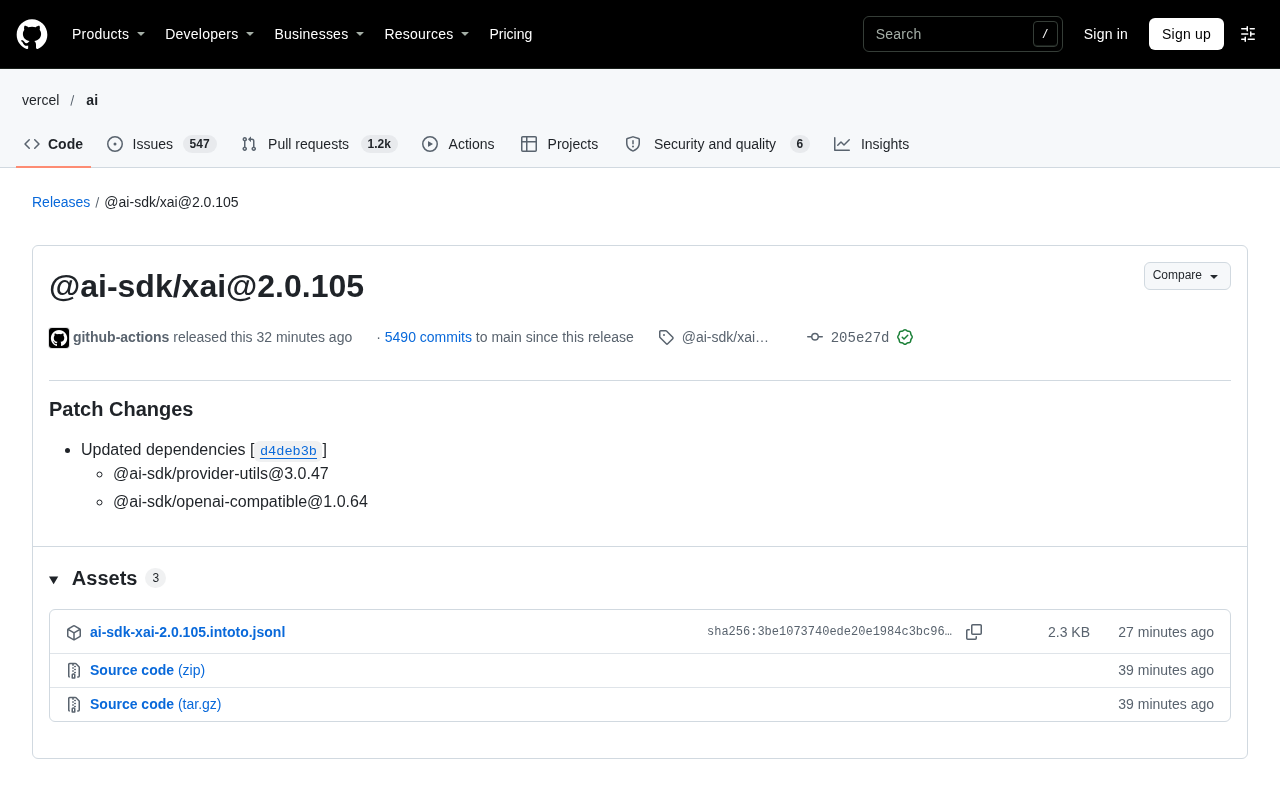
The AI SDK ecosystem has received a routine patch update. Vercel's AI SDK project recently released version 2.0.105 of the @ai-sdk/xai package, which primarily involves synchronized upgrades of underlying dependencies and does not introduce new features or breaking changes.
Core Content of the Version Update
According to the release notes on GitHub, @ai-sdk/xai@2.0.105 is a patch-level version update. Its changes are very focused: it updates the dependency versions for two internal packages, @ai-sdk/provider-utils and @ai-sdk/openai-compatible.
Specifically, @ai-sdk/provider-utils is upgraded to version 3.0.47, and @ai-sdk/openai-compatible is upgraded to version 1.0.64. These two packages are foundational utility libraries in the AI SDK ecosystem used for building provider adapters—the former provides general provider utility functions, while the latter encapsulates the logic for interacting with OpenAI-compatible APIs.
For developers using @ai-sdk/xai, the direct impact of this update is indirect—through dependency chain updates, it may include bug fixes or minor improvements from the underlying utility libraries. The release notes do not list specific fixes, so it can be regarded as a maintenance version alignment.
Semantic Versioning (SemVer) and Patch Level
The "patch level" mentioned in the article originates from the Semantic Versioning specification (SemVer). SemVer divides version numbers into major.minor.patch (e.g., 2.0.105), where a major version change indicates incompatible API changes, a minor version change indicates backward-compatible new features, and a patch version change is only for backward-compatible bug fixes or internal adjustments. Therefore, patch releases like 2.0.105 should not break existing interfaces by convention, which is also the basis for the article's judgment that "upgrade risk is extremely low." It should be noted that SemVer is a community convention rather than a mandatory standard, and individual projects may not fully follow it; for transitive updates in the dependency chain, actual behavior still depends on each downstream package's own release conventions.
Practical Significance for Developers
In the AI SDK's version management strategy, patch versions are typically used to fix bugs or synchronize dependencies and do not involve API changes. This means the risk of upgrading to version 2.0.105 is extremely low, and existing code is compatible without modification.
You may not have noticed that this update involves the @ai-sdk/openai-compatible package. xAI's API is designed to be compatible with OpenAI's interface specifications, so the @ai-sdk/xai package likely relies on this compatibility layer to implement calls to xAI models (such as the Grok series). The dependency update may mean the compatibility layer has improved handling of certain edge cases, but the release notes do not provide further details.
For production environment applications, it is recommended to follow the AI SDK's official changelog to confirm whether dependency updates include fixes relevant to your use cases. If your project has extremely high stability requirements, you may wait for subsequent versions before upgrading.
The Role of the OpenAI-Compatible API Compatibility Layer
OpenAI-compatible API refers to third-party services aligning as closely as possible with OpenAI's interface specifications in terms of request paths, request body structure (such as the messages array, model field), response format (such as choices, usage), and streaming (SSE data: chunks). Since a large number of toolchains and SDKs have been built around this format, new vendors adopting compatible designs can significantly reduce integration costs. Packages like @ai-sdk/openai-compatible extract common logic such as "how to construct requests, how to parse responses and streaming chunks, and how to map error codes," so that each provider's adapter only needs to handle the differences. Therefore, when this package is updated, even if the upper-level provider package code remains unchanged, underlying behaviors such as request construction, streaming parsing, or error mapping may change accordingly.
Release Cadence and Ecosystem Observations
From the commit history on GitHub, this release came shortly after the previous version, and the repository's cumulative commit count has reached 5490 (since the last release), reflecting the AI SDK project's active development iteration pace.
As one of the official provider packages of AI SDK, @ai-sdk/xai's update frequency stays synchronized with updates to the underlying common packages. This centralized dependency management approach helps ensure behavioral consistency across provider packages and reduces adaptation costs for developers using different model providers.
For teams building multi-model AI applications, regularly following such patch updates is a routine practice to maintain dependency health. However, since this update does not include descriptions of feature enhancements or security fixes, developers do not need to invest additional migration effort.
Dependency Chain Health and Lock Files
In multi-package (monorepo) ecosystems, top-level packages typically declare dependencies on underlying common packages as ranges (e.g., ^3.0.0), and lock files (package-lock.json, pnpm-lock.yaml, yarn.lock) pin the actual installed versions. Therefore, for releases like @ai-sdk/xai@2.0.105 that only bump internal dependency versions, whether the impact propagates to your project depends on whether your lock file is updated and whether there are version constraint conflicts from other packages on the same underlying package. In practice, you can use commands like npm ls @ai-sdk/provider-utils to check the actual deduplicated version in the dependency tree, confirming whether multiple provider packages share the same underlying implementation, thereby assessing the real benefits and potential impact scope of this update.
Summary
@ai-sdk/xai@2.0.105 is a maintenance release focused on dependency synchronization, with the core change being version upgrades of @ai-sdk/provider-utils and @ai-sdk/openai-compatible. Developers can update dependencies through the normal process without worrying about compatibility issues. For developers following the AI SDK ecosystem, tracking such releases helps to understand the evolution direction of the underlying toolchain.
Related articles

A 19-Year-Old's Rental Horror Story: Ceiling Collapse, Bug Infestation, and the Lessons It Taught Me
At 19, my first off-campus rental brought bug infestations, no heat, a collapsed ceiling, and a ruined laptop with no renter's insurance. Here are the hard-won lessons for first-time student renters.

Veda Nurse's Cranial Nerve Exam: Why ASMR Role-Play Is Going Viral
Bilibili creator Veda's cranial nerve exam ASMR video goes viral, blending humor and sensory triggers through nurse role-play. This article analyzes its unique appeal and the audience psychology behind ASMR role-play.

LG Cinebeam AI Review: 120-Inch Giant Screen + 3000 Lumens, a New Choice for the Living Room Theater
LG Cinebeam AI projector review: 3000 ANSI lumens, 4K, 100 inches from about 8 cm and 120 inches from about 18 cm. Built-in webOS, AI Concierge voice recommendations, AI Sound Pro 11.1.2 virtual surround, and Game Optimizer—positioned for fixed living room installation, complementing the portable Cinebeam S.