@ai-sdk/valibot 3.0.66 Patch Release: A Maintenance Signal for the AI SDK Ecosystem

Analysis of the @ai-sdk/valibot 3.0.66 patch update: validation reliability and ecosystem maintenance signals behind a small change.
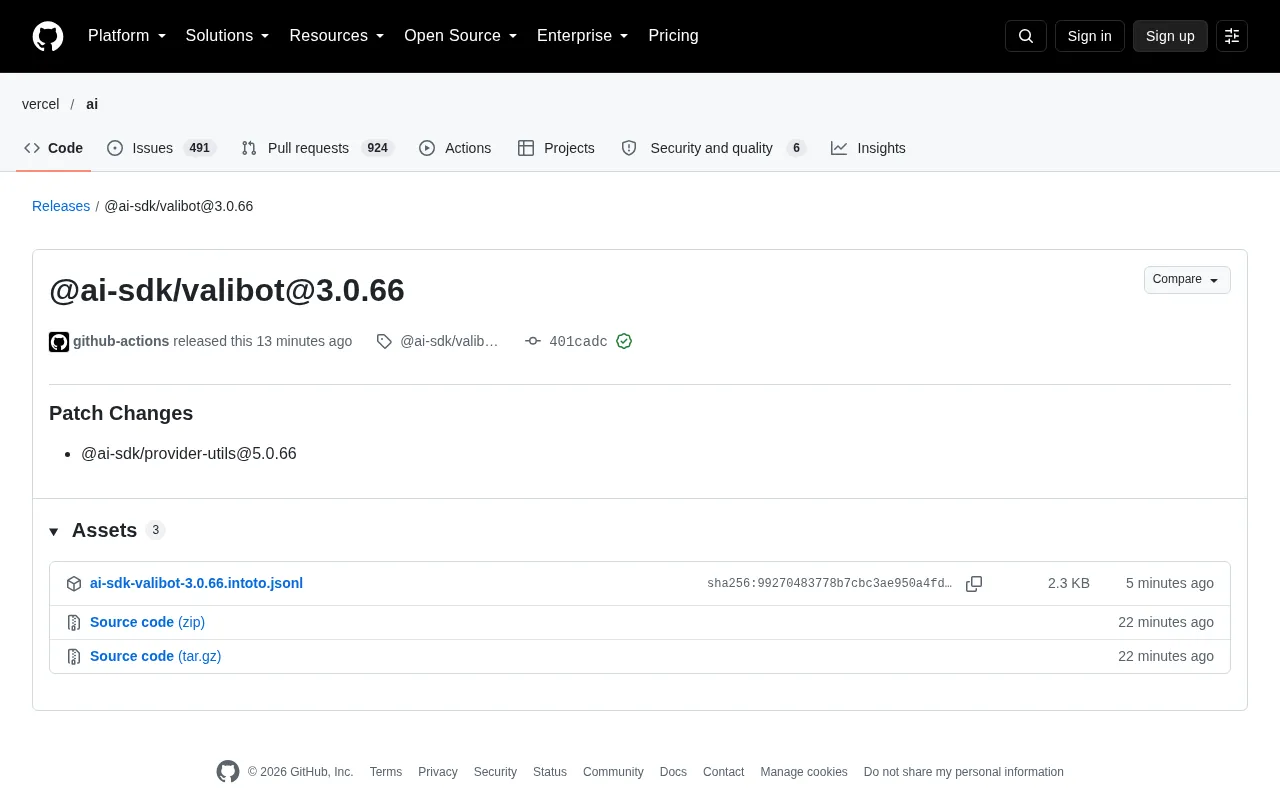
The article focuses on the patch-level update @ai-sdk/valibot@3.0.66, noting that it was automatically published by a GitHub Actions bot and linked to changes in the underlying @ai-sdk/provider-utils@5.0.66. The author explains that @ai-sdk/valibot serves as an adapter layer between the Valibot schema validation library and the Vercel AI SDK, used to validate model output in a type-safe way. The article analyzes that patch updates usually mean synchronization of underlying bug fixes or corrections to type definitions, and mentions that the release includes a GPG signature, reflecting supply chain security practices. Finally, it points out that high-frequency patch iterations are a signal of healthy project maintenance and advises developers to pay attention to dependency compatibility when upgrading.
A Seemingly Routine Patch Update
In the open-source world, not every version iteration means a revolutionary new feature. The release of @ai-sdk/valibot@3.0.66 is essentially a patch-level update. According to the release records on GitHub, this update was automatically published by the github-actions bot and is linked to changes in @ai-sdk/provider-utils@5.0.66.
For readers unfamiliar with the AI SDK ecosystem, this string of version numbers may seem dry. But for developers building applications with the Vercel AI SDK, such patch updates often mean stability fixes in underlying dependencies, corrections to type definitions, or subtle adjustments to the build process.
Where @ai-sdk/valibot Fits in the AI Development Stack
To understand the significance of this update, it helps to first clarify the role of @ai-sdk/valibot. Vercel's AI SDK provides a unified interface for calling different large model services in JavaScript/TypeScript environments. Meanwhile, valibot is a lightweight schema validation library often used to validate structured data returned by AI models (such as JSON output).
The @ai-sdk/valibot package is precisely the adapter layer that connects Valibot's validation capabilities with AI SDK features such as streaming responses and tool calls. When data returned by a model needs strict validation, this package helps developers handle output in a type-safe manner and reduces runtime errors.
Therefore, although the 3.0.66 patch version has a small scope of change, it directly relates to the reliability of the data validation step.
Schema Validation and Valibot's Positioning
In the TypeScript ecosystem, schema validation libraries are used to verify at runtime whether data conforms to an expected structure and type, filling the gap left after TypeScript types are erased at compile time. Common solutions include Zod, Yup, Joi, and Valibot. Valibot's design philosophy is "modular + tree-shakable": each of its validation functions can be imported independently, and bundlers can shake out unused parts, making it attractive in edge runtimes or scenarios sensitive to package size. Compared with Zod, Valibot's API style is similar, but it is lighter by default. When an AI model returns JSON, developers cannot know at compile time whether fields are missing or types have drifted. At this point, using a Valibot schema for runtime validation becomes a key part of ensuring the safety of downstream logic.
Maintenance Priorities Revealed by the Patch Changes
From the release notes, the core association of this update is @ai-sdk/provider-utils@5.0.66. provider-utils is the underlying utility set in the AI SDK responsible for provider adaptation, involving common logic such as request construction, response parsing, and error handling.
When an upper-layer adapter package (such as the valibot adapter layer) publishes a patch together with an underlying utility package, it usually means one of the following: the underlying utility fixed a bug with broad impact, and the upper-layer package needs to synchronize the dependency version; or validation-related type definitions need to remain consistent with new types in provider-utils.
The release record also includes GitHub's verified signature information (GPG key ID: B5690EEEBB952194), indicating that the release process underwent automated signature verification and conforms to supply chain security practices in modern open-source projects.
Semantic Versioning and the Meaning of Patch Numbers
Under semantic versioning (SemVer), in the version number MAJOR.MINOR.PATCH, an increment to the patch number indicates a "backward-compatible bug fix" that introduces no new features and does not break the existing API. Therefore, changes in 3.0.66 relative to 3.0.65 should theoretically not require developers to modify business logic. However, in the npm ecosystem, patch versions are often used to synchronize fixes in underlying dependencies—especially when one package directly re-exports or wraps the logic of another package. The AI SDK uses a monorepo, with multiple packages sharing the same toolchain and release pipeline. The patch numbers of provider-utils and the various adapter packages often increment in tandem, which is exactly the background for this valibot adapter layer's follow-up release. Understanding this helps developers assess upgrade risk: patch-level linkage usually means "just bringing underlying fixes up," rather than interface changes.
Practical Impact on Developers
For ordinary users, the cost of upgrading to 3.0.66 is extremely low—usually just changing the version number in package.json and reinstalling dependencies. But it is worth noting that although the patch version is small, in AI applications, which are sensitive to output quality, any subtle correction in the validation layer may affect the final user experience.
If your project relies on @ai-sdk/valibot for strict validation of model output, it is advisable to check whether this update resolves edge cases you previously encountered. At the same time, because this package is linked with provider-utils, it is best to check the version compatibility of related dependencies when upgrading to avoid type mismatches.
GPG Signatures and Supply Chain Security
The GPG key ID in the release record (B5690EEEBB952194) is the product of GitHub Actions' automatic signing mechanism. GPG (GNU Privacy Guard) signatures apply cryptographic signatures to release artifacts or commits, allowing users to verify that "this package indeed comes from the build process of that repository and has not been tampered with in between." Against the backdrop of frequent npm supply chain attacks, this mechanism is especially important: if an attacker wants to inject malicious code, they would also need to forge the signature, greatly raising the bar. For developers, commands such as npm audit signatures can be used to check the validity of dependency package signatures. Such practices are becoming standard for mainstream open-source projects and are also one reference dimension for assessing whether a dependency is trustworthy.
A Routine Signal of Ecosystem Maintenance
This release was completed by an automated bot, reflecting that the AI SDK project has established a relatively mature CI/CD process. High-frequency patch iterations are a sign of healthy maintenance—they show that the maintenance team is continuously following up on issues rather than waiting until problems pile up before making a major release.
For technology decision-makers, a package that continuously publishes patches is usually more trustworthy than one that has long been dormant. This minor version update of @ai-sdk/valibot is not news in itself, but as a slice of the daily maintenance of the AI SDK ecosystem, it reminds us that the reliability of AI applications is often built on these inconspicuous dependency updates.
Related articles

Amphibious Transforming Drone: Beyond 100x Power Savings, What Are the Real Needs?
Is the amphibious transforming drone just a gimmick? Starting from the 100x power difference of the M4 Morphobot, explore real application scenarios and thesis topic ideas, analyzing boundary conditions where pure drones and pure ground robots both fail.

Warhound Raises $200 Million: Genetically Engineered "War Dogs" Paired with Anduril Gear
Warhound raises $200M, backed by Ben Lamm and Palmer Luckey, to genetically engineer dogs for military and law enforcement use and equip them with Anduril gear. This article analyzes its technology direction, funding logic, and ethical controversy.

Claude API Comes to Google Cloud: IAM Integration and SDK Access Guide
Anthropic hosts the full Claude API on Google Cloud with IAM-controlled permissions and unified billing. This guide covers the Vertex AI and Anthropic-hosted entry points, IAM role configuration, and SDK access.