@ai-sdk/voyage 1.0.32 Released: A Dependency-Update Patch

Vercel AI SDK's @ai-sdk/voyage 1.0.32 is a maintenance patch that syncs internal dependencies with no functional changes.
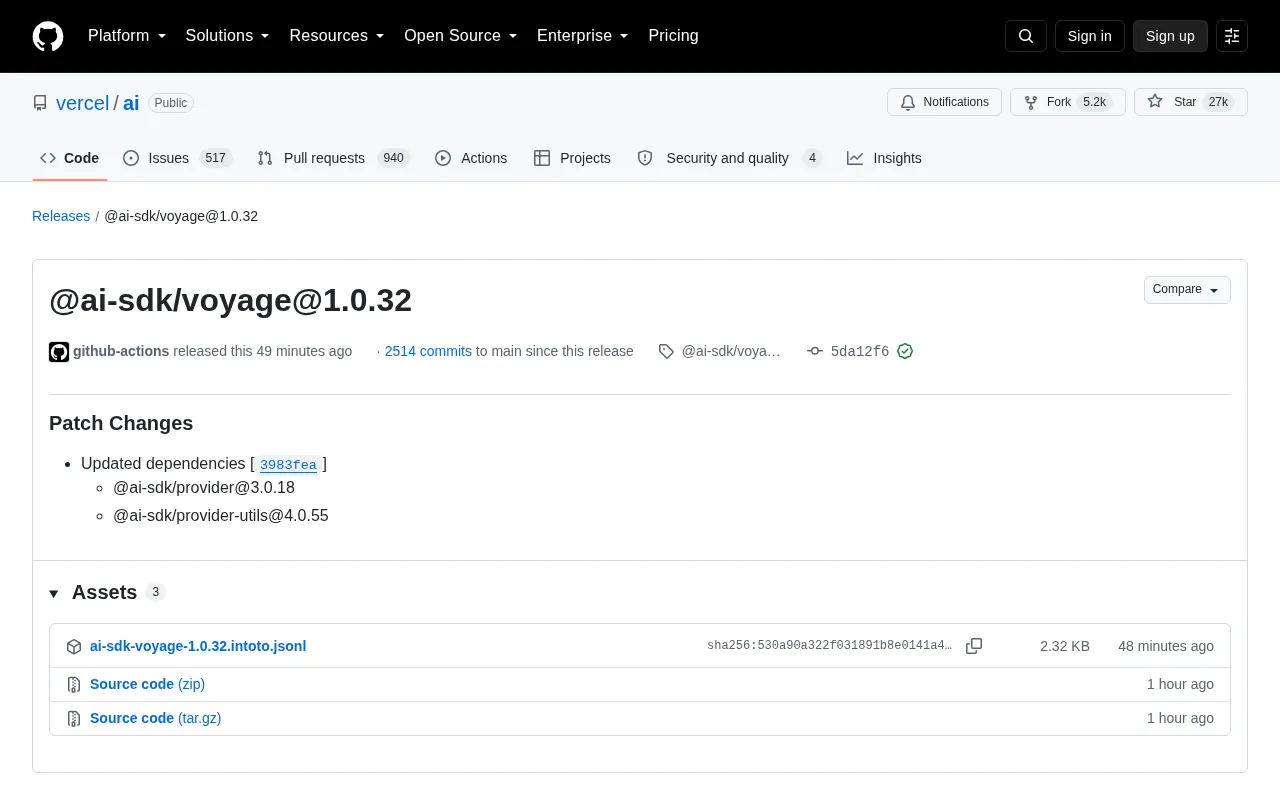
@ai-sdk/voyage 1.0.32 is a purely maintenance-focused patch update, with the core change being the synchronization of @ai-sdk/provider and @ai-sdk/provider-utils to their latest versions. The package is Vercel AI SDK's official integration for Voyage AI, designed for text embedding and reranking in RAG workflows. As a patch release following SemVer, it contains no breaking changes and is safe to upgrade. The update's primary purpose is to keep provider packages aligned with base modules across the AI SDK ecosystem, preventing type incompatibilities or runtime warnings.
The @ai-sdk/voyage package in the Vercel AI SDK ecosystem has released version 1.0.32. This is a patch-level update focused entirely on syncing underlying dependencies — no new features or breaking changes are introduced. For developers using Vercel AI SDK to integrate Voyage AI embedding models, this kind of update is generally safe to apply.
What's in This Update
According to the GitHub Releases page, this version was published by an automated github-actions workflow and falls under the Patch Changes category. The core change is the synchronization of two internal dependencies:
@ai-sdk/provider@3.0.18@ai-sdk/provider-utils@4.0.55
These dependencies are shared foundational modules within the Vercel AI SDK, responsible for defining provider interface specifications and providing common utility methods across providers. When these base modules are upgraded, individual provider packages (including voyage) publish corresponding patch versions to maintain version consistency across the entire SDK ecosystem.
What Is @ai-sdk/voyage
@ai-sdk/voyage is the official Voyage AI integration package for the Vercel AI SDK. Voyage AI specializes in high-quality text embedding and reranking models, which are commonly used for vector processing in RAG (Retrieval-Augmented Generation) workflows. This package allows developers to call Voyage's models through the Vercel AI SDK's unified interface, without writing separate adapter code for each vendor.
The Vercel AI project currently has approximately 27k stars and 5.2k forks on GitHub, making it one of the most active AI application development frameworks in the TypeScript/JavaScript ecosystem. Its modular provider architecture allows both the community and the official team to continuously integrate new model service providers.
RAG (Retrieval-Augmented Generation) is a core architectural pattern in modern LLM applications: the system first converts external documents into vector embeddings stored in a vector database, then retrieves relevant passages through similarity search when a user submits a query, and finally feeds those passages as context to the language model to generate a response. In this pipeline, the quality of the embedding model directly determines retrieval accuracy. Reranking is a precision-refinement step that follows the initial vector retrieval — a dedicated cross-encoder model re-scores the candidate results to surface the most semantically relevant documents, compensating for the precision limitations of pure vector similarity search. Voyage AI is well-known for its strong benchmark performance in both embedding and reranking, making it a popular choice for building high-quality RAG pipelines.
Should Developers Upgrade
As a patch version with purely dependency-level changes, 1.0.32 introduces no behavioral changes in code logic and carries low risk. For projects following Semantic Versioning (SemVer) practices, upgrading to this version typically requires only routine regression testing.
If you maintain an application built on the Vercel AI SDK, it's a good practice to keep provider packages aligned with core dependency versions to avoid type incompatibilities or runtime warnings caused by version mismatches. Overall, this is a routine maintenance update — its significance lies more in signaling the AI SDK team's ongoing commitment to dependency health and version synchronization than in any functional change.
Related articles

T3 Code: The Open-Source AI Coding Assistant's Comeback Story
T3 Code is an open-source AI coding assistant that unifies subscriptions like Codex and Claude, with powerful remote control and parallel task management.

Never Elected, Yet Ruled New York for 30 Years: The Ultimate Case Study in the Mechanics of Power
Robert Caro's biographies reveal how unelected Robert Moses ruled New York for 30 years through legal drafting and public authorities, and how Lyndon Johnson built leverage as a "powerless" Senate Majority Leader. Unpacking the underlying logic of accumulating and sustaining power.

The CPython 3.10 Recursion Trap and Synthetic Recovery in TokenGuard, an LLM Circuit Breaker
TokenGuard's author recounts a recursion crash caused by OrderedDict.pop in CPython 3.10 and introduces v0.3.0's Loop Nudge synthetic recovery, inline DLP scanning, and other new LLM agent circuit-breaker capabilities.