@ai-sdk/voyage 2.0.44 Released: Dependency Update Patch Version
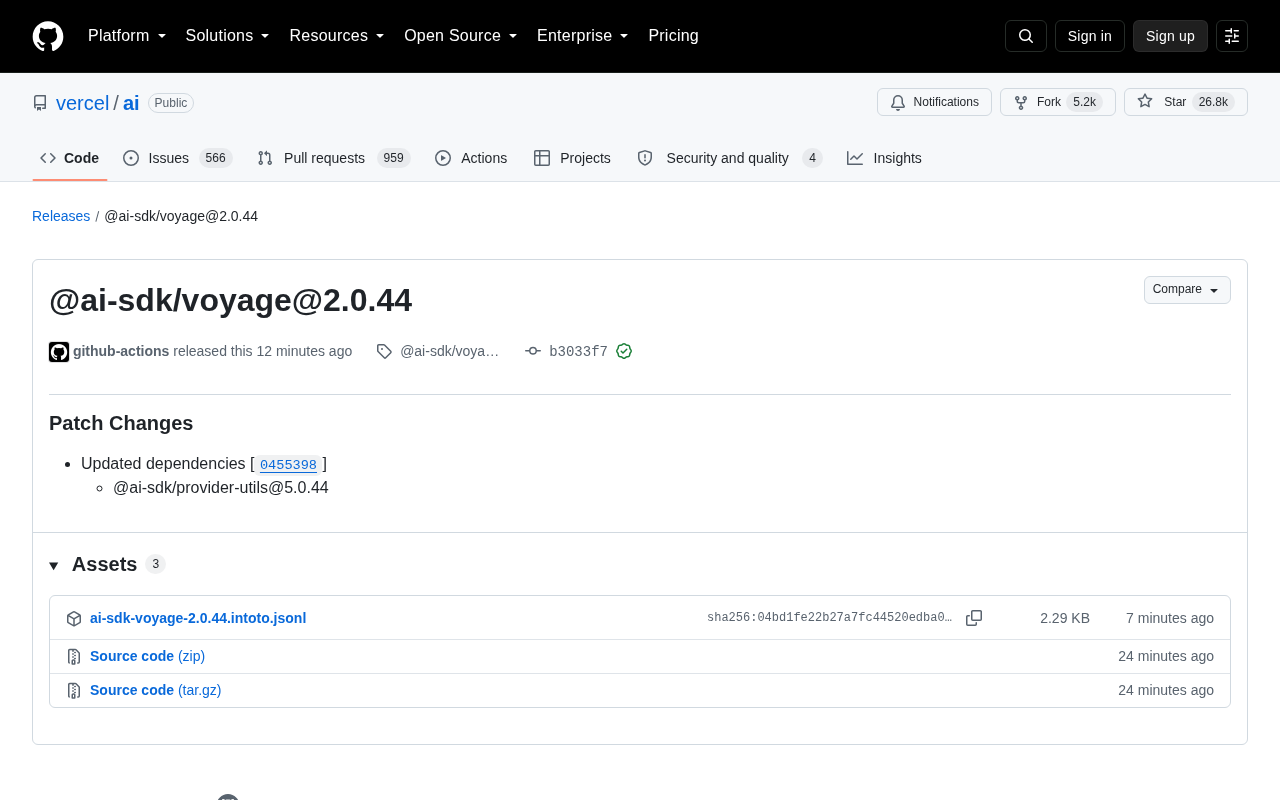
@ai-sdk/voyage 2.0.44 patch release syncs the underlying provider-utils dependency to 5.0.44.
Vercel AI SDK's `@ai-sdk/voyage` has released patch version 2.0.44, a typical maintenance update whose sole change is syncing the underlying `@ai-sdk/provider-utils` dependency to 5.0.44. In large monorepo-structured SDK projects, upgrades to foundational packages trigger synchronized patch releases across all dependent Provider packages to maintain dependency tree consistency. The release was automated via GitHub Actions with GPG signature verification. For existing users, this version involves no breaking API changes, making it a low-risk upgrade that delivers stability improvements from the underlying fix.
Vercel's AI SDK project has received another update, with @ai-sdk/voyage releasing version 2.0.44. This is a patch-level update focused on syncing internal dependencies.
Release Overview
According to the official GitHub Release page, @ai-sdk/voyage@2.0.44 was published by github-actions on September 18th at commit hash b3033f7, with a verified GPG signature (key ID: B5690EEEBB952194), ensuring the trustworthiness of the release source.
This version is one of the sub-packages in the Vercel AI ecosystem. Vercel's ai repository is a popular open-source AI toolkit, having accumulated approximately 26,800 stars and 5.2k forks on GitHub, reflecting broad community interest. As a Provider package within the ecosystem, @ai-sdk/voyage handles integration with Voyage AI's capabilities, such as text embedding and related model services.
A monorepo is an engineering organizational approach where multiple related projects or packages are stored together in a single repository. Vercel's ai repository adopts this architecture, centrally managing dozens of Provider packages — including @ai-sdk/openai, @ai-sdk/anthropic, @ai-sdk/voyage, and others — alongside core utility packages. The key advantages of this structure are: cross-package code changes can be completed in a single commit, dependency changes can be tracked and tested uniformly, and version releases can be batch-automated through CI/CD tools like GitHub Actions. The version sync update in @ai-sdk/voyage is a classic example of automated dependency management in a monorepo.
What Changed
The core change in this release is focused on a dependency update. The official Changelog marks it as Patch Changes, with the specific content being:
Updated dependencies [
0455398]@ai-sdk/provider-utils@5.0.44
In other words, @ai-sdk/voyage has been updated to follow its underlying dependency @ai-sdk/provider-utils to version 5.0.44. In the Semantic Versioning (SemVer) system, this type of update represents the lowest-impact level of change — it typically doesn't involve new features or breaking API changes, but rather maintains version consistency and compatibility across the SDK's various modules.
For developers, provider-utils is the foundational package in the AI SDK that houses common utility functions, and virtually every Provider package depends on it. When it gets upgraded, the upstream Provider packages (such as voyage, openai, anthropic, etc.) typically release synchronized patch versions to ensure a stable dependency tree.
Semantic Versioning (SemVer) is the widely adopted standard for software version number management. A version number consists of three segments: MAJOR.MINOR.PATCH (e.g., 2.0.44). A MAJOR version change signals backwards-incompatible breaking API changes; a MINOR version change indicates new features added in a backwards-compatible manner; and a PATCH change is used only for backwards-compatible bug fixes or dependency syncs. In large SDK projects with a monorepo structure, when a foundational package (such as provider-utils) receives any level of update, dependent upstream packages — even if their own code hasn't changed — typically need to release a patch version as well. This keeps the version numbers locked in package.json aligned with the actual ecosystem, preventing version conflicts or unexpected behavior during installation.
Impact on Users
The value of a patch version lies in "safe adoption." If you're currently using @ai-sdk/voyage in your project, upgrading to 2.0.44 is generally a low-risk operation — it won't change any existing calling patterns, but you'll gain the stability improvements brought by fixes in the underlying utility package.
Developers using this package are encouraged to check the @ai-sdk/provider-utils changelog to understand the specific fixes included in commit 0455398. In production environments, following a "test before upgrading" approach remains the prudent path — especially when multiple AI SDK sub-packages have version interdependencies. Keeping the overall dependency versions aligned can help avoid potential compatibility issues.
Summary
@ai-sdk/voyage@2.0.44 is a typical maintenance release with no new functional features at the feature level. Its primary value lies in syncing dependencies and maintaining ecosystem consistency. This also reflects the Vercel AI SDK team's disciplined approach to version management — using automated GitHub Actions workflows and signature verification to provide a stable and reliable release cadence for a large monorepo.
For the complete changelog, you can visit the project's GitHub Releases page to review the original records.
Related articles
Three Stages of AI LLM Testing: A Practical Guide from Core Concepts to API Calls
A learning path for testers covering LLM fundamentals, prompt engineering, OpenAI SDK calls, API Key vs Token differences, streaming output, RAG, and Agent systems.
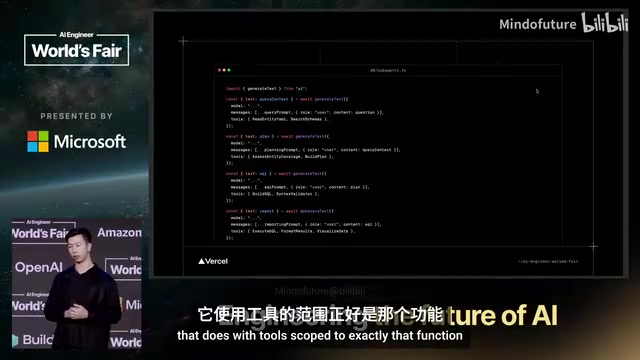
Vercel's Chief of Software Looks Back: The Evolution of Agent Building — From Multi-Agent Chains to File System Agents
Vercel's Chief of Software Andrew recaps the agent-building journey at AI Engineer: from giant prompts to multi-agent chains, monolithic memory, file system agents, and the open-source EVE framework.
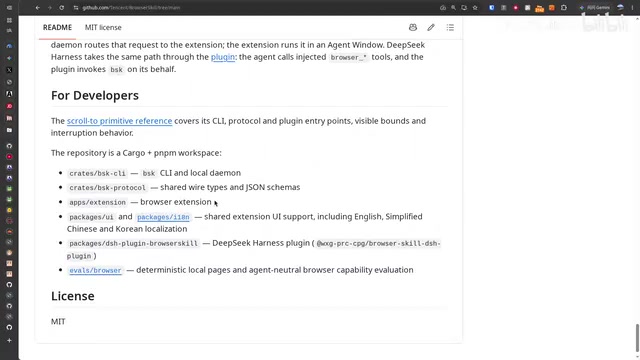
Tencent's Open-Source BSK in Action: Letting AI Take Over Your Already-Logged-In Browser
Tencent's open-source BSK (Browser Skill Kit) lets AI take over your real, logged-in Chrome via WebSocket. We break down the architecture, setup, and three key pitfalls from real-world testing.