@ai-sdk/voyage 2.0.46 Released: A Dependency Update Patch

Vercel AI SDK's Voyage embedding package releases v2.0.46 patch to sync underlying dependencies.
`@ai-sdk/voyage@2.0.46` is a routine patch update in the Vercel AI SDK ecosystem, bumping shared dependencies `@ai-sdk/provider` to 4.0.18 and `@ai-sdk/provider-utils` to 5.0.46, with no new features or breaking changes. The package integrates Voyage AI's text embedding models into the Vercel AI SDK's unified interface, serving RAG and semantic search use cases. The release was automated via GitHub Actions with a verified signature, reflecting the ecosystem's high-frequency, standardized release cadence. Upgrade risk is low for teams using Voyage embeddings, though verifying upstream dependency changes in production is still recommended.
Vercel's AI SDK ecosystem has released @ai-sdk/voyage@2.0.46. This is a patch-level update focused on dependency synchronization. For developers using Voyage AI embedding models, updates like this may seem minor, but they play an important role in keeping the toolchain running smoothly.
What Changed in This Release
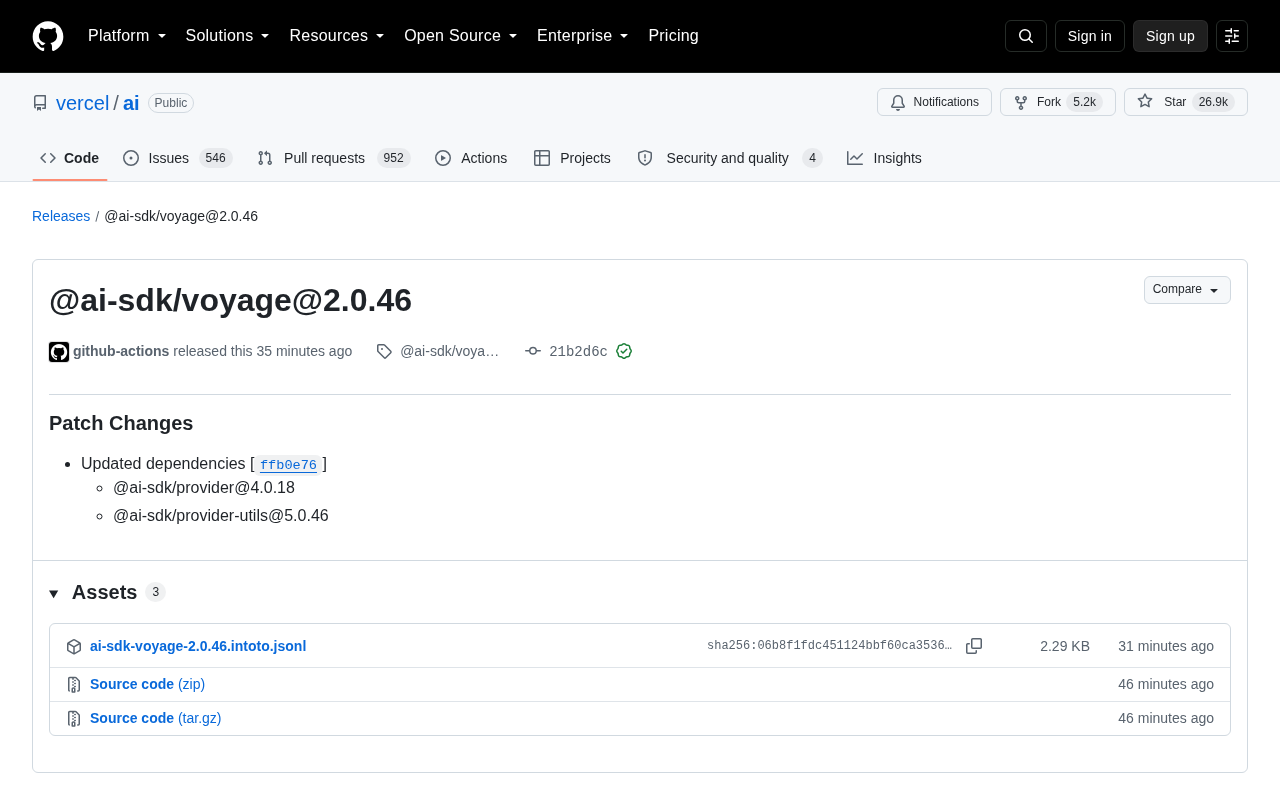
According to the GitHub release notes, @ai-sdk/voyage@2.0.46 falls under Patch Changes, with the core update being a bump of internal dependencies:
@ai-sdk/provider@4.0.18@ai-sdk/provider-utils@5.0.46
This version was automatically published via GitHub Actions and signed with a verified signature using GPG key ID B5690EEEBB952194, ensuring the authenticity of the release source.
Patch releases typically do not introduce breaking changes — they are primarily used to fix issues or align dependency versions. This means the risk of upgrading existing projects to this version is low, and developers can generally apply the update directly.
About @ai-sdk/voyage and the AI SDK
@ai-sdk/voyage is a provider package within the Vercel AI SDK ecosystem that integrates the text embedding capabilities offered by Voyage AI. Voyage AI's embedding models are widely used in retrieval-augmented generation (RAG) and semantic search scenarios, known for their high retrieval accuracy.
The Vercel AI SDK itself is a popular open-source toolkit with approximately 26.9k stars and 5.2k forks on GitHub. It covers capabilities such as model invocation, streaming responses, and tool calling. Through a unified interface abstraction, it allows developers to switch flexibly between different AI model providers — and @ai-sdk/voyage is the module responsible for integrating Voyage's embedding models.
Text embedding is a technique that transforms words, sentences, or documents into high-dimensional numerical vectors, positioning semantically similar content closer together in vector space. Voyage AI specializes in high-quality embedding models that perform strongly on standard benchmarks like MTEB (Massive Text Embedding Benchmark), particularly excelling at code retrieval and long-document understanding. In a RAG architecture, embedding models play a central role in vectorizing both user queries and knowledge base documents — the system converts a question into a vector, uses approximate nearest neighbor search (e.g., FAISS, Pinecone) to find the most semantically relevant document chunks, and then feeds those chunks as context to a large language model to generate an answer. Choosing a higher-accuracy embedding model directly impacts retrieval recall, which in turn determines the quality of the final response.
What This Means for Developers
The frequent, incremental nature of these patch releases reflects the relatively aggressive continuous integration and release cadence adopted by the AI SDK ecosystem. Since provider and provider-utils are shared low-level dependencies, any update to them typically triggers synchronized releases across all upstream provider packages — such as voyage, openai, anthropic, and others — to ensure consistency across the entire toolchain.
For projects running in production, it's recommended to review the full changelog before upgrading to confirm the actual changes included in the underlying ffb0e76 commit. While patch releases carry low risk, in the fast-moving world of AI application development, locking and incrementally verifying dependency versions remains sound engineering practice.
Vercel AI SDK uses a Changesets workflow to manage versioning across its monorepo. Under this model, whenever a low-level shared package (such as @ai-sdk/provider or @ai-sdk/provider-utils) changes, all upstream provider packages that depend on it must publish new versions to declare compatibility with the updated dependency — even if the upstream package itself has no code changes. This "cascading release" mechanism ensures that SemVer declarations in the npm dependency tree remain accurate, preventing runtime issues caused by inconsistent implicit dependency versions. Teams maintaining multiple AI provider integrations can use tools like npm outdated, Renovate, or Dependabot to automatically track these cascading updates and reduce the overhead of manual checks.
Summary
@ai-sdk/voyage@2.0.46 is a typical dependency-sync patch update. It introduces no new features, but reflects the active maintenance and disciplined release practices of the Vercel AI SDK ecosystem. Teams using Voyage embedding models can confidently upgrade to this version, while also keeping an eye on the continued evolution of the upstream @ai-sdk/provider package.
Related articles

Random Pruning of the DPO Computation Graph: 1.4x Training Speedup and Lower Peak Memory
DPO training too slow and memory-hungry? This paper proposes a random pruning framework for the DPO computation graph, sampling independently across position, sequence, and branch dimensions; branch pruning achieves a 1.426x step-time speedup and cuts training time by about 30%, with in-depth attribution of memory and time gains.

Why Does JEPA Underperform MLM in Longitudinal EHR Representation Learning?
New study compares JEPA and MLM for longitudinal EHR representation learning on MIMIC-IV: three JEPA variants train stably without collapse but underperform MLM; target size, not heterogeneity, drives prediction error.

Transfer Learning + Visible Light Communication: A New Approach to Energy-Efficient Indoor Positioning
A study proposes a transfer learning-based visible light communication indoor positioning method, achieving 47% accuracy improvement on the BOSCH factory dataset, 67.5% model efficiency under high noise, and introducing the ME composite metric for energy-efficient positioning in energy-constrained industrial IoT scenarios.