@ai-sdk/voyage 2.0.56 Released: Dependency Update Patch Breakdown

@ai-sdk/voyage 2.0.56 is a maintenance patch syncing base dependencies with no breaking changes.
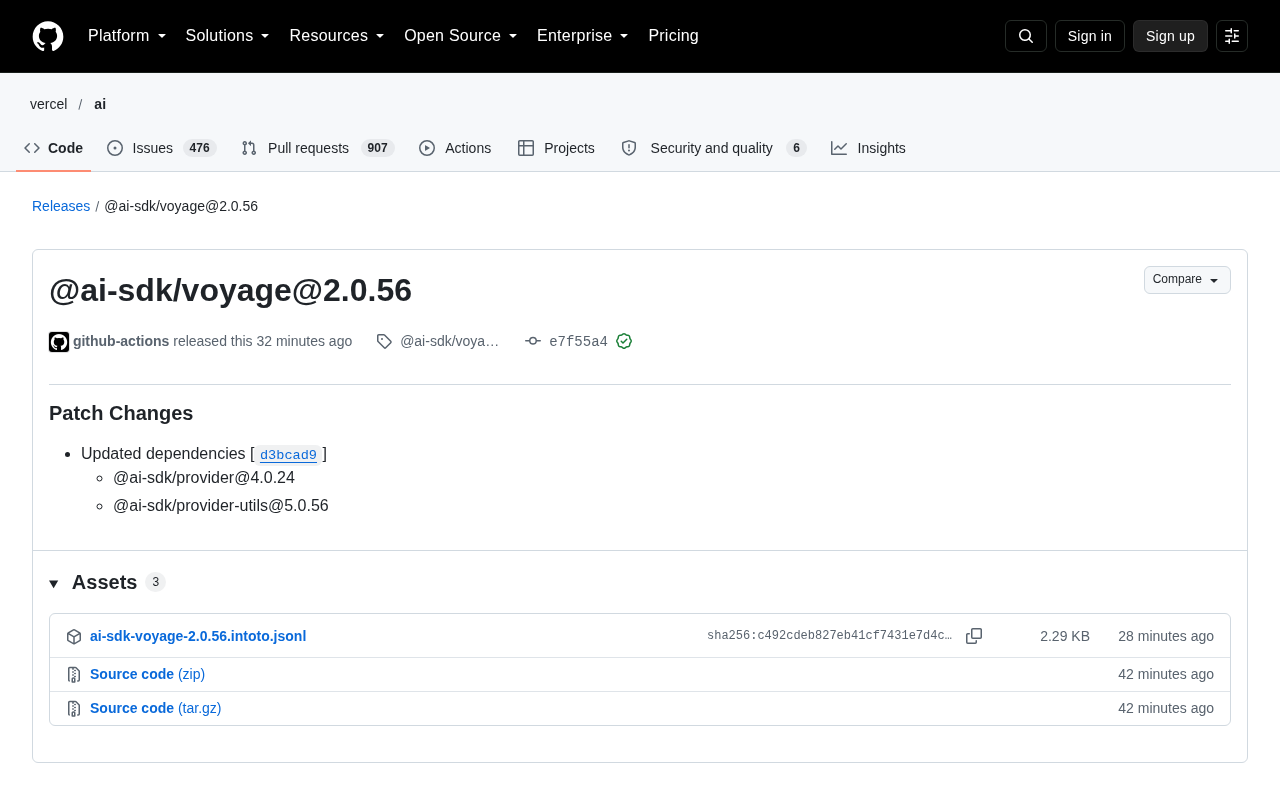
@ai-sdk/voyage 2.0.56 is a patch-level update to the Voyage AI embedding provider package in the Vercel AI SDK ecosystem, bumping @ai-sdk/provider to 4.0.24 and @ai-sdk/provider-utils to 5.0.56. Released automatically via GitHub Actions with GPG signature verification, it follows supply chain security best practices. There are no API changes or breaking modifications — developers can upgrade with minimal risk and are advised to update all related ai-sdk dependencies together to avoid version mismatch issues.
Version Overview
@ai-sdk/voyage is the provider package within the Vercel AI SDK ecosystem for integrating Voyage AI's vector embedding capabilities. Version 2.0.56 is a patch-level update, primarily focused on syncing upstream dependency upgrades. It was published on October 7 via GitHub Actions automation and passed GitHub's GPG signature verification (key ID: B5690EEEBB952194).
In terms of semantic versioning, 2.0.56 is a patch increment — meaning this update contains no new features or breaking changes, making it a very low-risk upgrade for existing projects.
What Changed: Dependency Sync
According to the release notes, this update falls under Patch Changes, with the core change being a sync to updated upstream dependencies:
- @ai-sdk/provider@4.0.24
- @ai-sdk/provider-utils@5.0.56
These two packages form the foundational infrastructure of the entire AI SDK provider system. @ai-sdk/provider defines the unified interface specifications that all model providers must implement, while @ai-sdk/provider-utils provides shared utility functions for request handling, error parsing, streaming responses, and more. When these base packages are updated, the specific providers that depend on them — like @ai-sdk/voyage in this case — typically publish a corresponding patch release to maintain compatibility.
This "dependency-driven" release pattern is very common in SDK projects managed as monorepos. The Vercel AI SDK uses a multi-package collaborative architecture, where a single low-level change (in this case linked to commit d3bcad9) triggers version bumps across multiple downstream packages, ensuring consistency throughout the entire toolchain.
Vector embeddings are a technique for converting unstructured data — such as text or images — into high-dimensional numerical vectors, where semantically similar content ends up closer together in vector space. Voyage AI is a service provider specializing in high-quality embedding models, widely used in scenarios like Retrieval-Augmented Generation (RAG) and semantic search. As a Vercel AI SDK provider package, @ai-sdk/voyage abstracts away the communication details with the Voyage AI API, allowing developers to call different vendors' embedding capabilities through a unified SDK interface without worrying about the underlying HTTP request construction or error handling.
What This Means for Developers
For developers currently using Voyage embedding models, this type of patch update is generally safe to apply with confidence. It typically signals that something has been fixed or improved under the hood, without requiring any changes to your application code.
Some practical recommendations worth noting:
Upgrade Strategy
If your project depends on @ai-sdk/voyage, it's recommended to update it alongside @ai-sdk/provider and @ai-sdk/provider-utils to avoid type incompatibilities or runtime errors caused by version mismatches. When using lockfile management tools with npm, pnpm, or yarn, you can update the entire group of ai-sdk-related dependencies in one pass.
The Significance of Automated Releases
This release was completed automatically by github-actions and carries a verified GitHub signature. This reflects good practices around supply chain security — signature verification confirms that the published artifact has not been tampered with, which is especially important for SDK packages that are widely integrated across many projects.
Software supply chain security has received significant attention in recent years, particularly after malicious package poisoning incidents in the npm ecosystem. GPG (GNU Privacy Guard) signature verification is one key defense mechanism: the publisher signs the release artifact with a private key, and users can verify with the corresponding public key that the artifact genuinely came from the legitimate publisher and hasn't been altered in transit. GitHub's "verified" badge indicates that the commit or release was signed with a GPG key bound to the account. For foundational SDK packages that are depended upon by a large number of projects, this mechanism effectively reduces the risk of dependency chain hijacking — and is an important part of modern open-source release standards.
Summary
@ai-sdk/voyage 2.0.56 is a typical maintenance patch update with no functional changes — its core purpose is to sync the underlying provider and provider-utils dependencies. For projects integrating Voyage AI embedding capabilities, this is a routine, low-risk upgrade that's worth keeping up with. Since the official release notes are minimal, further details about the underlying changes should be referenced from the associated commits and the changelogs of the updated dependency packages.
Related articles

Random Pruning of the DPO Computation Graph: 1.4x Training Speedup and Lower Peak Memory
DPO training too slow and memory-hungry? This paper proposes a random pruning framework for the DPO computation graph, sampling independently across position, sequence, and branch dimensions; branch pruning achieves a 1.426x step-time speedup and cuts training time by about 30%, with in-depth attribution of memory and time gains.

Why Does JEPA Underperform MLM in Longitudinal EHR Representation Learning?
New study compares JEPA and MLM for longitudinal EHR representation learning on MIMIC-IV: three JEPA variants train stably without collapse but underperform MLM; target size, not heterogeneity, drives prediction error.

Transfer Learning + Visible Light Communication: A New Approach to Energy-Efficient Indoor Positioning
A study proposes a transfer learning-based visible light communication indoor positioning method, achieving 47% accuracy improvement on the BOSCH factory dataset, 67.5% model efficiency under high noise, and introducing the ME composite metric for energy-efficient positioning in energy-constrained industrial IoT scenarios.