AI SDK Voyage 2.0.71 Patch Released: Dependency Sync Update

@ai-sdk/voyage releases 2.0.71 patch, syncing provider-utils to version 5.0.71.
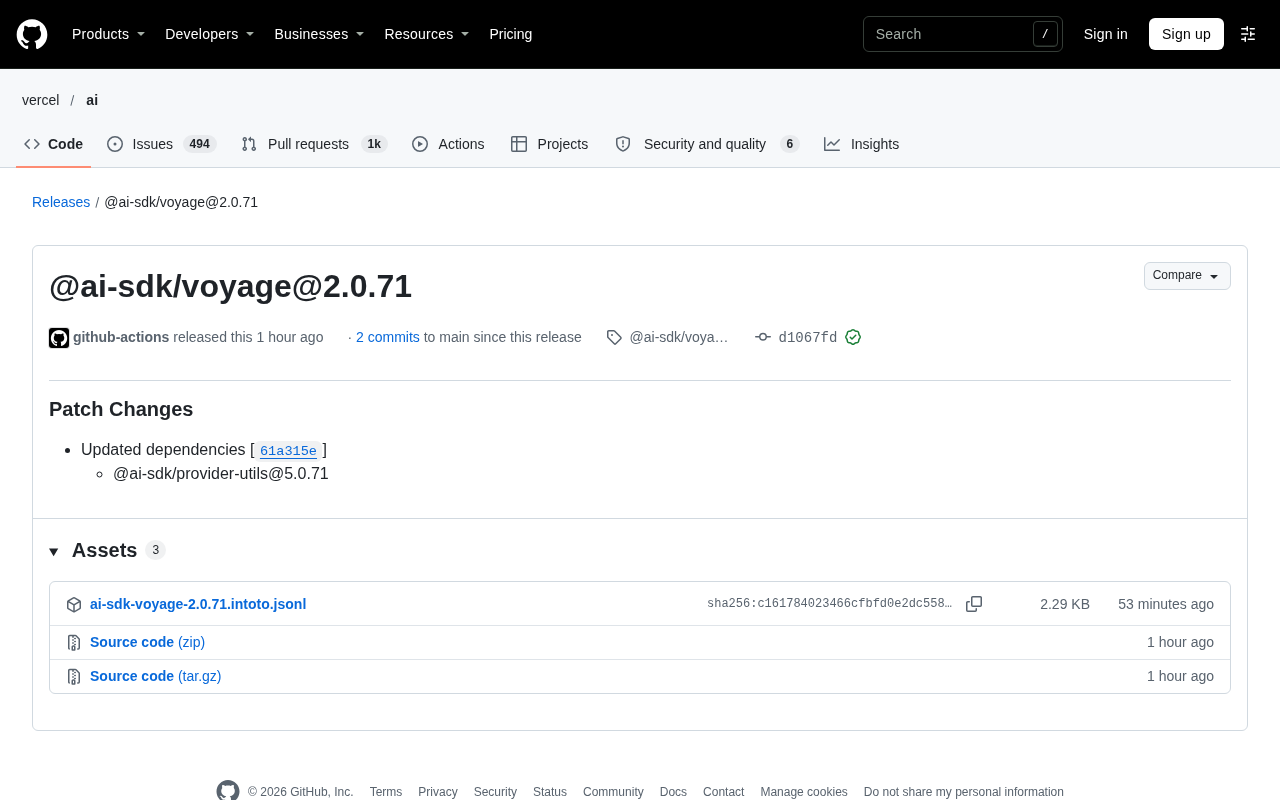
@ai-sdk/voyage releases patch version 2.0.71. This update introduces no new features; the core change is syncing the underlying dependency @ai-sdk/provider-utils to 5.0.71 to maintain version alignment within the AI SDK ecosystem and reduce compatibility risks. The release was automated via github-actions, and the commit carries GitHub's verified GPG signature, reflecting a standardized CI/CD process. Since there are no external API changes, upgrade risk is low, and developers using this plugin can follow up at their regular cadence. However, the release notes only list dependency changes without details on the specific modifications in provider-utils 5.0.71, so further consultation of that package's release records is needed. Overall, this is a typical maintenance dependency sync update.
The Voyage plugin in the AI SDK ecosystem has received a minor version update. This patch release introduces no new features, focusing instead on synchronizing the dependency chain to keep it consistent with the underlying toolkit.
Core Content of the Version Update
According to the release records on GitHub, @ai-sdk/voyage@2.0.71 is a Patch Changes-level release. The release notes show that this update primarily revolves around dependency adjustments, syncing @ai-sdk/provider-utils to version 5.0.71.
This kind of dependency synchronization is very common in the daily maintenance of SDKs. As part of the AI SDK system, Voyage needs to keep its version aligned with foundational packages like provider-utils to avoid compatibility issues caused by version mismatches.
The Significance of the Dependency Update
@ai-sdk/provider-utils is the underlying package in the AI SDK that handles provider-related utility logic. Updating it to 5.0.71 means the Voyage plugin can inherit the fixes or improvements in that version, although the release notes themselves do not elaborate on what specific changes provider-utils 5.0.71 contains.
For developers building applications with the AI SDK, the value of such patch updates lies in reducing the risk of version conflicts. When multiple AI SDK-related packages are used in a project simultaneously, unified dependency versions can reduce debugging costs.
Semantic Versioning (SemVer) is the foundation for understanding this type of patch update. SemVer divides version numbers into three segments: major version.minor version.patch number. An increment in the patch number (e.g., 2.0.70 → 2.0.71) indicates that only backward-compatible bug fixes are included, with no new features introduced and no breaking changes to the existing API. Therefore, as a Patch Changes-level release, @ai-sdk/voyage@2.0.71 should not change the plugin's external behavior according to convention. It is worth noting that SemVer is a community convention rather than a mandatory standard, and the actual impact still needs to be judged in conjunction with the release notes—in this case, the release notes do not elaborate on the changes in provider-utils, so developers who care about the underlying fixes should further check that package's changelog.
Release Information and Credibility
This release was completed automatically by github-actions, with a timestamp of 29 Oct 17:14, containing 2 commits merged into the main branch. The commit records carry GitHub's verified signature, with GPG key ID B5690EEEBB952194.
The automated release process combined with signature verification indicates that this update followed a standardized CI/CD path rather than manual intervention. For teams concerned about supply chain security, the verified signature is a positive signal.
Should You Upgrade
If you use @ai-sdk/voyage in your project and your currently depended-upon provider-utils version is older, this patch is worth following up on. It does not change the external API, so the upgrade risk is low. If your project has a strict dependency version locking policy, you can also handle it at the next maintenance window according to your regular cadence.
GPG signature verification is an important mechanism for ensuring software supply chain security. Developers sign commits or tags with a private key, and others verify the signature with the corresponding public key, thereby confirming that the code source is authentic and the content has not been tampered with. The GPG key ID mentioned in the article (B5690EEEBB952194) is the identifier of the key used for signing. GitHub displays a "Verified" badge for commits with verified signatures. Combined with the automated github-actions release, this indicates that the entire process from merge to release was completed by the pipeline, reducing the room for errors or malicious tampering introduced by manual operations. For enterprise-level projects, signature verification policies can be configured during dependency installation to further enhance supply chain trustworthiness.
Dependency locking and version alignment are key considerations when deciding whether to upgrade. In the npm ecosystem, package-lock.json or pnpm-lock.yaml locks the specific versions of the dependency tree, ensuring that team members and CI environments install exactly the same packages. When multiple AI SDK packages in a project jointly depend on @ai-sdk/provider-utils, if the version ranges declared by each are inconsistent, the package manager may install multiple copies, leading to type mismatches or runtime behavior differences. Therefore, upgrading the Voyage plugin to 2.0.71 helps converge versions and reduce duplicate copies. If the project adopts a strict locking policy, you can first verify the lock file changes in a separate branch and merge only after confirming there are no peer dependency conflicts.
Limitations Worth Noting
The release notes provide limited information, listing only dependency changes without accompanying migration guides or behavior change descriptions. Developers who need to understand the specific changes in provider-utils 5.0.71 will need to consult that package's release records separately.
Overall, this is a typical maintenance patch: small in scope, clear in purpose, and suitable as a reference for routine dependency updates.
Related articles

Mistral Large 4 Open-Sources a Trillion Parameters, Microsoft Offers Voluntary Severance to 60,000 Employees
Mistral Large 4 open-sources a trillion-parameter multimodal model with a coding agent score of 48; SanDisk earnings show AI inference reshaping NAND demand; Google Gemini adds in-app file editing, OpenAI raises Codex quotas, and Microsoft offers voluntary severance to 60,000 employees.
Mistral Large 4 Opens Its Weights: AI Morning Brief Roundup of Models and Ecosystem Trends
Mistral Large 4 opens its weights, a 1-trillion-parameter MoE architecture that can run locally on MacStudio; Meta's test-generation technology enters production; top tax benchmark pass rate only 10.8%; Canadian government takes a stake in Cohere; Doubao Work opens third-party model calls. This AI Morning Brief rounds up model, ecosystem, capital, and policy developments.

Mistral Large 4 Goes Open Source: A 1T-Parameter European Qwen Challenging DeepSeek
Mistral Large 4 is now open source: 1T total parameters, 52B activated, focused on coding and cybersecurity, with ~610G NVFP4 weights. We analyze its comparison with DeepSeek V4 Flash, API pricing, demo realism, and local deployment value.