AI SDK Vue 2.0.276 Released: Patch Update Syncs Core Dependency

@ai-sdk/vue releases patch update 2.0.276, syncing core dependency ai@5.0.276; follow up as needed.
Vercel-maintained @ai-sdk/vue has released version 2.0.276, a patch-level update that introduces no new features or breaking changes; the main action is synchronizing the core dependency ai@5.0.276. The article notes that the AI SDK uses a "core package + framework adapter package" version linkage mechanism, where the Vue adapter layer's version line evolves independently but each release specifies its dependent core package version, making it easier for developers to map the framework layer to the core layer. For developers building Vue applications with the AI SDK, patch updates are usually worth following, especially when core dependencies are synced; if the project is stable with no specific bugs, waiting for the next feature release is also fine.
The AI SDK ecosystem has a new version iteration. The @ai-sdk/vue package maintained by Vercel has released version 2.0.276, a routine patch update.
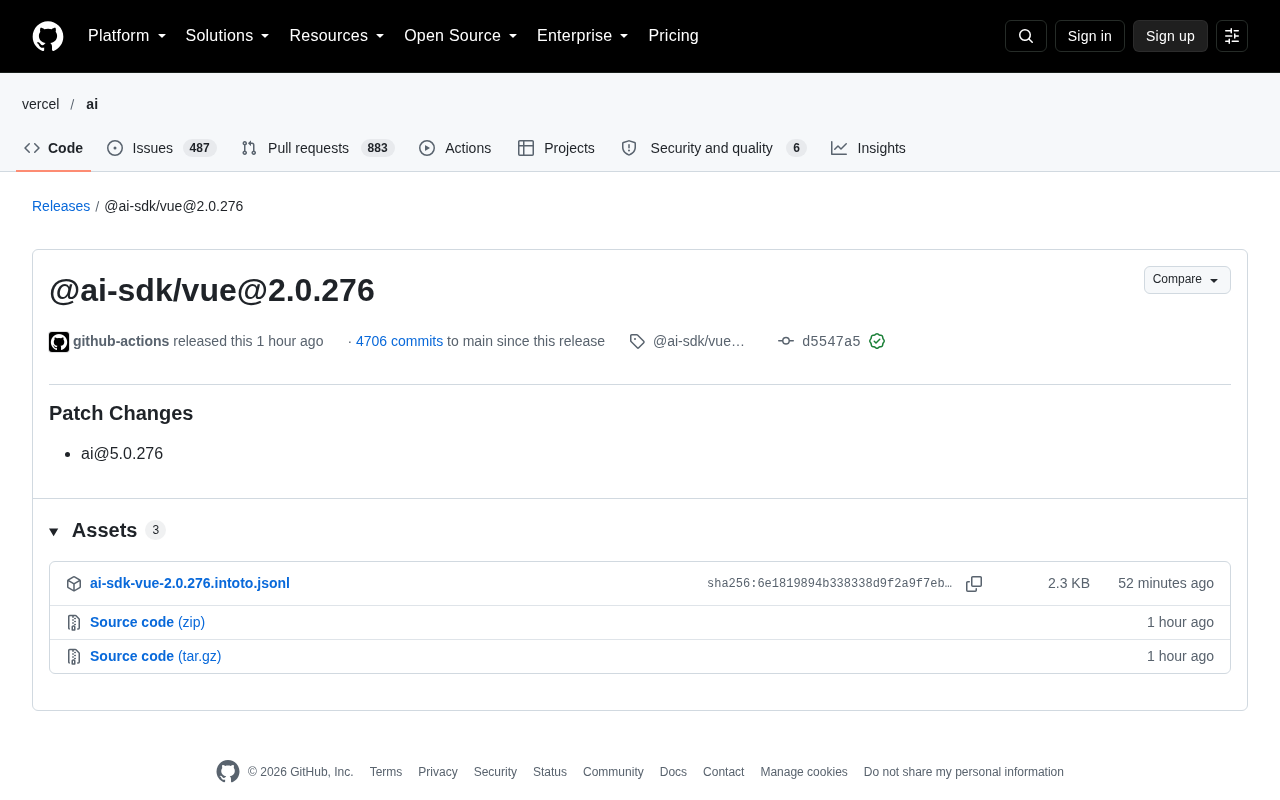
A Typical Patch Update
Judging from the release information, @ai-sdk/vue@2.0.276 is a patch-level update. Updates of this kind typically introduce no new features and involve no breaking changes; their main purpose is to fix defects or sync dependency versions.
In this release, the most direct change is the synchronized upgrade of the core dependency package ai@5.0.276. This "core package + framework adapter package" version linkage mechanism is standard practice for the Vercel AI SDK—the Vue wrapper layer is released in sync with the underlying ai package, ensuring users get behavior at the framework level that's consistent with the core package.
Framework adapter packages are a common layered design for cross-framework libraries like the AI SDK. The core package ai provides framework-agnostic capabilities, such as model invocation, streaming response parsing, tool-call orchestration, and message state management; adapter packages like @ai-sdk/vue and @ai-sdk/react then wrap these capabilities into interfaces that match each framework's conventions, such as Vue composables (like useChat) or React Hooks. This "core + adapter" split lets the same underlying logic be reused across multiple frontend ecosystems, avoiding duplicate implementations.
Since the adapter layer itself is relatively thin, its version changes often amount to simply syncing dependency versions with the core package. This is why @ai-sdk/vue's version number advances in lockstep with the ai package. Understanding this layered structure helps developers determine whether a problem originates in the core layer or the framework wrapper layer, making it faster to identify which repository an issue belongs to.
The AI SDK's Version Evolution Logic
For developers unfamiliar with the AI SDK's versioning conventions, its version number system is worth noting. The AI SDK uses semantic versioning, and @ai-sdk/vue, as the framework adapter layer, keeps its version number in sync with the core ai package. The core package has now entered the 5.x stage, while the Vue adapter package shows 2.0.x, indicating that the adapter layer's version line evolves independently—but each release clearly specifies which core package version it depends on.
The benefit of this approach: when troubleshooting, developers can quickly identify the correspondence between the framework layer and the core layer, avoiding compatibility confusion caused by version mismatches.
Semantic Versioning (SemVer) is the mainstream convention for software package version management today, formatted as MAJOR.MINOR.PATCH. The MAJOR position represents incompatible breaking changes, the MINOR position represents backward-compatible new features, and the PATCH position represents backward-compatible bug fixes. The 276 in @ai-sdk/vue@2.0.276 is the PATCH position, meaning this version introduces no new APIs and doesn't change existing behavior—upgrade risk is low. So-called "breaking changes" refer to changes that may cause existing code to fail compilation or produce different runtime results after upgrading, such as adjusted function signatures or removed exports. The point of SemVer is to let dependents predict the cost of upgrading from the version number alone: as long as the MAJOR position doesn't change, it's generally safe to update.
It's worth noting that SemVer is only a convention, not a mandatory standard—in practice, a PATCH-level release can still introduce behavioral changes. So when upgrading in production, combining the changelog with automated tests remains the prudent approach.
Is It Worth Upgrading?
For developers currently using the AI SDK to build Vue applications, patch updates are usually worth following—especially when the update involves syncing core dependencies. If your current project is running stably and you haven't hit any specific bugs, you can also choose to upgrade together when the next feature release comes out.
Release records show this update includes only Patch Changes, and marks ai@5.0.276 as the associated dependency. For production projects that prioritize stability, paying attention to the cadence of these synchronized releases helps keep the dependency tree clean.
Summary
The release of @ai-sdk/vue@2.0.276 itself doesn't carry much information, but it reflects the AI SDK maintenance team's ongoing iteration cadence. For AI application developers in the Vue ecosystem, keeping an eye on patch updates like these is a routine part of maintaining project health.
One-line Summary
@ai-sdk/vue releases patch update 2.0.276, syncing core dependency ai@5.0.276; follow up as needed.
Paragraph Summary
Vercel-maintained @ai-sdk/vue has released version 2.0.276, a patch-level update that introduces no new features or breaking changes; the main action is synchronizing the core dependency ai@5.0.276. The article notes that the AI SDK uses a "core package + framework adapter package" version linkage mechanism, where the Vue adapter layer's version line evolves independently, but each release specifies which core package version it depends on, making it easier for developers to map the framework layer to the core layer. For developers currently building Vue applications with the AI SDK, patch updates are usually worth following, especially when they involve syncing core dependencies; if the project is running stably with no specific bugs, it's also fine to wait and upgrade together with the next feature release.
Related articles

Random Pruning of the DPO Computation Graph: 1.4x Training Speedup and Lower Peak Memory
DPO training too slow and memory-hungry? This paper proposes a random pruning framework for the DPO computation graph, sampling independently across position, sequence, and branch dimensions; branch pruning achieves a 1.426x step-time speedup and cuts training time by about 30%, with in-depth attribution of memory and time gains.

Why Does JEPA Underperform MLM in Longitudinal EHR Representation Learning?
New study compares JEPA and MLM for longitudinal EHR representation learning on MIMIC-IV: three JEPA variants train stably without collapse but underperform MLM; target size, not heterogeneity, drives prediction error.

Transfer Learning + Visible Light Communication: A New Approach to Energy-Efficient Indoor Positioning
A study proposes a transfer learning-based visible light communication indoor positioning method, achieving 47% accuracy improvement on the BOSCH factory dataset, 67.5% model efficiency under high noise, and introducing the ME composite metric for energy-efficient positioning in energy-constrained industrial IoT scenarios.