AI SDK Vue 2.0.277 Patch Released: Syncs with ai 5.0.277

@ai-sdk/vue releases patch 2.0.277, with the core change being syncing the ai package to 5.0.277.
@ai-sdk/vue has released version 2.0.277, a patch update marked as Patch Changes, with the only change being syncing the internal ai dependency to 5.0.277. The version was automatically released by GitHub Actions, and the commit carries a GPG-verified signature, making it traceable and trustworthy. The article notes that the Vue adapter package itself does not introduce new APIs and is only responsible for binding core package capabilities to Vue's reactive system, so it often releases in step with the upstream core package to maintain version alignment. In 2.0.277, the patch number has accumulated to 277, reflecting that the package is on a high-frequency iteration cadence. Developers can upgrade with confidence because patch-level changes are backward compatible, but they should confirm that the ai core package is synced to 5.0.277 and that paths such as streaming responses and tool calling pass tests. The release notes do not include specific fix details, so you need to check the ai package changelog for more information.
Release Overview
The AI SDK's Vue adapter package @ai-sdk/vue has released version 2.0.277. According to the GitHub release page, this is a patch update marked as Patch Changes, with the core change being that the internal ai dependency has been synced to version 5.0.277.
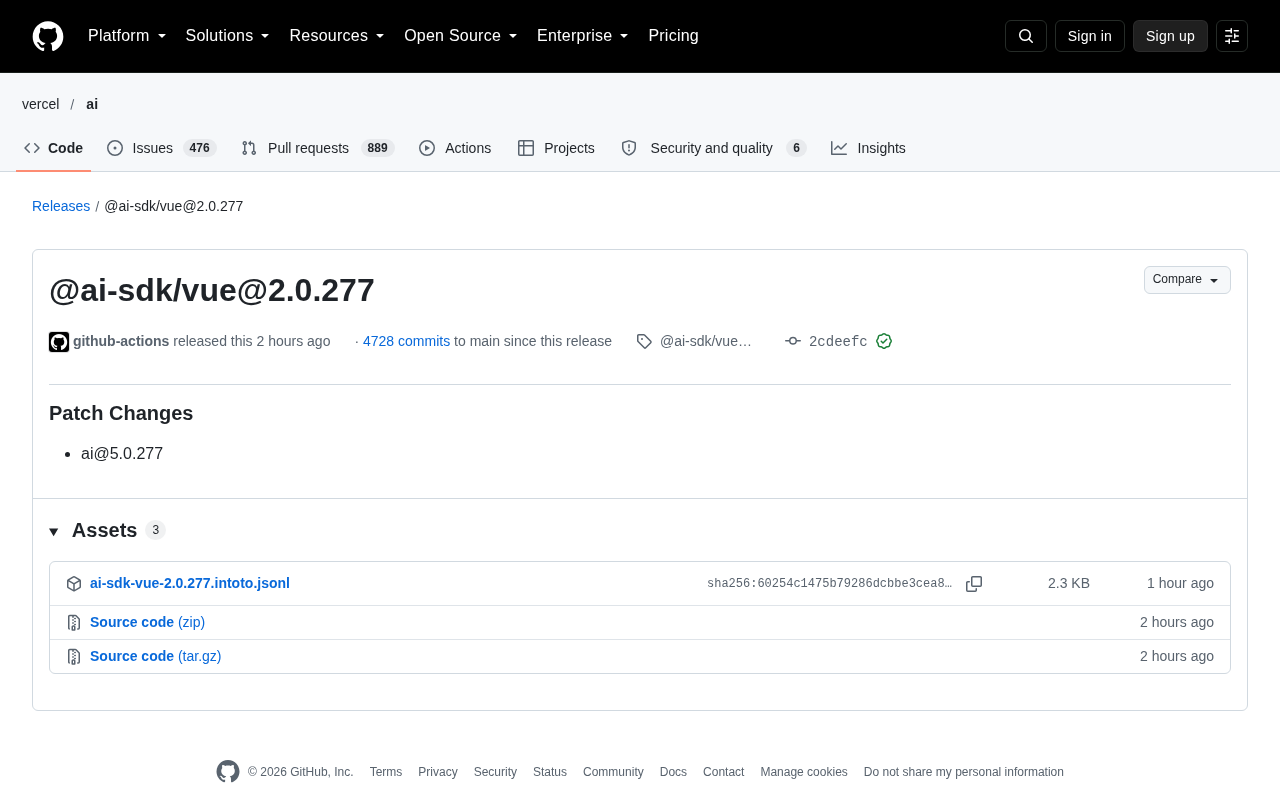
This version was released by a GitHub Actions automated workflow, with commit 2cdeefc carrying a GitHub-verified signature (GPG key ID: B5690EEEBB952194), indicating that the release pipeline is trustworthy and traceable. Based on the timestamp, the release was created on October 15 at 03:17, and the main branch has accumulated 4728 commits since the previous version.
What the Patch Changes Actually Contain
The changelog entries listed in the release notes are extremely concise, with only one item:
Patch Changes
- ai@5.0.277
This means that @ai-sdk/vue itself does not introduce new APIs or fix standalone functional issues, but rather follows the version progression of the upstream ai core package. This "upstream releases, downstream follows" pattern is common in SDK ecosystems—the Vue adapter layer is typically only responsible for binding the core package's capabilities to the framework's reactive system. So when the core package publishes a new patch, the adapter package also releases a version in sync, ensuring that both versions are aligned during dependency resolution.
AI SDK is an open-source tool library led by Vercel for integrating large language models into JavaScript/TypeScript applications. It provides a unified API abstraction that lets developers switch between different model providers such as OpenAI, Anthropic, and Google, while also offering built-in capabilities like streaming responses, Tool Calling, and structured output. Its architecture uses a layered design of "core package + framework adapter packages": the core package is named ai and carries all logic for interacting with models; framework adapter packages include @ai-sdk/vue, @ai-sdk/react, @ai-sdk/svelte, etc., which are responsible for connecting core capabilities to each framework's reactive system. A direct consequence of this design is version coupling—adapter packages typically depend on the core package with an exact version or a very narrow range in package.json, so when ai releases a new patch, the adapter package often releases a patch version as well, ensuring that the combination resolved by npm install is officially validated.
The Meaning Behind the Version Number
The version number 2.0.277 is worth noting. The third digit of the minor segment has already reached 277, indicating that this package is on a very high-frequency iteration cadence. For developers building Vue applications with the AI SDK, this usually means one thing: upgrading can be relatively safe, but be mindful of dependency locking.
Patch-level changes should be backward compatible under semantic versioning conventions and should not break existing APIs. However, high-frequency releases also bring a practical engineering issue—if the versions of @ai-sdk/vue and ai in a project are not aligned, type mismatches or runtime behavior differences may occur. This release explicitly binds both to the same version number (277), precisely to avoid this situation.
Semantic Versioning (SemVer) specifies that version numbers take the form MAJOR.MINOR.PATCH: the major version increments for incompatible changes, the minor version increments for backward-compatible feature additions, and the patch version increments for backward-compatible bug fixes. Under this convention, the patch increment from 2.0.277 should not break any existing APIs. But in practice, the patch number accumulating into the hundreds indicates that the release cadence is driven by automated pipelines, and every change to the upstream core package triggers a downstream adapter package version bump. For users, this has two implications: first, upgrade risk is low; second, the version number itself no longer reflects the actual importance of the changes—looking at 2.0.277 alone, you cannot tell what was actually fixed underneath, and you must trace back to the core package's changelog.
How Developers Should Handle It
For projects currently using @ai-sdk/vue, this update does not require any special migration work. Simply perform a routine dependency upgrade:
- Update to 2.0.277 using your package manager
- Confirm that the
aicore package is also synced to 5.0.277 - Run your existing tests to verify core paths such as streaming responses and tool calling
If your project has high requirements for version stability, you can also stay on the current version for now and upgrade later after several patches have accumulated. Changes to the Vue adapter layer usually do not affect underlying capabilities, so lagging by one or two minor versions generally will not cause you to miss critical fixes.
The Value of This Kind of Release Information
From a content perspective, this release information itself has limited informational value—it does not include a changelog explaining what specific bugs were fixed, nor does it link to related issues or PRs. For developers tracking the AI SDK ecosystem, the value of this kind of automated release lies more in version coordinates: knowing which version the ecosystem has advanced to, which helps locate problems when troubleshooting dependency conflicts.
If you need to understand what exactly changed in the core version 5.0.277, you still need to check the release notes for the ai package itself, because the Vue adapter package is merely following passively.
Dependency version alignment is a key engineering practice under this "upstream releases, downstream follows" pattern. In the JavaScript ecosystem, the same package may be installed in multiple copies due to different dependency trees (npm's flattened installation can mitigate this, but nested copies still occur when version ranges conflict). If the ai version depended on by @ai-sdk/vue in a project differs from the ai version explicitly installed in the project, two instances of the core package will appear, leading to hidden issues such as type mismatches, failed instanceof checks for Symbols/class instances, and inability to share reactive state. Common mitigation methods include: using npm ls ai to check for duplicate dependencies, pinning versions in the lockfile (package-lock.json/pnpm-lock.yaml), or simply keeping the adapter package and core package within the same minor version range.
One-line Summary
@ai-sdk/vue releases patch 2.0.277, with the core change being syncing the ai package to 5.0.277.
Paragraph Summary
@ai-sdk/vue has released version 2.0.277, a patch update marked as Patch Changes, with the only change being syncing the internal ai dependency to 5.0.277. The version was automatically released by GitHub Actions, and the commit carries a GPG-verified signature, making it traceable and trustworthy. The article notes that the Vue adapter package itself does not introduce new APIs and is only responsible for binding core package capabilities to Vue's reactive system, so it often releases in step with the upstream core package to maintain version alignment. In 2.0.277, the patch number has accumulated to 277, reflecting that the package is on a high-frequency iteration cadence. Developers can upgrade with confidence because patch-level changes are backward compatible, but they should confirm that the ai core package is synced to 5.0.277 and that paths such as streaming responses and tool calling pass tests. The release notes do not include specific fix details, so you need to check the ai package changelog for more information.
Related articles

Amphibious Transforming Drone: Beyond 100x Power Savings, What Are the Real Needs?
Is the amphibious transforming drone just a gimmick? Starting from the 100x power difference of the M4 Morphobot, explore real application scenarios and thesis topic ideas, analyzing boundary conditions where pure drones and pure ground robots both fail.

Warhound Raises $200 Million: Genetically Engineered "War Dogs" Paired with Anduril Gear
Warhound raises $200M, backed by Ben Lamm and Palmer Luckey, to genetically engineer dogs for military and law enforcement use and equip them with Anduril gear. This article analyzes its technology direction, funding logic, and ethical controversy.

Claude API Comes to Google Cloud: IAM Integration and SDK Access Guide
Anthropic hosts the full Claude API on Google Cloud with IAM-controlled permissions and unified billing. This guide covers the Vertex AI and Anthropic-hosted entry points, IAM role configuration, and SDK access.