AI SDK Vue 2.0.280 Released: Dependency Update and Ecosystem Impact
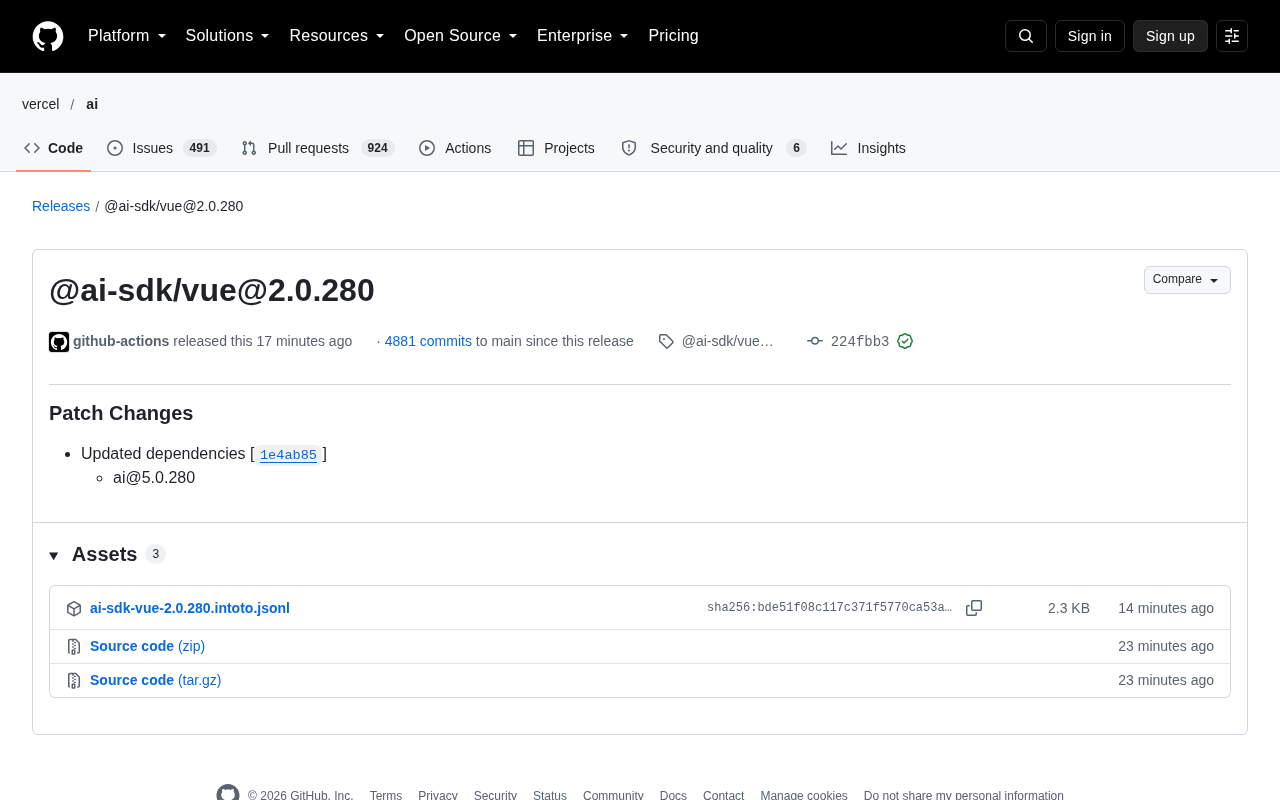
@ai-sdk/vue releases patch 2.0.280, syncing dependency ai@5.0.280—a low-risk upgrade.
@ai-sdk/vue has released version 2.0.280, an automatically generated patch update from GitHub Actions whose core action is syncing the dependency on the core package ai@5.0.280, with commit hash 224fbb3 and a verified signature. AI SDK uses a monorepo and maintains version linkage between the core package and framework adapters for Vue, React, Svelte, and others. Keeping versions aligned avoids type mismatches and runtime exceptions, while automated dependency updates lower maintenance costs. Upgrade risk is low, but running type checks and tests after upgrading is recommended.
Vercel's AI SDK family has been busy lately, with the Vue adapter package @ai-sdk/vue releasing version 2.0.280. On the surface this looks like a routine patch release, but it reflects AI SDK's continued investment in multi-framework support and its dependency management strategy.
Core Content of the Version Update
According to the release record on GitHub, @ai-sdk/vue@2.0.280 is a patch change (Patch Changes), and its main action is updating the dependency ai@5.0.280. The commit hash is 224fbb3, it was automatically published by GitHub Actions, and it carries a GitHub-verified signature.
This release came shortly after the previous version and is a typical dependency sync update. Under the monorepo management model, the AI SDK core package ai and the framework adapter packages (Vue, React, Svelte, etc.) maintain version linkage, ensuring developers get consistent underlying capabilities when using different frameworks.
Semantics of Patch Changes: According to semantic versioning conventions, a patch-level change indicates backward-compatible fixes and internal adjustments, with no new APIs or breaking changes. The changesets-style release record mentioned in the article (where GitHub Actions automatically generates version numbers, commits, and tags based on changesets) is a common practice in monorepo projects. It automates mechanical operations like "modifying dependencies," reducing human error and ensuring every release comes with a traceable commit hash and signature verification.
Why Dependency Sync Deserves Attention
For developers using @ai-sdk/vue, this kind of patch update usually does not introduce breaking changes, but the advancement of dependency versions often means the underlying ai package includes bug fixes or subtle behavior adjustments. As the bridge connecting large models with frontend frameworks, the AI SDK's core package ai handles key capabilities such as streaming response processing, tool calling, and structured output, while the Vue adapter layer wraps these capabilities into composable functions that fit Vue's reactivity system.
Keeping the adapter package and core package versions aligned avoids type errors or runtime exceptions caused by version mismatches. From an engineering practice perspective, this automated dependency update process lowers maintenance costs and allows downstream projects to receive upstream fixes faster.
Core Capabilities of AI SDK: The core package ai of the Vercel AI SDK provides a unified model invocation abstraction (adapting to different vendors such as OpenAI and Anthropic through providers), and includes built-in capabilities such as streaming responses, tool calling / function calling, and structured output (constraining model return formats based on schemas such as Zod). These capabilities are implemented in a framework-agnostic way. Each framework adapter package is only responsible for connecting the states and callbacks exposed by the core package to the corresponding framework's reactivity system and lifecycle. Therefore, every version advancement of the core package may affect behavioral consistency across all adapter layers.
Monorepo and Lockstep Versioning Strategy: AI SDK uses a monorepo to organize its code. The core package and framework adapter packages share the same repository and release pipeline, and are released in lockstep (synchronized version numbers)—the 2.0.280 in the adapter package version number matches the last segment of the core package ai@5.0.280, which is exactly a reflection of this strategy. The benefit is that any adapter package version can clearly correspond to a specific core package version, avoiding semantic version ranges (such as ^5.0.0) resolving to incompatible minor versions during installation, thereby reducing type definition drift and runtime behavior differences.
Practical Impact on Vue Ecosystem Developers
If you are using @ai-sdk/vue to build AI chat interfaces or intelligent applications, upgrading to 2.0.280 is a low-risk operation. After upgrading, it is recommended to run a full type check and existing test cases to confirm that features such as streaming rendering and tool calling work properly.
For Vue projects that have not yet adopted AI SDK, this version itself is not a reason to migrate, but it can be seen as an observation window: AI SDK's iteration cadence is stable, and the framework adapter layer continues to keep pace, showing that its commitment to multi-framework support is reliable.
Vue Composable Function Adapter Layer: @ai-sdk/vue wraps the core package's capabilities into composable APIs (such as useChat for conversation state management and useObject for structured generation), internally using Vue's ref/shallowRef and reactive dependency tracking to reflect incremental streaming content in component views in real time. Because these wrappers directly depend on the core package's message types and callback signatures, once the core package's type definitions are adjusted, the adapter layer must be upgraded in sync—this is the practical reason for recommending type checks after upgrading.
Conclusion
@ai-sdk/vue@2.0.280 is a standard patch release, with the core information being the synchronized update of the dependency ai@5.0.280. It has no flashy feature announcements, but it reflects the maturity of AI SDK in dependency management and multi-framework ecosystem maintenance. For production users, simply upgrade according to the normal process; for ecosystem observers, this kind of high-frequency small version update is itself a signal of project activity.
One-line Summary
@ai-sdk/vue releases patch version 2.0.280, syncing dependency ai@5.0.280—a low-risk upgrade.
Paragraph Summary
@ai-sdk/vue has released version 2.0.280, an automatically generated patch update from GitHub Actions whose core action is syncing the dependency on the core package ai@5.0.280, with commit hash 224fbb3 and a verified signature. The article notes that AI SDK is organized as a monorepo, with the core package and framework adapter packages for Vue, React, Svelte, and others maintaining version linkage. The adapter layer wraps core capabilities such as streaming responses, tool calling, and structured output into interfaces that fit each framework's reactivity system. Keeping versions aligned avoids type mismatches and runtime exceptions, and the automated dependency update process also lowers maintenance costs. For developers using this package, upgrade risk is low, and running type checks and tests after upgrading is recommended; for projects that have not adopted AI SDK, this update is more of a signal for observing project activity and multi-framework commitment.
Related articles

Amphibious Transforming Drone: Beyond 100x Power Savings, What Are the Real Needs?
Is the amphibious transforming drone just a gimmick? Starting from the 100x power difference of the M4 Morphobot, explore real application scenarios and thesis topic ideas, analyzing boundary conditions where pure drones and pure ground robots both fail.

Warhound Raises $200 Million: Genetically Engineered "War Dogs" Paired with Anduril Gear
Warhound raises $200M, backed by Ben Lamm and Palmer Luckey, to genetically engineer dogs for military and law enforcement use and equip them with Anduril gear. This article analyzes its technology direction, funding logic, and ethical controversy.

Claude API Comes to Google Cloud: IAM Integration and SDK Access Guide
Anthropic hosts the full Claude API on Google Cloud with IAM-controlled permissions and unified billing. This guide covers the Vertex AI and Anthropic-hosted entry points, IAM role configuration, and SDK access.