AI SDK Vue 3.0.310 Patch Released: ai@6.0.310 Updated in Sync

@ai-sdk/vue releases patch 3.0.310, syncing core package ai@6.0.310—routine maintenance.
Vercel's @ai-sdk/vue releases patch 3.0.310, synced with core package ai@6.0.310, with no breaking changes. Published automatically by GitHub Actions with GPG signature verification, the only change is the core package sync, indicating substantive changes are in the ai core package rather than the Vue binding layer. The article notes such patches mainly keep framework bindings aligned with the core package and avoid dependency mismatches; since release notes lack specific fixes, developers should check the core package's commit history or PRs. Upgrading is reasonable for mismatched versions; risk is low for stable projects, but a smoke test is recommended.
The AI SDK ecosystem has seen another version iteration. Vercel's @ai-sdk/vue has released version 3.0.310, keeping in sync with its core package ai@6.0.310. This update is a patch-level release with no breaking changes—more of a routine maintenance for stability and dependencies.
Release Overview
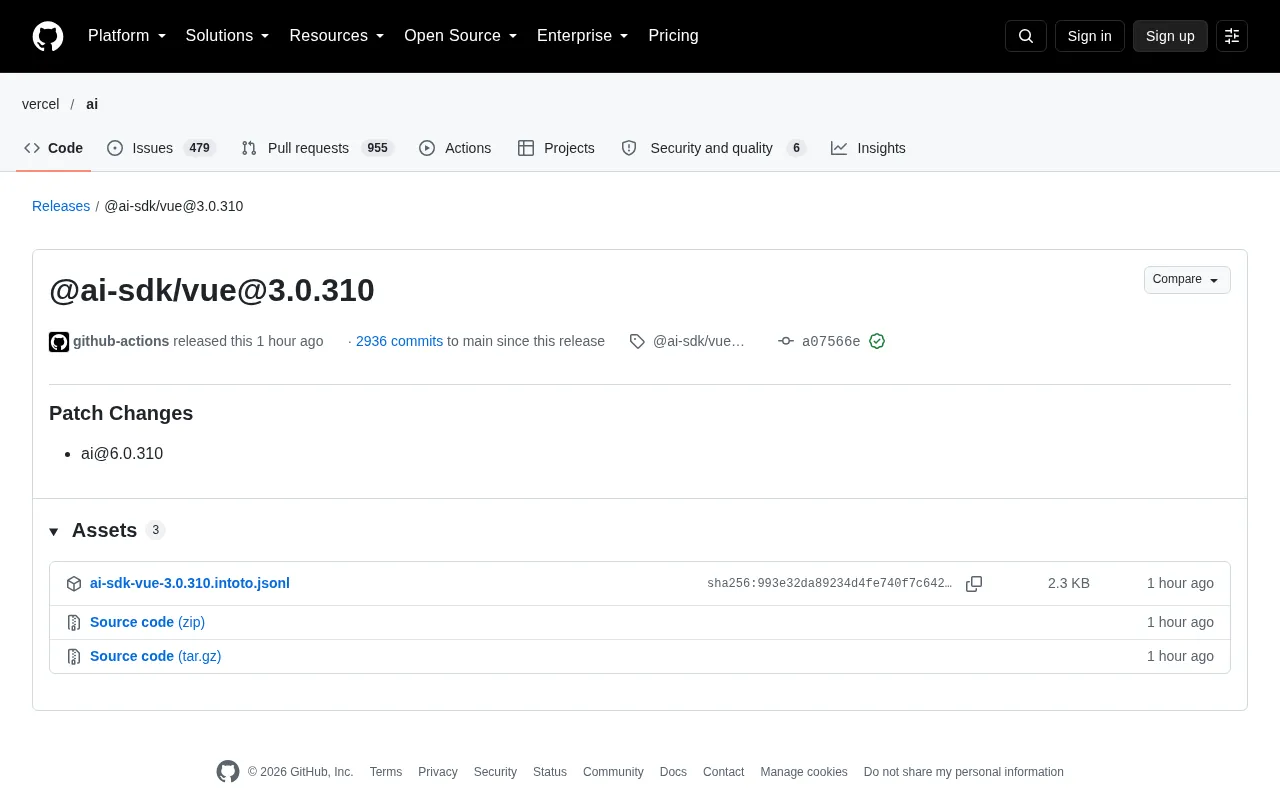
According to the GitHub Releases page, @ai-sdk/vue@3.0.310 was automatically published by the github-actions bot. The commit history shows that 2936 commits have been merged into the main branch since this version's release. The commit hash is a07566e, with a GitHub verified signature (GPG key ID: B5690EEEBB952194), indicating the release process complies with the project's security standards.
The Patch Changes section lists only one core change: synchronizing the update to ai@6.0.310. This means the Vue adapter layer mainly follows the main package's version number, and any substantive functional changes are likely concentrated in the ai core package rather than the Vue bindings themselves.
Vercel AI SDK and the ai Core Package: Vercel AI SDK is an open-source toolkit for integrating large language models into JavaScript/TypeScript applications. Its core package is named ai, providing unified streaming responses, tool calling, structured output, and more. For different frontend frameworks, the team also maintains adapter packages such as @ai-sdk/vue and @ai-sdk/react, which wrap the core package's capabilities into framework-idiomatic APIs (composables in Vue). Thus, the ai package carries the substantive logic, while framework binding packages typically serve as thin wrappers and advance their version numbers in sync with the core package—which is why this Vue package lists "sync update to ai@6.0.310" as its only change.
Semantic Versioning and Patch Level: A patch version (the third number in the version, e.g., 310 in 3.0.310) under semantic versioning indicates backward-compatible bug fixes and should not include breaking changes or new features. Consecutively large patch numbers often indicate a high release frequency. For dependents, patch upgrades are generally low-risk, but they may still imply dependency tree changes, so the article recommends running a smoke test after upgrading.
What a Patch Update Means
For developers building Vue applications with the AI SDK, patch versions like 3.0.310 typically don't bring API-level changes. Their value lies in two aspects: first, keeping the Vue bindings aligned with the core ai package version to avoid runtime issues caused by dependency mismatches; second, automated publishing through continuous integration ensures fixes reach users quickly.
From an engineering practice perspective, tying the Vue adapter layer's version number to the core package (3.0.310 corresponding to ai@6.0.310) is a strategy to reduce "version drift." When upgrading in package.json, developers can more easily determine compatibility boundaries.
Observations on the Ecosystem and Release Process
One detail of this release is worth noting: the version was automatically created and signed by GitHub Actions. This kind of automated release process is increasingly common in open-source projects—it reduces the probability of manual errors and makes the cadence of patch versions more predictable. For teams relying on the AI SDK, continuous minor version updates mean dependency upgrades are no longer a major undertaking.
However, the Release Notes for this version offer limited information, with no specific fix items or behavior change descriptions listed. If developers want to know whether a particular bug was fixed in 3.0.310, it's advisable to check the commit history of ai@6.0.310 or the corresponding PR records directly rather than relying solely on this release note.
Should You Upgrade
If you're using @ai-sdk/vue and your current version is out of sync with the core ai package, upgrading to 3.0.310 is a reasonable choice—it helps align your dependency tree. If your existing project runs stably with no known issues, the risk of a patch upgrade is low, but it's still recommended to run a smoke test after upgrading to confirm that the Vue composable API calls behave as expected.
Overall, this release continues the AI SDK project's "small steps, fast pace" iteration rhythm—no flashy new features, but maintaining ecosystem consistency. For Vue developers focused on AI application development, keeping up with such patch versions is a fundamental practice for managing dependency risk.
One-line Summary
@ai-sdk/vue releases patch 3.0.310, syncing core package ai@6.0.310—routine maintenance.
Paragraph Summary
Vercel's @ai-sdk/vue has released patch version 3.0.310, in sync with core package ai@6.0.310, with no breaking changes. This version was automatically published by GitHub Actions with GPG signature verification. The only change in the Release Notes is the core package sync, indicating that substantive changes are concentrated in the ai core package rather than the Vue binding layer. The article notes that the main value of such patches is keeping framework bindings aligned with the core package version, avoiding dependency mismatches, and using automated processes to deliver fixes quickly. Since the release notes don't list specific fixes, developers concerned about particular bugs should check the core package's commit history or PRs. For projects with version mismatches, upgrading is a reasonable choice; for stable projects, upgrade risk is low, but a smoke test is recommended.
Related articles

Chain of Thought Isn't Just for AI: How Humans Can Use CoT to Improve Thinking Quality
Chain of Thought isn't just a prompt trick for large models. Starting from a Hacker News discussion, this article analyzes why CoT works for human thinking too, breaks down actionable ways to transfer it, and highlights the key differences between human CoT and machine CoT.
Cloudflare Teams Up with OpenAI: Closi…
Cloudflare Teams Up with OpenAI: Closing the Loop from Vulnerability Discovery to Defense with AI
Cloudflare uses OpenAI Daybreak to investigate security vulnerabilities and generate reviewable remediation plans, while developers use Codex to boost coding efficiency and quality.

Orca Multi-Agent Orchestration in Practice: A Guide to Parallel Collaboration with Claude and Codex
Orca is Stable AI's free open-source agent workbench supporting 34 agents like Claude Code and Codex in parallel. Learn its Git worktree isolation, multi-model orchestration, and mobile management.