AI SDK Vue 3.0.333 Release Analysis: Dependency Upgrades and Ecosystem Alignment
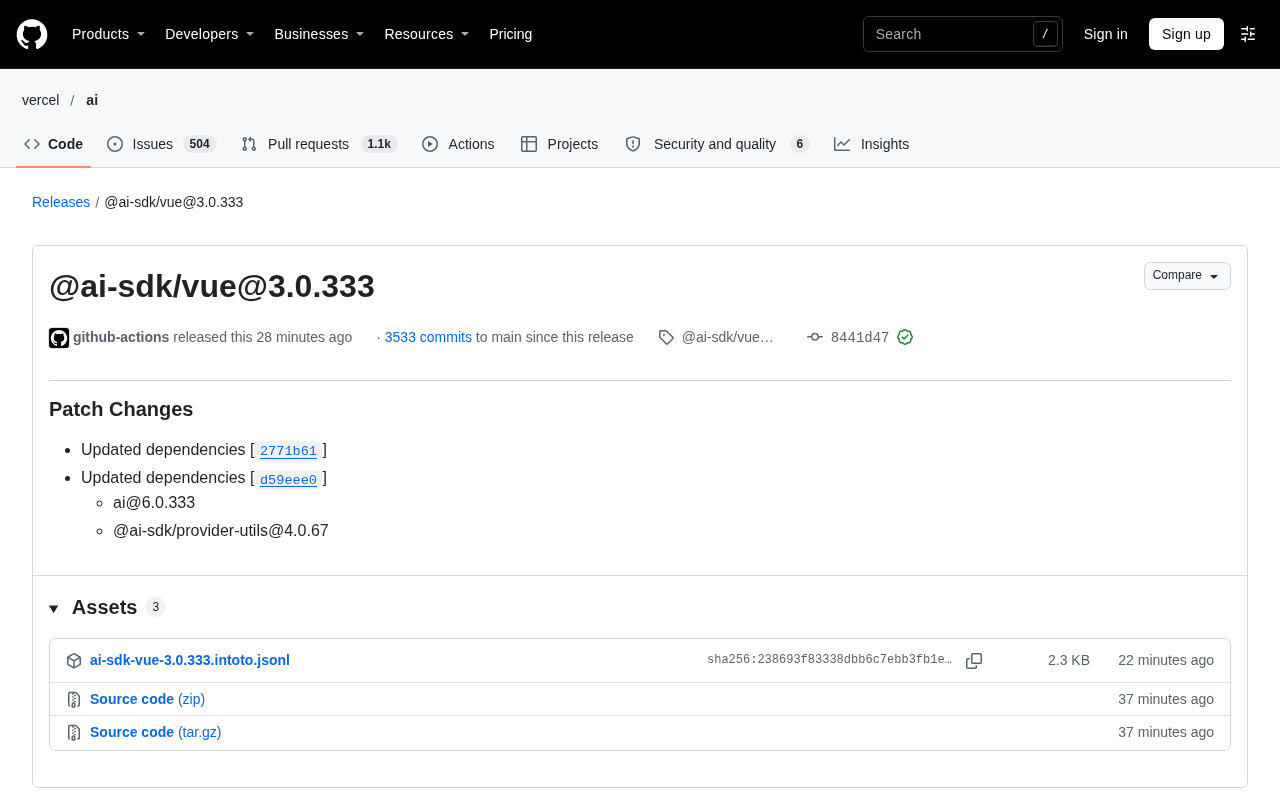
@ai-sdk/vue releases 3.0.333 patch, syncing core package and provider-utils upgrades.
Vercel's @ai-sdk/vue released version 3.0.333, with the core ai package synced to 6.0.333 and @ai-sdk/provider-utils to 4.0.67. This is a typical patch-level maintenance release with no new features or breaking changes, focused on dependency chain synchronization and internal fixes. The Vue adapter layer and core package share the same revision number for easier compatibility troubleshooting. The release was auto-triggered by github-actions, reflecting continuous delivery. The article recommends syncing ai and @ai-sdk/vue upgrades to avoid type conflicts or runtime differences from inconsistent provider-utils versions, and verifying streaming responses and tool calls after upgrading.
The AI SDK ecosystem has entered another round of iteration. Vercel's @ai-sdk/vue package has released version 3.0.333, with the core ai package updated to 6.0.333 and @ai-sdk/provider-utils bumped to 4.0.67. This is a typical patch-level release, focused on dependency chain synchronization and internal fixes.
Technical Details of the Version Update
According to the GitHub release record, @ai-sdk/vue@3.0.333 is a patch change involving two dependency updates: first, upgrading the ai core package to 6.0.333; second, upgrading @ai-sdk/provider-utils to 4.0.67. The corresponding commits are linked to different commit hashes, indicating this is a routine dependency sync under an automated release pipeline.
From a version number alignment perspective, the Vue adapter layer and the core package share the same revision number (333). This consistency strategy helps developers troubleshoot cross-package compatibility issues. When multiple packages share the same revision number, it usually means they were built in the same release pipeline, and the internal API contracts have been jointly validated.
Version alignment: Multiple packages sharing the same revision number (e.g., 333) is a common release strategy in monorepos. It typically means these packages are built and tagged together by a single release pipeline; package versions no longer evolve independently but are published as a unified snapshot. The benefit is that developers can infer the compatibility relationships of the entire package group from a single version number, reducing the troubleshooting cost of "combinatorial explosion"; the trade-off is that some packages may be version-bumped without actual changes, so release notes can only state "dependency updates." When reading such changelogs, a more effective approach is to trace back to the commit history of the upstream core package (ai) rather than just looking at the adapter layer entries.
The Ecosystem Strategy Behind the Patch Release
This update introduces no new features or breaking changes—it is a maintenance release. However, the frequent patch iterations reveal the AI SDK team's emphasis on dependency governance: provider-utils, as the shared layer for all model provider adapters, often involves fine-tuning request wrapping, error handling, or type definitions in its minor upgrades, which in turn affects all downstream framework adapter packages.
For developers using the Vue integration, such updates typically require no business code changes, but version drift in the dependency tree is worth monitoring. If your project pins both ai and @ai-sdk/vue versions, it is recommended to keep them upgraded in sync to avoid type conflicts or runtime behavior differences caused by inconsistent provider-utils versions.
Semantic versioning and patch numbers: The article repeatedly mentions "patch changes" and "patch-level releases," which stem from the Semantic Versioning specification (SemVer). In the version number MAJOR.MINOR.PATCH, an increment of the third position represents backward-compatible bug fixes without new features or breaking changes. Therefore, advancing a revision number like 3.0.333 → 3.0.333 is theoretically safe for existing callers. Note, however, that SemVer only constrains the public API contract. Internal shared layers like provider-utils may, even with a patch bump, change error message wording, retry strategies, or type definition details, indirectly affecting the behavior of downstream framework adapter packages. This is the fundamental reason the article recommends developers "keep multiple packages upgraded in sync"—a patch upgrade in the dependency chain does not equal zero risk.
What Developers Should Watch For
This release was automatically triggered by github-actions, with commits going directly to the main branch, reflecting continuous delivery engineering practices. The release notes list no specific feature changes or fix entries, only dependency updates, meaning the concrete changes must be traced back to the upstream package's commit history.
For Vue projects building AI chat interfaces, keeping SDK versions up to date helps obtain underlying fixes, but patch-level updates also require testing verification. After upgrading, it is recommended to focus on checking functional paths that interact closely with provider-utils, such as streaming responses and tool calls.
The position of provider-utils in the AI SDK architecture: @ai-sdk/provider-utils is not a direct entry point for business developers; it sits in the shared utility layer between the ai core package and various model providers (such as OpenAI and Anthropic adapters). It typically carries request parameter serialization, streaming response parsing and chunking, error object wrapping, retry and timeout logic, and TypeScript types shared across providers. Understanding this helps assess the impact scope of a patch upgrade: when this package changes, the most noticeably affected path is "communication with models," not the UI rendering layer. Thus the verification priorities suggested in the article—streaming responses and tool calls—fall exactly on this layer, closely matching the responsibilities of provider-utils.
Conclusion
@ai-sdk/vue@3.0.333 is a standardized minor maintenance release, whose core value lies in dependency chain synchronization and ecosystem consistency. The AI SDK iterates rapidly, so developers should establish version tracking mechanisms to enjoy fast fixes while controlling upgrade risk.
One-line Summary
@ai-sdk/vue releases 3.0.333 patch, syncing core package and provider-utils upgrades.
Paragraph Summary
Vercel's @ai-sdk/vue has released version 3.0.333, with the core ai package synced to 6.0.333 and @ai-sdk/provider-utils to 4.0.67. This is a typical patch-level maintenance release with no new features or breaking changes, focused on dependency chain synchronization and internal fixes. The Vue adapter layer and core package share the same revision number, making it easier for developers to troubleshoot cross-package compatibility. The release was automatically triggered by github-actions, reflecting continuous delivery practices. The article recommends keeping ai and @ai-sdk/vue versions upgraded in sync to avoid type conflicts or runtime differences caused by inconsistent provider-utils versions, and verifying functional paths that interact closely with provider-utils after upgrading, such as streaming responses and tool calls.
Related articles

Watching Movies in the Terminal: Building an SSH Streaming Service with Codex Multi-Agent Workflow
A creator uses Codex multi-agent workflow to build an SSH-accessible streaming service in the terminal, with planning, cloud async dev, AI-drawn scenes, and synced live channels.

AI Face Licensing: A New Micro-Drama Trend or a Hollywood Trap?
Actors are licensing their faces to micro-drama startups for AI digital doubles to perform. Popular in China, the model raises concerns in Hollywood over lost control and diluted bargaining power.

Amazon's First Digital Photo Frame Is 50% Off for Black Friday: Is the Alexa Frame Worth Buying?
Amazon's first digital photo frame, the Alexa Photo Frame, is nearly 50% off for Black Friday, with prices starting at $114. We analyze why this new product dropped in price just one month after launch, its positioning, who it's for, and buying advice.