AI SDK Vue 4.0.144 Release: Dependency Upgrades and Ecosystem Alignment

AI SDK Vue package releases 4.0.144 patch with no new features, only synchronized core dependency upgrades.
This article covers the release of @ai-sdk/vue@4.0.144. It is a Patch Change type with no new APIs or features; the core action is upgrading the `ai` package to 7.0.144 and `@ai-sdk/provider-utils` to 5.0.63. The Vue package is a lightweight wrapper providing composables like useChat and useCompletion; its patch updates typically don't change its own code but indirectly receive underlying fixes through dependency upgrades. The release shows GitHub Actions automated publishing and GPG signature verification, reflecting mature CI/CD and supply chain security practices. For Vue developers, this is a low-cost upgrade with no breaking changes; run existing tests after upgrading, focusing on streaming chat and tool calling, and confirm version compatibility.
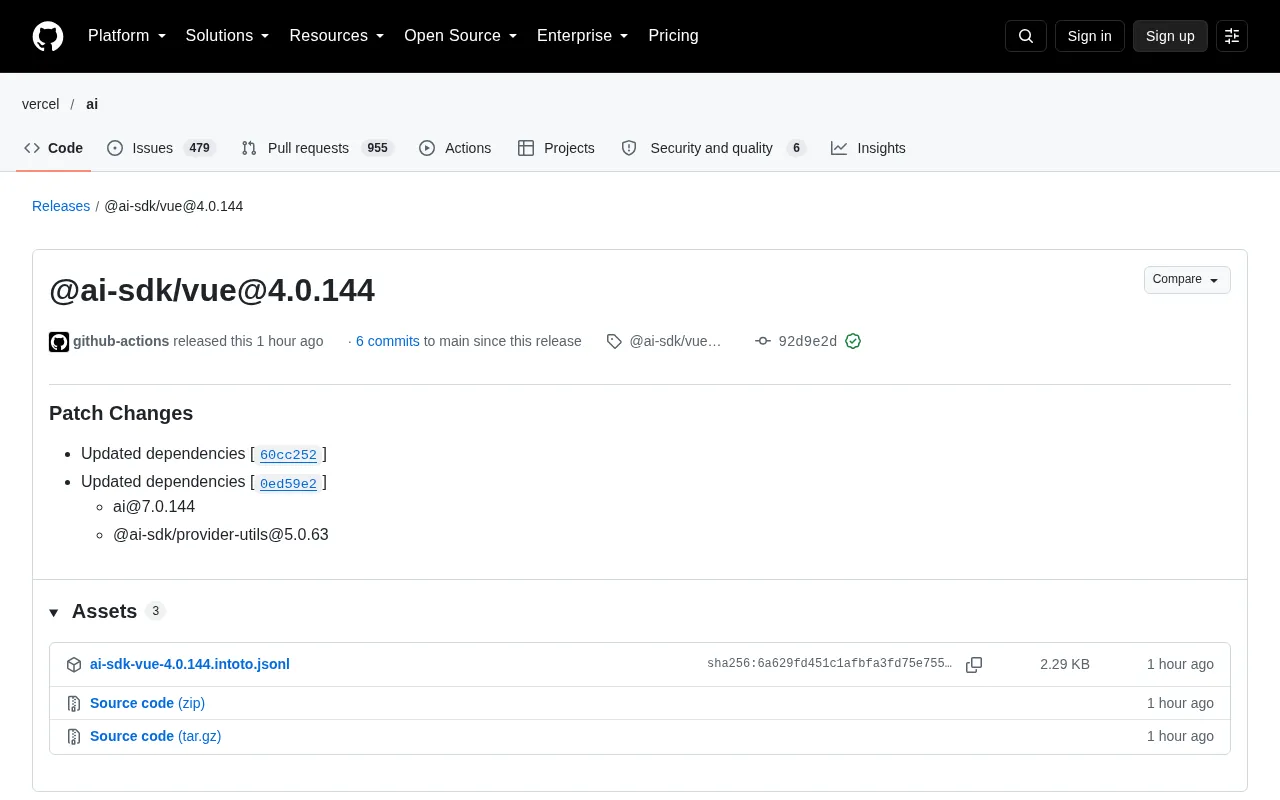
The Vue package of AI SDK has released patch version 4.0.144. According to the GitHub release notes, this update introduces no new APIs or features; the core action is synchronizing underlying dependencies to ensure version consistency between the Vue layer, the core SDK, and the utility library. For frontend developers building Vue applications with AI SDK, this is a routine but noteworthy maintenance release.
Core Content of the Update
According to the release notes, @ai-sdk/vue@4.0.144 is classified as a Patch Change and includes two dependency updates: upgrading the ai package to 7.0.144 and @ai-sdk/provider-utils to 5.0.63. The two dependencies correspond to commits 60cc252 and 0ed59e2, respectively. This version alignment (Vue package 4.0.144 corresponding to ai package 7.0.144) indicates that AI SDK adopts a cross-package synchronized release strategy with matching patch numbers, making it easier for developers to track compatible combinations.
What the Dependency Upgrades Mean
ai is the core package of AI SDK, providing foundational capabilities such as model invocation, streaming responses, and tool calling; @ai-sdk/provider-utils is the shared utility set for the provider adapter layer, handling request construction, response parsing, and other low-level logic. The Vue package itself is a lightweight wrapper that mainly provides composables such as useChat and useCompletion. Its patch updates typically do not change its own code but instead indirectly receive underlying fixes through dependency upgrades. Therefore, the actual impact of this update depends on which fixes are included in ai@7.0.144 and provider-utils@5.0.63, and these details require consulting the changelogs of the corresponding packages.
useChat and useCompletion are the two core composables provided by the AI SDK Vue package. useChat targets multi-turn conversation scenarios, internally maintaining the message list, loading state, and error state, merging incremental streamed text into the message array in real time, and exposing operations such as append, reload, and stop; useCompletion targets single-shot text completion scenarios, maintaining only one input and output string, suitable for lightweight use cases such as writing assistance and summary generation. Both are implemented based on Vue's reactivity system (ref/computed) and lifecycle hooks, automatically aborting in-flight requests when the component unmounts. Understanding this helps clarify that patches to the Vue package itself typically do not touch the signatures of these two functions; behavioral changes mostly come from adjustments in the core package to streaming parsing, request retries, or error formats.
Signals of a Standardized Release Process
The release notes show GitHub Actions automated publishing, GPG signature verification (key ID B5690EEEBB952194), and 6 commits merged into the main branch. This indicates that the AI SDK project employs a relatively mature CI/CD process, with each release going through signing and automated builds, providing basic supply chain security guarantees. For enterprise-level project selection, this kind of engineering discipline is a plus.
GPG signature verification in open-source releases is used to prove that a given Git tag or commit was indeed produced by a maintainer holding the corresponding private key. The key ID appearing in the release notes (B5690EEEBB952194) is the short identifier of the signing public key; anyone can use the maintainer's public key to verify that the commit pointed to by the tag has not been tampered with. Combined with GitHub Actions automated publishing, a common practice is for CI to automatically build and push to npm after tagging, while also signing the tag, thereby binding "who released what" to verifiable cryptographic evidence. For consumers, this means npm provenance or signature verification can be enabled to confirm the correspondence between downloaded packages and the source repository, reducing the risk of dependency hijacking or poisoning. This is also one of the important criteria for enterprises evaluating the supply chain security of third-party SDKs.
Practical Impact on Vue Developers
From a usage perspective, 4.0.144 is a patch version with no breaking changes, so the upgrade cost is very low. If the project has pinned the version of the ai package, confirm that the version combination of the core package and the Vue package matches after upgrading. AI SDK's cross-package version alignment mechanism reduces this risk, but it is still recommended to run existing tests after upgrading, focusing on streaming chat and tool-calling logic.
Upgrade Recommendations
For new projects, simply install the latest version; for existing projects, follow the standard patch upgrade process with no special migration work required. If the project has high requirements for version stability, you can wait for the version to run in the community for a period before following up. Since the release notes list no feature changes, this update is best viewed as routine maintenance to keep dependencies healthy.
AI SDK's cross-package version alignment is not accidental but achieved through a fixed-version strategy within the monorepo: the core package, provider packages, and framework adapter packages are bumped together in the same release pipeline with matching patch numbers, avoiding implicit mismatches such as "the Vue package requires ai@7.0.144 while the project has 7.0.140 installed." During actual upgrades, you can use npm ls ai @ai-sdk/provider-utils to check whether multiple copies exist in the dependency tree—duplicate installations often lead to type inconsistencies or failed instanceof checks. If using pnpm, you can enforce version unification through the overrides field; if using npm, use overrides or simply delete the lockfile and reinstall. After upgrading, focus on regression testing chunked rendering of streaming responses and parameter parsing for tool calls, as these two areas are most sensitive to underlying changes in provider-utils.
Summary
@ai-sdk/vue@4.0.144 is a typical dependency-synchronization patch release with no new features but maintaining version consistency across AI SDK packages. It reflects the project's automated, signed release process and is suitable for developers concerned with the stability of frontend AI integration to keep following.
One-line Summary
AI SDK Vue package releases 4.0.144 patch with no new features, only synchronized core dependency upgrades.
Paragraph Summary
This article introduces the release of @ai-sdk/vue@4.0.144. This version is a Patch Change type, introducing no new APIs or features; the core action is upgrading the ai package to 7.0.144 and @ai-sdk/provider-utils to 5.0.63. The article notes that the Vue package itself is a lightweight wrapper providing composables such as useChat and useCompletion, and its patch updates typically do not change its own code but instead indirectly receive underlying fixes through dependency upgrades, with actual impact depending on the changes in the core package. The release notes show the project uses GitHub Actions automated publishing and GPG signature verification, reflecting relatively mature CI/CD and supply chain security practices. For Vue developers, this is a low-cost upgrade with no breaking changes; it is recommended to run existing tests after upgrading, focusing on streaming chat and tool-calling logic, and to confirm that the version combination of the core package and the Vue package matches.
Related articles

Amphibious Transforming Drone: Beyond 100x Power Savings, What Are the Real Needs?
Is the amphibious transforming drone just a gimmick? Starting from the 100x power difference of the M4 Morphobot, explore real application scenarios and thesis topic ideas, analyzing boundary conditions where pure drones and pure ground robots both fail.

Warhound Raises $200 Million: Genetically Engineered "War Dogs" Paired with Anduril Gear
Warhound raises $200M, backed by Ben Lamm and Palmer Luckey, to genetically engineer dogs for military and law enforcement use and equip them with Anduril gear. This article analyzes its technology direction, funding logic, and ethical controversy.

Claude API Comes to Google Cloud: IAM Integration and SDK Access Guide
Anthropic hosts the full Claude API on Google Cloud with IAM-controlled permissions and unified billing. This guide covers the Vertex AI and Anthropic-hosted entry points, IAM role configuration, and SDK access.