@ai-sdk/vue 4.0.146 Patch Release: Dependency Chain Update

@ai-sdk/vue 4.0.146 is a dependency-only patch aligning ai 7.0.146 and provider-utils 5.0.64.
This article analyzes the patch release of @ai-sdk/vue@4.0.146, which contains only four "Updated dependencies" entries with no feature changes or bug fixes, auto-submitted by the github-actions bot with a signature. It notes this is routine coupling in the AI SDK's multi-package monorepo: after the core package ai and the utility library @ai-sdk/provider-utils release, the Vue adapter layer must synchronously lock dependencies. The aligned versions this time are ai@7.0.146 and @ai-sdk/provider-utils@5.0.64. For consumers, the article recommends deciding whether to upgrade based on the project's version-locking strategy, and reminds that overrides/resolutions must be updated in sync to avoid locked versions overriding the dependency update.
Vercel's AI SDK family has rolled out another version iteration. @ai-sdk/vue@4.0.146 has been released as a patch version, with its core changes centered on dependency synchronization—which in itself reveals the maintenance rhythm of the AI SDK's multi-package architecture.
A Release That "Looks Like It Has No Content"
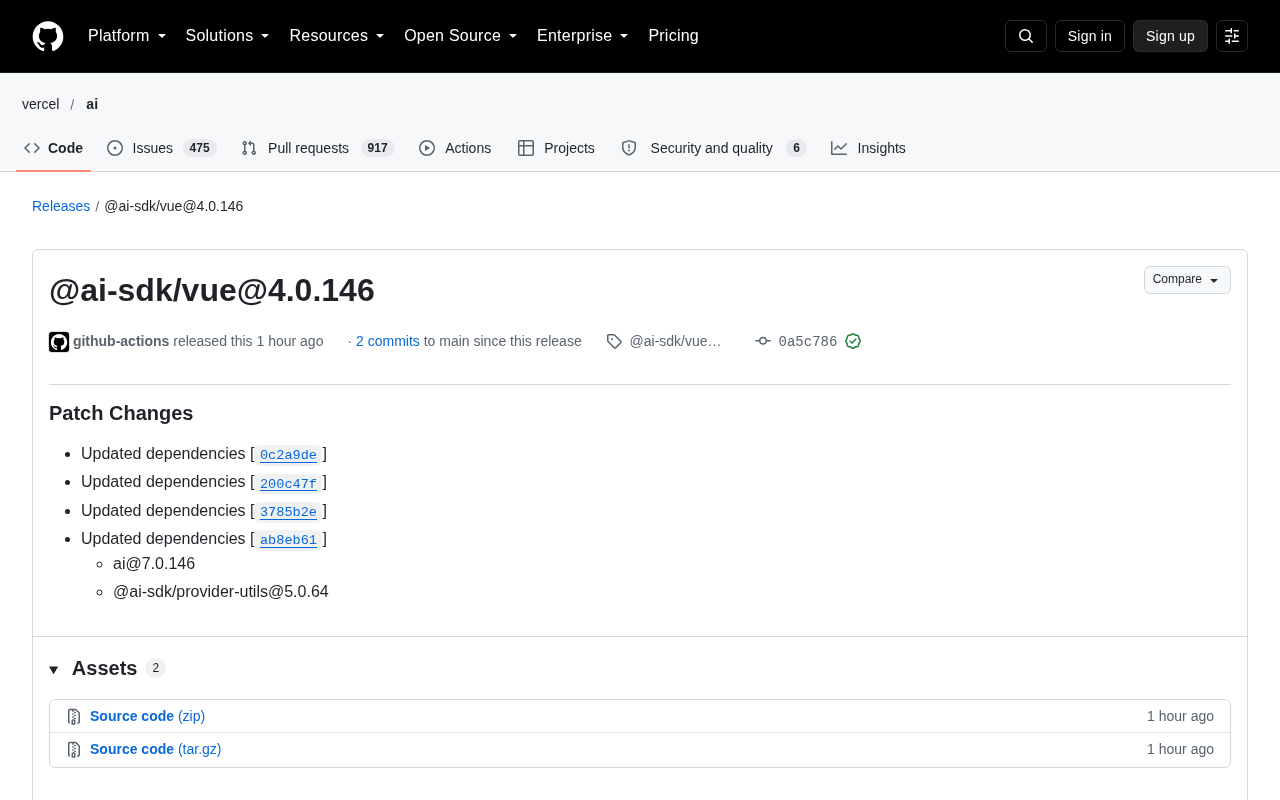
Looking at the GitHub Release page, the changelog for @ai-sdk/vue@4.0.146 contains only four "Updated dependencies" entries, with no description of new features, bug fixes, or API adjustments. The corresponding commit 0a5c786 was automatically submitted by the github-actions bot and carries a GitHub verified signature.
Releases like this are common in monorepo projects: once an upstream package ships a release, downstream adapter layers need to synchronously lock in the new dependency versions. The four dependency commits involved this time (0c2a9de, 200c47f, 3785b2e, ab8eb61) were not detailed in the release notes.
The Role of the Vue Adapter Layer in the AI SDK
The AI SDK's package structure is split by framework: ai is the core package, responsible for the unified model invocation interface, streaming response handling, and tool-calling abstraction; @ai-sdk/provider-utils is the shared utility library for the provider layer. @ai-sdk/vue sits on top, wrapping the core capabilities into Vue composables so that Vue developers can integrate large models directly through APIs like useChat and useCompletion.
The benefit of this layering is that core logic is written only once, while each framework adapter layer stays thin and light. The cost is frequent version coupling—any patch to the core package or utility library triggers a re-release of the adapter layer. This 4.0.146 release is a product of that coupling mechanism.
Composable is the core code reuse mechanism introduced in Vue 3. Through the setup() function or <script setup> syntax, developers can encapsulate stateful logic into reusable functions. Compared with Vue 2's mixin, composables avoid naming conflicts, explicitly pass reactive dependencies, and offer friendlier type inference. The useChat and useCompletion provided by @ai-sdk/vue are typical composables: they internally manage reactive state such as message lists, loading states, and error handling, and return ref objects for direct binding in templates. This design means Vue developers don't need to manually maintain the stitching logic for streaming responses—they simply call the function and destructure the return value to integrate large-model conversation capabilities.
Streaming response handling refers to the mechanism where the server pushes content token by token as it is generated, and the client renders as it receives. In AI applications, streaming responses can significantly reduce time-to-first-token and improve the interaction experience. The ai core package abstracts this, while the adapter layer is responsible for converting stream data into framework-friendly reactive updates. The Vue adapter layer automatically triggers view re-renders through the refs exposed by the composables.
Signals Revealed by the Dependency Versions
The release notes explicitly list the two key versions after synchronization: ai@7.0.146 and @ai-sdk/provider-utils@5.0.64. In other words, the @ai-sdk/vue 4.x series is currently aligned with AI SDK core 7.x.
For consumers, this is the basis for troubleshooting version conflicts. If you encounter behavior inconsistencies between the ai package and @ai-sdk/vue in a Vue project, first check whether the versions of the two satisfy this alignment relationship—this is often more effective than line-by-line debugging.
Semantic Versioning (SemVer) is key to understanding this version number. SemVer specifies the format major.minor.patch, where an increment in the patch number indicates a backward-compatible bug fix. @ai-sdk/vue 4.0.146 is a patch version, which by convention should not contain breaking changes—this is also the basis for the article's judgment that "upgrade risk is usually low." Note, however, that in a monorepo, multiple packages evolve their version numbers independently: @ai-sdk/vue 4.x and ai 7.x are not on the same major version line. The alignment relationship should be determined by the dependency versions explicitly listed in the release notes, not by simply comparing major version numbers.
Type mismatch is a common consequence of dependency version misalignment. In TypeScript projects, if the ai package and the ai version locked by @ai-sdk/vue are inconsistent, the same type may be resolved as two different declarations, causing "type is not assignable" compilation errors. Keeping versions aligned ensures type declarations come from the same source, avoiding such issues.
When to Follow Up with an Upgrade
For a patch version that is purely a dependency sync, upgrade risk is usually low—but it's not something to blindly adopt either:
- If the project has locked the
@ai-sdk/vueversion and is running stably, there is no compelling reason to upgrade; - If the project also directly depends on
aior@ai-sdk/provider-utils, keeping versions aligned avoids duplicate installations and type mismatches; - If you use pnpm/npm's overrides or resolutions fields, remember to update them as well; otherwise, the locked version may override this dependency update.
Engineering Practices Behind Automated Releases
This release was completed automatically by github-actions with a GPG signature, indicating that the AI SDK team uses an automated release process like changesets: dependency changes automatically generate patch records, automatically tag, and automatically publish. For open-source projects, this pipeline reduces the manual cost of releasing and makes version history more traceable.
Developers can glean limited information from the release notes, but combined with the monorepo's dependency graph, they can still determine the actual scope of impact of this update: the adapter layer follows the core package, the functional surface is unchanged, and whether to upgrade depends on the project's own version management strategy.
Related articles

Random Pruning of the DPO Computation Graph: 1.4x Training Speedup and Lower Peak Memory
DPO training too slow and memory-hungry? This paper proposes a random pruning framework for the DPO computation graph, sampling independently across position, sequence, and branch dimensions; branch pruning achieves a 1.426x step-time speedup and cuts training time by about 30%, with in-depth attribution of memory and time gains.

Why Does JEPA Underperform MLM in Longitudinal EHR Representation Learning?
New study compares JEPA and MLM for longitudinal EHR representation learning on MIMIC-IV: three JEPA variants train stably without collapse but underperform MLM; target size, not heterogeneity, drives prediction error.

Transfer Learning + Visible Light Communication: A New Approach to Energy-Efficient Indoor Positioning
A study proposes a transfer learning-based visible light communication indoor positioning method, achieving 47% accuracy improvement on the BOSCH factory dataset, 67.5% model efficiency under high noise, and introducing the ME composite metric for energy-efficient positioning in energy-constrained industrial IoT scenarios.