@ai-sdk/vue 4.0.154 Patch Released: Dependency Sync Upgrade
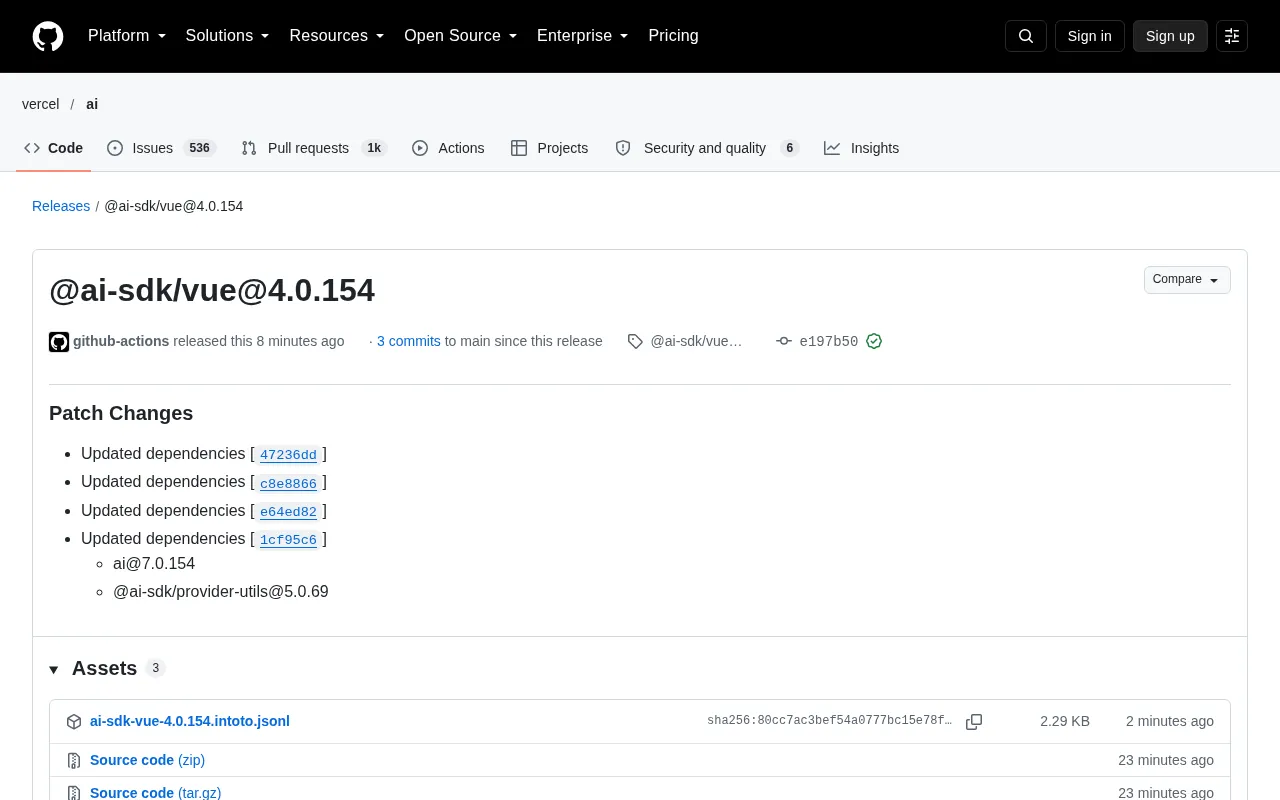
@ai-sdk/vue releases patch 4.0.154, syncing dependency versions only, with no feature changes.
@ai-sdk/vue in Vercel's AI SDK ecosystem released patch 4.0.154, a purely maintenance-oriented update that syncs the Vue adapter layer to the same version line as ai@7.0.154 and @ai-sdk/provider-utils@5.0.69, with no new APIs or bug fixes. The article explains why version alignment matters across the multi-package architecture and recommends verifying in development before production.
Vercel's AI SDK ecosystem has undergone another routine iteration. @ai-sdk/vue has released patch version 4.0.154, with the core changes centered on synchronized dependency updates rather than new features. For developers using Vue to integrate AI capabilities, this is a maintenance update worth noting.
Patch Content: A Pure Dependency Alignment
According to the release record on GitHub, @ai-sdk/vue@4.0.154 is marked as Patch Changes, backed by four dependency update commits (47236dd, c8e8866, e64ed82, 1cf95c6). The affected packages listed in the release notes include ai@7.0.154 and @ai-sdk/provider-utils@5.0.69.
In other words, this version itself introduces no new APIs or fixes for specific bugs; its significance lies in bringing the Vue adapter layer onto the same version line as the AI SDK core package and the provider utilities package. This kind of "follow-along" release is common in monorepo-managed SDK projects, aimed at preventing downstream projects from encountering type mismatches or runtime exceptions due to version misalignment.
This commit carries a GitHub verified signature and was automatically published by github-actions, indicating that the entire release pipeline is functioning normally.
Semantic Versioning and Patch Changes
Under Semantic Versioning (SemVer) conventions, version numbers follow the form major.minor.patch: major version changes represent breaking changes, minor versions represent backward-compatible new features, and patch numbers are only for backward-compatible bug fixes. Release tools like Changesets automatically determine the change level based on commit content and annotate Patch Changes in the CHANGELOG. The 4.0.154 in this article is at the patch level, theoretically containing no API changes, thus carrying the lowest upgrade risk. It's worth noting that under a monorepo's fixed versioning strategy, the patch number may also increment solely due to internal dependency pointer updates, and does not necessarily correspond to a code fix.
The Role of provider-utils
@ai-sdk/provider-utils is the shared toolbox for model provider adapters, encapsulating common logic such as request construction, streaming response parsing (e.g., SSE parsing), error mapping, and schema validation. Each provider package (such as the OpenAI and Anthropic adapters) depends on it, so its version changes propagate along the dependency chain to the ai core package, and then to framework adapter layers like @ai-sdk/vue, forming a bottom-up cascading update.
Why Dependency Alignment Matters
The AI SDK employs a multi-package collaborative architecture: the core ai package handles model invocation and streaming, @ai-sdk/provider-utils handles common logic for various model providers, and @ai-sdk/vue wraps the capabilities of the former two into Vue composables for direct frontend use. The versions of all three must remain coordinated, otherwise interface signature inconsistencies can easily arise.
For teams building AI chat interfaces with Vue, the practical benefit of upgrading to 4.0.154 is obtaining behavioral consistency with ai@7.0.154. If a project simultaneously locks in an older core package version, mixing versions across packages may lead to hard-to-diagnose errors, so it's recommended to check the versions of ai and provider-utils in sync when upgrading.
Monorepo and Fixed Versioning Strategy
The AI SDK is a typical monorepo (a single repository managing multiple npm packages) project, usually managed and released via pnpm workspace or Turborepo. Such repositories often adopt a "fixed versioning" strategy: all sub-packages share the same version number and increment together upon release. Therefore, the version number of @ai-sdk/vue always stays consistent with ai and @ai-sdk/provider-utils, with patch numbers jumping in sync. The benefit of this strategy is that downstream developers only need to remember one version number rather than comparing compatibility matrices package by package; the cost is that any small change in any sub-package triggers a full release, producing a large number of patch versions that "seem like nothing happened" — 4.0.154 as mentioned in this article falls into this category.
Vue Composables and the Adapter Layer
The core output of @ai-sdk/vue is the composable, such as useChat which encapsulates streaming chat state. Internally it depends on the core ai package's streaming protocol and message serialization format, and then pushes incremental tokens to components through Vue's reactivity system (ref, computed). Since this wrapper layer directly calls the core package's internal interfaces, once the core package's signatures or return structures change without the adapter layer syncing, type mismatches or even runtime exceptions can occur — this is precisely the technical reason why dependencies must be strictly aligned.
Upgrade Recommendations and Caveats
Patch versions are generally considered low-risk updates, but it's still advisable to follow standard procedures: first verify in a development environment that composable calls work correctly, then push to production. Since there are no breaking change notes for this release, the upgrade cost is low.
It's worth noting that some resource loading errors appeared on the release page, and version comparisons and some asset information could not be fully displayed. If you need to confirm specific diff details, you can directly consult the corresponding commit records.
Summary
@ai-sdk/vue@4.0.154 is a typical maintenance patch whose value lies not in new features but in maintaining version synchronization between the Vue adapter layer and the AI SDK core ecosystem. For production projects pursuing stability, this kind of fast, small-step update cadence actually reduces long-term maintenance complexity.
One-line Summary
@ai-sdk/vue releases patch 4.0.154, syncing dependency versions only, with no feature changes.
Paragraph Summary
@ai-sdk/vue in Vercel's AI SDK ecosystem has released patch version 4.0.154. This update is a purely maintenance-oriented iteration, with the core change being dependency synchronization that brings the Vue adapter layer onto the same version line as ai@7.0.154 and @ai-sdk/provider-utils@5.0.69, introducing no new APIs or fixing specific bugs. The article explains the necessity of version alignment under the multi-package collaborative architecture: the core package handles model invocation and streaming, provider-utils handles provider common logic, and the Vue package wraps them into composables; version misalignment among the three leads to inconsistent interface signatures and hard-to-diagnose errors. The version was automatically published by GitHub Actions with a verified signature, indicating a normal process. The article recommends checking the core package version in sync when upgrading, following standard procedures of verifying in a development environment before pushing to production, and notes that if some resources on the release page fail to load, you can consult commit records to confirm details.
Related articles

Vibe Coding Full-Stack in Practice: AI Programming from Beginner to Enterprise Deployment
From Cursor to Claude Code, this Bilibili AI programming course uses four progressive projects to cover full-stack development, open-source secondary development, and team collaboration. The article analyzes the shock to frontend roles, the efficiency shift from 50 people to 5, and the methodology required for enterprise-grade projects.

David Blaine's Global Quest for Real Magic: From South Africa to Japan and India
David Blaine travels to South Africa, Japan, and India in his Do Not Attempt special, documenting Spinning drivers, black mamba rescuers, iaijutsu masters, and ascetics—exploring the boundary between magic and real human极限 challenges.

Is a Touchscreen MacBook Coming? Vergecast Reveals Apple Executive's Response
Vergecast podcast reveals a conversation between a reporter and Apple executive John Ternus about a touchscreen MacBook and Apple Pencil support. Ternus says iPad is the best device for a stylus, while the reporter bets MacBook will eventually support Apple Pencil.