AI SDK Vue 4.0.160 Released: A Patch Update and Dependency Upgrade

@ai-sdk/vue 4.0.160 is a patch release updating only dependencies, with no new features.
Vercel AI SDK team released @ai-sdk/vue 4.0.160, a typical patch update that only bumps the ai dependency to 7.0.160. This package is the Vue adapter layer for AI SDK, providing Composition API wrappers without implementing model invocation logic. Thus, the update's value comes mainly from fixes in the core ai package, not new adapter features. For Vue developers, upgrade cost is minimal—just adjust the locked version—but watch for transitive dependency conflicts. This high-frequency patching reflects AI SDK's rapid iteration and per-framework maintenance strategy.
A Seemingly Routine Dependency Update
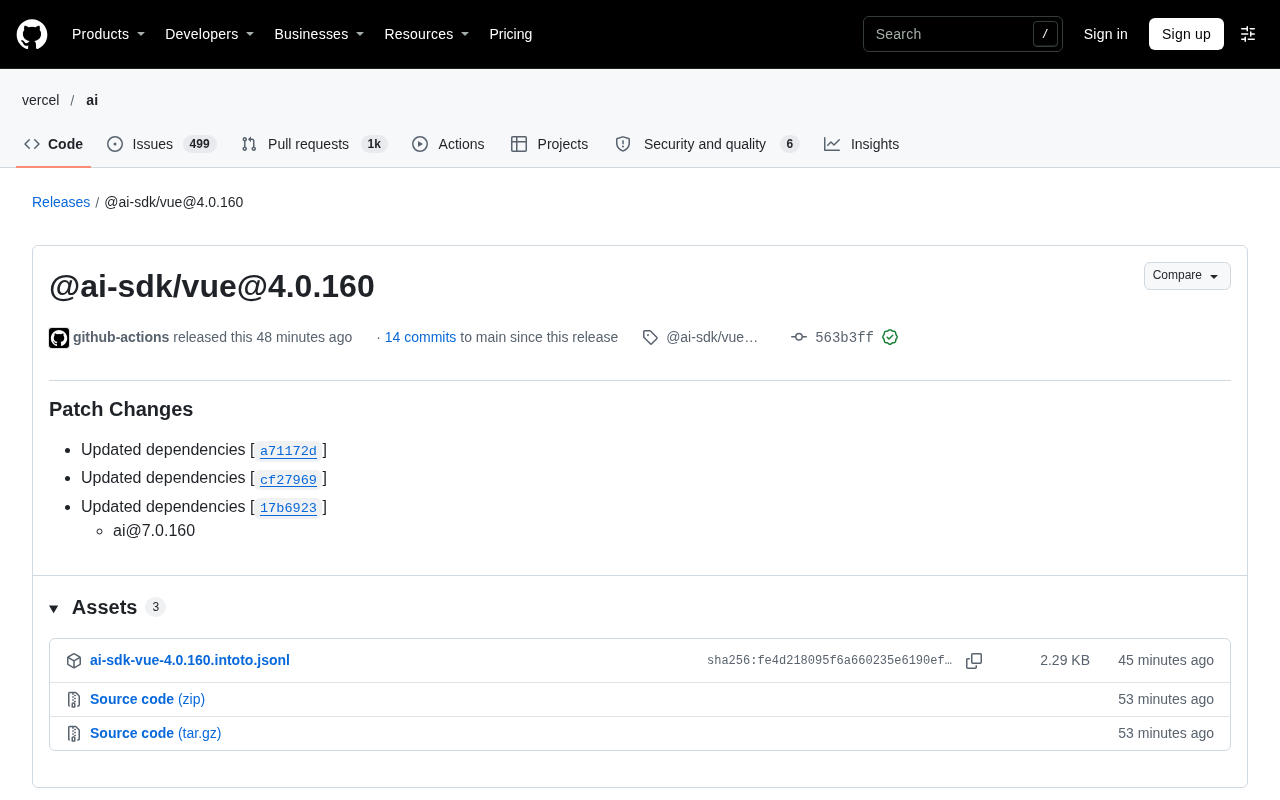
Vercel's AI SDK team has released version 4.0.160 of @ai-sdk/vue. According to the GitHub release notes, this is a typical patch update (Patch Changes), with the core content being just one line: updating dependencies, specifically pointing to ai@7.0.160. The page shows this release includes 13 commits, automatically published by the github-actions bot.
For readers unfamiliar with AI SDK, this package is Vercel's official Vue adapter layer. AI SDK itself provides a unified interface for calling large language models in applications, while @ai-sdk/vue wraps the Vue Composition API, allowing Vue developers to declaratively integrate streaming conversations, tool calls, and other capabilities. Its release cadence typically rolls together with the core package ai, so the version correspondence between 4.0.160 and 7.0.160 reflects the independent evolution of two product lines.
What a Patch Update Actually Means
In the semantic versioning (SemVer) system, a patch number signifies backward-compatible bug fixes and dependency synchronization, without new features. The three dependency update commits in this release (a71172d, cf27969, 17b6923) come with no changelog or code change descriptions, further confirming this: the package itself has no logic changes, only the underlying ai package bumped to a specified version.
This release approach is common in the AI SDK ecosystem. Since @ai-sdk/vue does not directly implement model invocation logic—it primarily provides a reactive wrapper—when the core package fixes certain edge cases or adjusts internal interfaces, the adapter layer only needs to sync dependency versions. For users, the benefit of upgrading to 4.0.160 comes mainly from the fixes included in ai@7.0.160, not from anything new in this Vue package itself.
Semantic versioning (SemVer) is a convention for software version management, formatted as major.minor.patch (e.g., 4.0.160). A major version change indicates incompatible API modifications, a minor version change indicates backward-compatible feature additions, and a patch version change indicates backward-compatible bug fixes. In dependency update scenarios, bumping only the patch number typically means the depended-upon package contains only fixes, so upgrade risk is low—which is why @ai-sdk/vue only updated its patch number this time.
Impact on Vue Developers
If you're using @ai-sdk/vue in your project, upgrading this version is very simple—just update the locked version in your package manager. Since it's a patch update, migration cost is nearly zero, with no business code changes needed. However, note that dependency updates can sometimes introduce version changes in transitive dependencies. If other packages in your project depend on different versions of ai, you may need to check for version conflicts.
From an ecosystem perspective, this high-frequency patch release also indicates that AI SDK is still in a rapid iteration phase. The separate releases of the core package and framework adapters allow users of different frameworks to upgrade at their own pace, rather than being tied to a single major version. For production projects prioritizing stability, locking versions and regularly following patches is the safer approach; for projects wanting to try new capabilities, keep an eye on the minor version release notes of the ai package.
Transitive dependencies refer to other packages that a project's direct dependencies depend on. For example, if a project directly depends on @ai-sdk/vue, which in turn depends on ai, then ai is a transitive dependency. When @ai-sdk/vue updates its dependency on ai, the version of ai in the project's dependency tree may change accordingly, potentially causing version conflicts with other packages in the project that directly or indirectly depend on ai. Therefore, even for patch updates, it's advisable to check the lock file to ensure dependency tree consistency.
Summary
@ai-sdk/vue@4.0.160 is not a release worth extensive coverage; its value lies in maintaining consistency between the adapter layer and the core package. Understanding this release cadence is more meaningful than focusing on a single patch number—it reflects Vercel AI SDK's ongoing maintenance commitment in the Vue ecosystem, rather than a feature leap.
Related articles

DSH + Ollama Local LLM Deployment in Practice: Free Chat with Da Fei Yu
Bilibili creator tests DSH + Ollama local LLM deployment end to end: Ollama install, Xunlei-accelerated downloads, ModelScope GGUF model import, DSH custom API address setup, and a comparison of Qwen 3.5 4B, 8B, Gemma, and other models on 8GB VRAM, with advice on choosing local deployment vs. API calls.

Tested: A $899 Mac Mini vs. a $200/Month AI Subscription
Real-world test of whether an M4 Mac mini can replace a $200 AI subscription: 16GB can't fit large models, and both speed and quality fall short—but privacy, no caps, and near-zero running costs make it an ideal host for an always-on agent. Includes buying advice per configuration and money-saving strategies.

RSTGameTranslation: Real-Time OCR Localization + Offline Translation with Local LLMs
RSTGameTranslation is an open-source real-time Windows game translation tool: OCR for English, Japanese, and Korean with Chinese overlays in place, plus Ollama or LM Studio local LLM offline translation and Whisper speech transcription for games, manga, and visual novels.