AI SDK Vue 4.0.177 Patch Released: Dependency Sync Upgrade
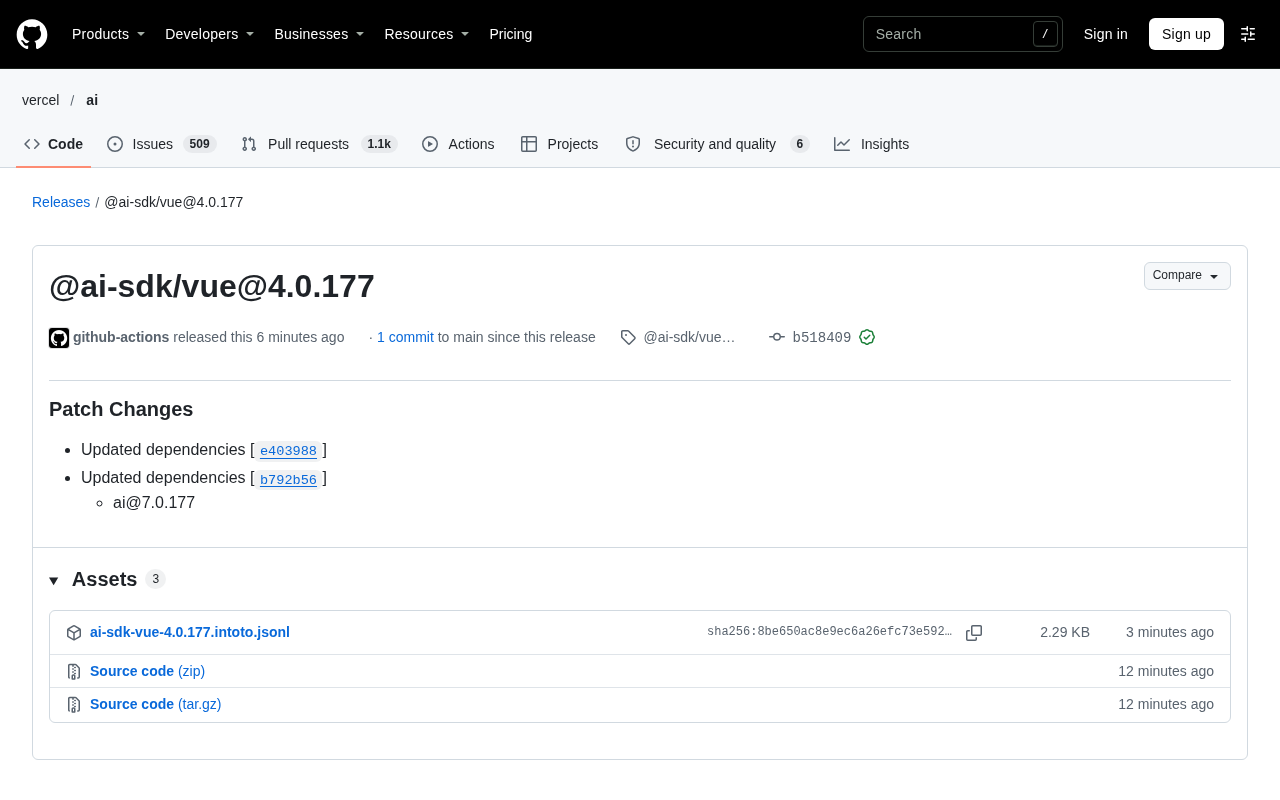
@ai-sdk/vue 4.0.177 patch syncs dependencies to ai 7.0.177 with no API changes.
GitHub Actions auto-published @ai-sdk/vue@4.0.177 as a patch version that syncs internal dependencies to ai@7.0.177 with no new APIs or behavior changes. The article explains AI SDK's monorepo release mechanism: frequent "Updated dependencies" entries in adapter patch versions keep the dependency tree aligned with the upstream core package, reducing type mismatches and runtime differences. For Vue developers, upgrades cost little and following up within the lock file range is recommended; if the project is stable with no core upgrades planned, no dedicated release window is needed. The release by the github-actions bot is a typical Changesets workflow output, and the page's loading error is unrelated to the package.
Title
AI SDK Vue 4.0.177 Patch Released: Dependency Sync Upgrade
Meta Description
AI SDK Vue adapter package releases patch version 4.0.177, auto-published by GitHub Actions. Main update is dependency sync, aligning the ai core package to 7.0.177. No feature changes. This article explains what this dependency alignment means, its impact on Vue project upgrades, and the signals from the automated release process.
Article Content
The AI SDK's Vue adapter package has received a minor version update. @ai-sdk/vue@4.0.177, auto-published by github-actions on GitHub, is a patch-level release (Patch Changes). The core action is syncing upstream dependencies; it introduces no new APIs or behavioral changes.
Version Positioning: Patch Release Focused on Dependency Alignment
According to the release record, this update corresponds to commit b518409, automatically triggered by GitHub Actions and carrying a GitHub verified signature. The release notes list only two "Updated dependencies" entries, corresponding to commits e403988 and b792b56, and then align the ai package to 7.0.177.
This means the release of @ai-sdk/vue is not a feature iteration, but rather advancing the internal dependency version pointer to match ai@7.0.177. For Vue projects using this adapter package, the upgrade brings no perceptible interface-level changes.
What Dependency Sync Means
AI SDK uses monorepo management, with the ai core package and framework adapters like @ai-sdk/vue released under separate version numbers. The frequent appearance of "Updated dependencies" in patch versions of adapter packages usually means the upstream core package has already released fixes or minor changes, and the adapter package is rebuilt and pointed to the new version to ensure dependency tree consistency at install time.
The benefit of this sync mechanism is reduced version mismatch. Mixing an old adapter package with a new core package can easily lead to inconsistent type definitions or runtime behavioral differences; binding the two through patch releases reduces the probability of such hidden issues.
Monorepo and Changesets Version Management
AI SDK uses a monorepo structure (a single code repository managing multiple packages), where the ai core package and framework adapters like @ai-sdk/vue and @ai-sdk/react reside in the same repository but are released independently. Under this layout, package version numbers are not globally unified; instead, tools like Changesets calculate them individually by change type (patch/minor/major). Patch versions of adapter packages often come with "Updated dependencies" entries—essentially, Changesets automatically rewrites the version ranges of internal dependencies to the new version numbers at publish time and synchronously updates lock file references.
Peer Dependencies and Version Mismatch
Adapter packages typically declare ai as a peer dependency, requiring the host project to install a compatible version. If the adapter package and core package versions differ too much, the package manager may issue peer dependency warnings, or interface mismatches may appear at the type level. Patch releases align the version pointers of both, precisely to narrow this mismatch window and make dependency resolution results during npm install more predictable.
Should Vue Developers Upgrade?
For projects that use @ai-sdk/vue regularly, the upgrade cost of such patch versions is extremely low. It is recommended to follow up within the range allowed by the lock file, especially when the project directly depends on the ai package and has already upgraded to 7.0.177—keeping the adapter package at the same version avoids potential peer dependency warnings.
If the project is currently running stably and there are no plans to proactively upgrade the core package, there is no need to schedule a release window specifically for this patch. Patch versions do not involve breaking changes; upgrade risk mainly comes from cascading updates of indirect dependencies, so handling it according to the regular dependency maintenance rhythm is sufficient.
Automation Signals from the Release Process
This release was completed by the github-actions bot, a typical product of the changesets workflow: after commits are merged, versions are automatically calculated, changelogs generated, and tags created. The loading error message appearing on the release page comes from GitHub's tag comparison component and is unrelated to the release content itself; it does not affect the package's usability.
From an engineering perspective, this automated release indicates that the project's version management has been scripted, and the frequency of patch releases will follow the upstream fix cadence rather than manual scheduling. For downstream users, paying attention to dependency change entries in the changelog is more meaningful than focusing on the version number itself.
GitHub Actions and Bot-Signed Commits
The github-actions bot identity and "verified" signature displayed on the release page come from GitHub's automatic signing mechanism for commits created by Actions workflow tokens. This means the commit was generated by the repository's configured CI pipeline rather than manually pushed, serving as evidence of the release chain's traceability. Combined with the Changesets workflow, the typical process is: after a PR is merged, the release workflow is triggered, automatically bumping the version number, generating the changelog, creating the tag, and publishing to npm—all without manual intervention.
One-line Summary
@ai-sdk/vue releases patch 4.0.177, only syncing dependencies to ai 7.0.177, no API changes.
Paragraph Summary
The @ai-sdk/vue@4.0.177 auto-published by GitHub Actions is a patch version whose core action is syncing internal dependencies to ai@7.0.177, introducing no new APIs or behavioral changes. The article explains AI SDK's monorepo release mechanism: the frequent "Updated dependencies" entries in patch versions of adapter packages are meant to keep the dependency tree consistent with the upstream core package and reduce type inconsistencies or runtime differences caused by version mismatches. For Vue developers, such upgrades cost very little, and following up within the range allowed by the lock file is recommended; if the project is stable and there are no plans to upgrade the core package, there is no need to schedule a dedicated release window. The release was completed by the github-actions bot, a typical product of the changesets workflow; the loading error on the page is unrelated to the package itself.
Related articles

Hands-On with the Genie 4 World Model: Directing Worlds in Real Time Like a Puppeteer
Google DeepMind's Genie 4 world model in depth: Special Guest X's hands-on demo of real-time scene direction via prompts, custom interactive apps in Project Genie, and prompts-as-seeds reproducibility.

Nvidia RTX Spark Mini PCs Go on Sale, Asus, Dell, and MSI Lead the Launch
Nvidia's RTX Spark N1X chip expands to desktops, with Asus, Dell, and MSI launching the first mini PCs, followed by Acer, Gigabyte, HP, and Microsoft's Surface Dev Box, accelerating the desktop AI PC ecosystem.

If Jensen Huang Steps Down, What Happens to Nvidia's AI Empire?
Is Nvidia's AI dominance overly dependent on Jensen Huang? This article analyzes Silicon Valley's CEO personality cult phenomenon, explores Nvidia's technical moat and organizational risks, and why the AI industry must shed the savior narrative.