Nvidia RTX Spark Mini PCs Go on Sale, Asus, Dell, and MSI Lead the Launch

Nvidia's RTX Spark N1X chip expands from laptops to desktop mini PCs, with Asus, Dell, and MSI shipping the first batch.
Nvidia's RTX Spark N1X chip is moving from laptops to desktops, with Asus, Dell, and MSI having launched the first mini PCs equipped with the chip, marking the extension of its AI PC platform to the desktop segment. The mini PC form factor balances size, power consumption, and sustained performance, making it suitable for local AI inference, content creation, and light gaming. Acer, Gigabyte, HP, and Microsoft's Surface RTX Spark Dev Box will follow, with the Dev Box targeting developers and potentially preinstalled with an AI development toolchain. The article notes this is a key move by Nvidia in the AI PC wave, but pricing, performance specs, and competitor comparisons remain undisclosed, and actual power consumption, cooling, and AI inference performance still require real-world reviews.
Nvidia's RTX Spark N1X chip is moving from laptops to desktops. According to an RSS source, the first mini PCs equipped with the chip have been launched by Asus, Dell, and MSI, marking Nvidia's further expansion into the desktop AI PC market.
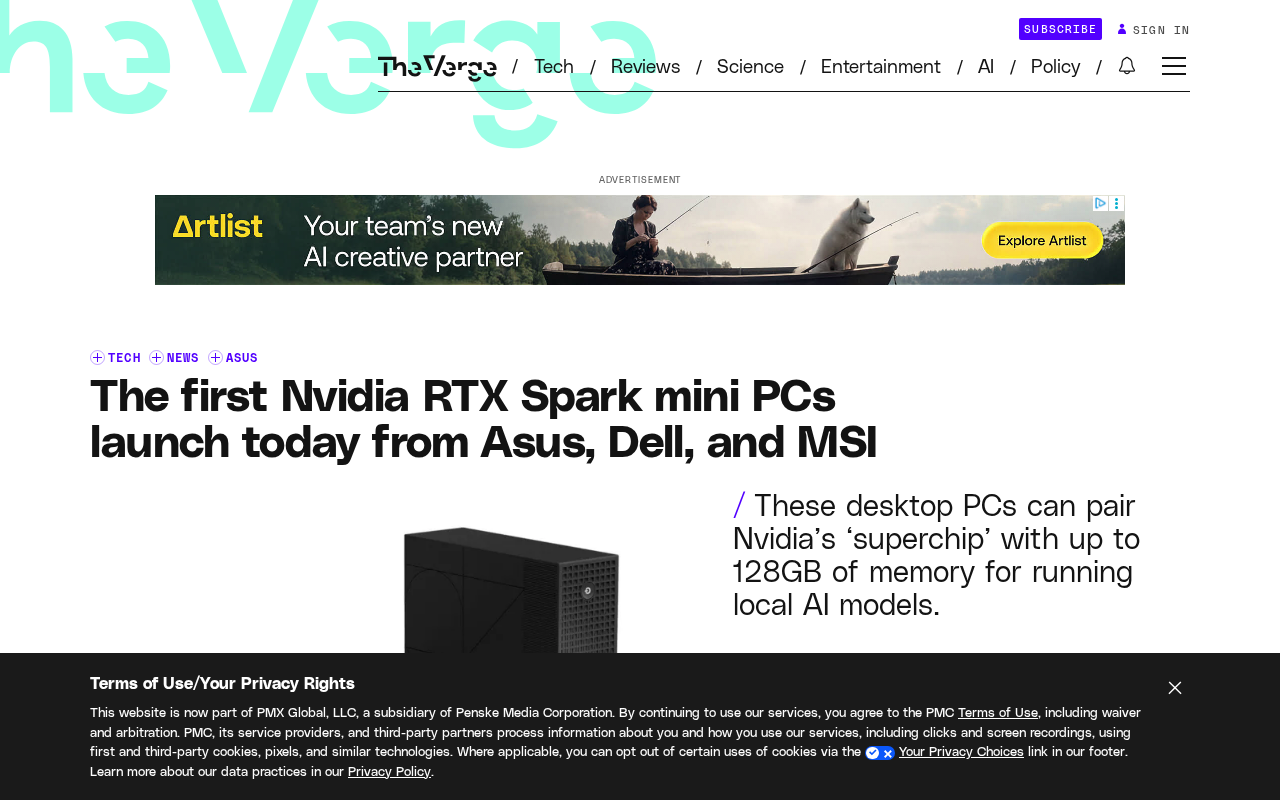
From Laptop to Desktop: The Form-Factor Expansion of RTX Spark
The RTX Spark N1X chip was previously used in laptop products that launched earlier this year. Now, the same chip has been packed into mini PCs, with Asus, Dell, and MSI becoming the first OEMs to ship. This move shows that Nvidia is extending its AI PC platform from mobile to desktop, covering a broader range of use cases.
The advantage of the mini PC form factor lies in its compact size and relatively controllable power consumption, while also offering stronger sustained performance than laptops. For users who need local AI inference, content creation, or light gaming, these products provide a choice somewhere between a traditional desktop and a laptop.
A mini PC is a complete system significantly smaller than a traditional desktop, typically using low-power mobile or desktop-grade processors, integrated graphics, or small discrete GPUs, powered through an external power adapter. Its typical size ranges from 0.5 to 2 liters, and it can be placed under a monitor or in a corner of the desk. Compared with laptops, mini PCs are not constrained by battery capacity or the cooling limits of a cramped chassis, and often can be set to higher sustained power limits (PL1/PL2), so multi-core and graphics sustained performance on the same chip is usually better than on a laptop; compared with desktops, their expandability (memory slots, drive bays, discrete GPU support) is limited, but they save space and run quieter. In recent years, with the rise of the AI PC concept, mini PCs have become a popular vehicle for local AI inference and edge computing thanks to their always-on operation, low power consumption, and local compute capabilities.
First Batch of Products and the Upcoming Lineup
Currently, only the first wave of products is on sale. According to the source, Acer, Gigabyte, and HP's RTX Spark desktop products will be launched later, and Microsoft's Surface RTX Spark Dev Box is also planned to begin shipping this month. This means that the RTX Spark desktop ecosystem is rapidly expanding, with a high level of OEM participation.
Worth noting is Microsoft's Dev Box product—judging from the name, it targets developers and may come preinstalled with a toolchain optimized for AI development. This is consistent with Nvidia's strategy of promoting local AI development.
"Dev Box" typically refers to dedicated hardware devices aimed at software developers. What distinguishes them from ordinary consumer mini PCs is that they come preinstalled with a complete development toolchain (such as SDKs, drivers, and framework runtimes), offer longer system support cycles, and may include optimized configurations for local large-model inference, CUDA acceleration, or specific AI frameworks. Microsoft previously launched the Dev Box cloud service for Windows developers, while the hardware form of Dev Box emphasizes an out-of-the-box local development environment, reducing the cost for developers to configure drivers and dependencies themselves. For Nvidia, such products help promote its CUDA ecosystem and local AI development stack, enabling developers to complete model fine-tuning, inference deployment, and performance tuning on a unified hardware platform without relying on cloud GPU resources.
Market Significance and Open Questions
The launch of RTX Spark desktop products is a key move by Nvidia in the AI PC wave. As more OEMs join, consumers will have multiple choices ranging from laptops to mini PCs. However, the source did not disclose specific pricing, performance specifications, or comparison data with competitors, and this information will directly affect the products' market acceptance.
For users concerned about local AI compute, the actual performance of RTX Spark mini PCs—including power consumption, cooling, and AI inference performance—still awaits real-world reviews. Market feedback on the first batch of products will also determine how aggressively subsequent OEMs follow suit.
An AI PC generally refers to a personal computer equipped with a dedicated neural processing unit (NPU) or a powerful integrated/discrete GPU that can run AI workloads locally. Its core value lies in privacy protection (data does not leave the local device), low-latency response, and offline availability. Typical scenarios include local large-model inference, image/video generation, real-time translation, and meeting noise reduction. A common metric for measuring AI PC compute is TOPS (trillions of operations per second), provided jointly by the CPU, GPU, and NPU. Nvidia, with its CUDA ecosystem and GPU architecture, has an advantage in local AI inference (especially for generative models that require larger VRAM), but its platform power consumption and cost are usually higher than solutions relying on low-power NPUs. RTX Spark's expansion from laptops to desktop mini PCs is precisely aimed at the headroom that the desktop form factor offers for sustained compute output and cooling, in order to handle more intensive local AI workloads.
One-line Summary
Nvidia's RTX Spark N1X chip expands from laptops to desktop mini PCs, with Asus, Dell, and MSI shipping the first batch.
Paragraph Summary
Nvidia's RTX Spark N1X chip is moving from laptops to desktops, with Asus, Dell, and MSI having launched the first mini PCs equipped with the chip, marking the extension of its AI PC platform to the desktop segment. The mini PC form factor strikes a balance among size, power consumption, and sustained performance, making it suitable for local AI inference, content creation, and light gaming. Acer, Gigabyte, HP, and Microsoft's Surface RTX Spark Dev Box will follow, with the Dev Box targeting developers and potentially coming preinstalled with an AI development toolchain. The article notes that this is a key move by Nvidia in the AI PC wave, but specific pricing, performance specifications, and competitor comparisons have not yet been disclosed, and actual power consumption, cooling, and AI inference performance still need to be verified through real-world reviews.
Related articles

Zed Editor Releases v1.29.2: Observations on a Routine Version Iteration
Zed editor releases patch v1.29.2, version bump by @JosephTLyons, commit verified via GitHub signature. This article covers the release's basic info, what a patch version means, and practical upgrade advice for users.

Anthropic IPO Questioned: Hacker News Debates Timing of Going Public
A Hacker News post titled "Just say no to Anthropic's IPO" sparks debate on the timing of Anthropic's public listing and AI capitalization, touching on valuation bubbles and mission independence.

Hands-On with the Genie 4 World Model: Directing Worlds in Real Time Like a Puppeteer
Google DeepMind's Genie 4 world model in depth: Special Guest X's hands-on demo of real-time scene direction via prompts, custom interactive apps in Project Genie, and prompts-as-seeds reproducibility.