@ai-sdk/vue@4.0.178 Patch Release: A Major Dependency Chain Overhaul

@ai-sdk/vue releases patch 4.0.178, syncing upstream dependencies only with no API changes.
Vercel's AI SDK Vue adapter package `@ai-sdk/vue@4.0.178` has released a patch-level update with just 1 commit, and all change types are "Updated dependencies." This version synchronizes the core package `ai@7.0.178` and the provider utility package `@ai-sdk/provider-utils@5.0.83`, triggered automatically by github-actions, with the commit hash having passed signature verification. `@ai-sdk/vue` itself is a lightweight adapter layer that wraps the core package's capabilities into Vue composables, and its benefits actually come from the two upstream packages. The article points out that patch versions are the main channel for obtaining fixes for streaming rendering, tool call parameter parsing, and provider compatibility, but they may also introduce upstream changes in batches. It is recommended to first verify dependency versions and run existing test cases before merging into the main branch; projects with high stability requirements can lock to a specific patch number.
Vercel's AI SDK has received a typical patch-level update — @ai-sdk/vue@4.0.178 was released recently with just 1 commit and a minor version bump, but its dependency list has grown into a long chain. For developers building AI chat interfaces with Vue, these updates often determine whether downstream projects can smoothly receive upstream bug fixes.
A Patch Update That "Only Touches Dependencies"
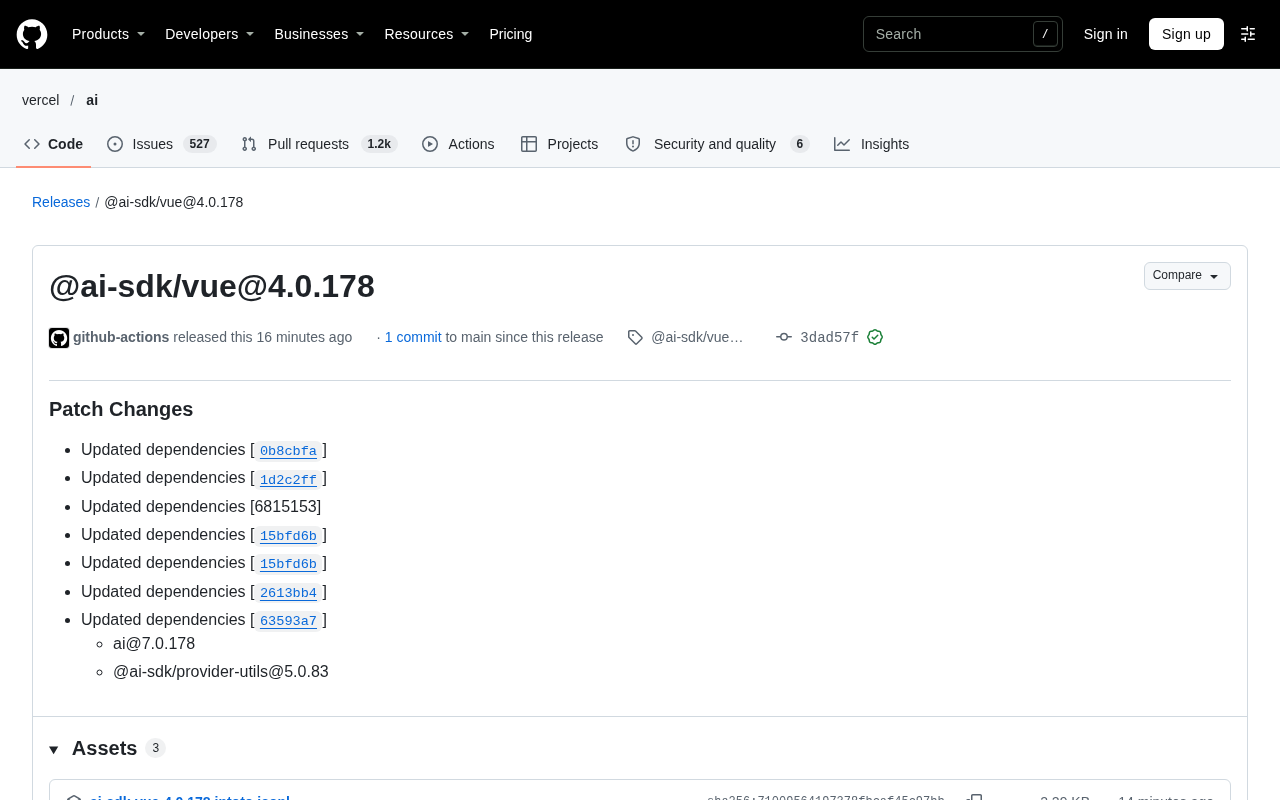
From the GitHub Release page, the changelog for this version is very simple: the only change type is Patch Changes, all of which point to "Updated dependencies." The commit hash 3dad57f has been marked by GitHub as having a verified signature and belongs to the github-actions automated release process, indicating this is a routine release automatically triggered by the pipeline.
The version number jumped to 4.0.178, with the patch position incrementing, meaning there are no breaking changes at the API level. The community release cadence is relatively fast, and the Vue adapter package iterating in sync with the ai core package has always been the release habit of the AI SDK.
Semantic Versioning (SemVer) and the Patch Position
Semantic versioning uses a three-part format of major.minor.patch. An increment in the patch position (the 178 in this case) represents backward-compatible bug fixes and does not include new features or breaking changes. In contrast, a minor version increment indicates new backward-compatible functionality, and a major version increment means there are incompatible API changes. Therefore, a change only in the patch position like 4.0.177 → 4.0.178 is the first signal for judging that a release "can be safely upgraded." However, note that a large patch number (178) often indicates the package is released extremely frequently, and its version number is more of a CI pipeline counter than a measure of accumulated quality.
Key Partners in the Dependency Chain: ai and provider-utils
Although the changelog does not elaborate on details, the listed dependency updates explicitly include two package names: ai@7.0.178 and @ai-sdk/provider-utils@5.0.83. The former is the core package of the AI SDK, responsible for unified model invocation, streaming responses, tool calls, and other capabilities; the latter provides the foundational utility functions shared by all AI provider adapters.
@ai-sdk/vue itself is a lightweight adapter layer whose main job is to wrap the core package's capabilities into Vue composables for direct consumption by frontend components. Therefore, its version changes often just "carry over" new versions of the core and utility packages into its own dependency declarations. The benefits developers actually get from upgrading this package come from those two upstream packages.
Dependency Transitivity and Version Locking
In the npm ecosystem, a package's dependencies declaration forms a dependency tree. When a downstream project installs @ai-sdk/vue, the declared ai and @ai-sdk/provider-utils are pulled in as well. If the downstream project also directly depends on these two packages, issues like "dependency hoisting" and "version arbitration" may arise: npm will try to reuse a single version that satisfies all constraints; otherwise, it nests multiple copies in node_modules, resulting in two different versions of provider-utils within the same process, causing hard-to-troubleshoot type mismatches or runtime behavior differences. This is the technical root of the original article's suggestion to "compare whether the actual versions in package.json are aligned." Using package-lock.json or pnpm-lock.yaml to lock the dependency tree ensures that the team and CI environments install exactly the same version combination.
Why Pay Attention to Patch Versions
For teams using the AI SDK, patch versions are often overlooked, but they are actually the main channel for fixing streaming rendering stutters, tool call parameter parsing anomalies, and provider compatibility issues. If @ai-sdk/vue's dependency updates lag behind, the project may be stuck on a provider-utils version with known issues.
Conversely, keeping up with such patches also has costs: a batch update of the dependency chain may simultaneously introduce multiple upstream changes, and troubleshooting requires tracing back to specific upstream commits. This changelog includes several short commit hashes, but the page does not provide more detailed change descriptions, so this Release alone cannot determine what specific issues were fixed.
github-actions Automated Releases and Commit Signing
GitHub Actions is GitHub's built-in CI/CD pipeline service that can automatically execute builds, tests, and releases through workflow files when code is merged, on a schedule, or manually triggered. High-frequency release projects like the AI SDK typically configure "changesets"-style tools: after developers submit change descriptions, a bot aggregates them to generate version numbers and changelogs, and then Actions automatically runs npm publish and creates a Release. The commit mentioned as "verified signature" means GitHub marks commits signed with GPG or SSH keys as Verified, which proves the commit was genuinely produced by the claimed identity and its content has not been tampered with. This is part of supply chain security, but it does not mean the code has undergone human review.
Practical Tips for Version Tracking
For dependency management, this kind of release information is better used as a "trigger signal" rather than a "decision basis." After seeing the release of 4.0.178, a safer approach is: first compare whether the actual versions of ai and @ai-sdk/provider-utils in package.json have been synchronized, then run through the existing conversation and streaming output test cases, and only then decide whether to merge into the main branch.
If the project has high stability requirements, you can lock to a specific patch number and wait for community feedback to settle before following up. The patch cadence of @ai-sdk/vue is dense, and this approach can avoid being dragged along by high-frequency dependency updates.
From both SEO and engineering practice perspectives, this version brings no new features; its value lies in maintaining version consistency between the Vue-side adapter layer, the core package, and the provider utility package, allowing downstream projects to obtain upstream fixes at minimal cost.
One-line Summary
@ai-sdk/vue releases patch 4.0.178, syncing upstream dependencies only with no API changes.
Paragraph Summary
Vercel's AI SDK Vue adapter package @ai-sdk/vue@4.0.178 has released a patch-level update with just 1 commit, and all change types are "Updated dependencies." This version synchronizes the core package ai@7.0.178 and the provider utility package @ai-sdk/provider-utils@5.0.83, triggered automatically by github-actions, with the commit hash having passed signature verification. @ai-sdk/vue itself is a lightweight adapter layer that wraps the core package's capabilities into Vue composables, and its benefits actually come from the two upstream packages. The article points out that patch versions are the main channel for obtaining fixes for streaming rendering, tool call parameter parsing, and provider compatibility, but they may also introduce upstream changes in batches. It is recommended to first verify dependency versions and run existing test cases before merging into the main branch; projects with high stability requirements can lock to a specific patch number.
Related articles

Prospero: A Lightweight Native AI Coding Tool Built with ImGui
Prospero is a bloat-free native AI coding tool built with ImGui, emphasizing lightweight design, high performance, and low dependencies. This article analyzes its design philosophy, technical choices, and the divergence between platformization and toolization in AI coding tools.

WebRTC Abused: New Variant of Credit Card Skimming Scripts on Shopping Sites
Security researchers found skimming scripts on popular shopping sites using WebRTC data channels to exfiltrate credit card data. This article analyzes the technical原理, differences from traditional Magecart attacks, and defense strategies for e-commerce platforms in third-party script governance and CSP policies.

Single GB10 Card Hits 101 tok/s: Inkling 2 Mini Performance Tested on vLLM
A developer shared on Hacker News running Inkling 2 Mini with vLLM on a single GB10 at 101 tok/s. This article analyzes the technical context, the significance of vLLM with small models on single cards, and caveats for interpreting tok/s metrics.