@ai-sdk/workflow 2.0.103 Patch Released: Dependency Chain Upgraded in Sync
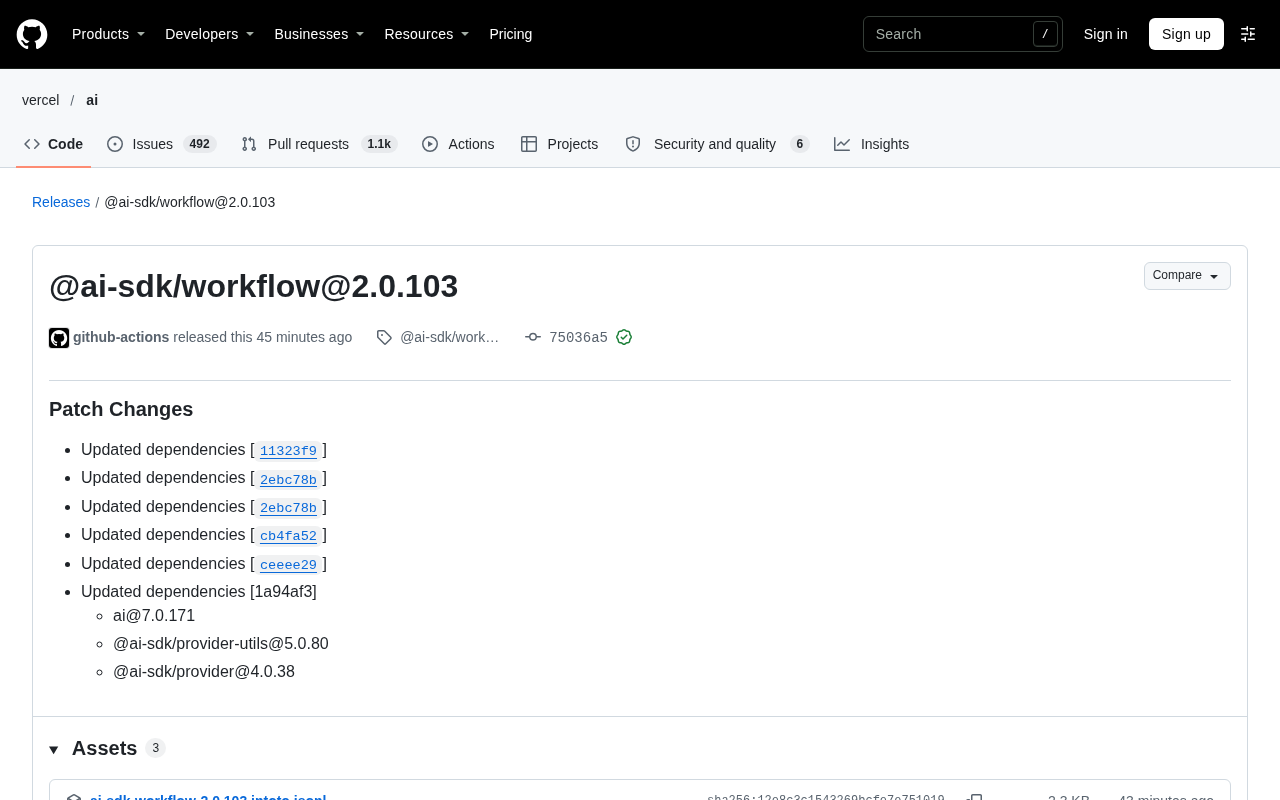
@ai-sdk/workflow 2.0.103 is a pure dependency patch that upgrades ai and the provider layer in sync, reflecting timely following at the orchestration layer.
@ai-sdk/workflow has released patch version 2.0.103, with all changes being dependency updates — no new APIs, behavior changes, or breaking adjustments, so the upgrade cost is essentially zero. The article uses this to observe the package's position in the AI SDK ecosystem: it depends on the main entry package ai@7.0.171, showing the workflow layer is built on a unified model-invocation abstraction rather than starting from scratch; it also synchronously upgrades @ai-sdk/provider-utils@5.0.80 and @ai-sdk/provider@4.0.38, reflecting that the provider abstraction layer is still being refined. The workflow package sits at the orchestration layer, responsible for chaining single model invocations into multi-step tasks, and its patch frequency and dependency-following speed reflect Vercel's investment in agent and workflow scenarios. Overall this release has no surprises but its strength is stability; the author suggests projects pinned to this package can upgrade safely, but custom provider projects should watch for behavioral differences in the main package and run integration tests.
Vercel's AI SDK ecosystem has rolled out another version iteration. @ai-sdk/workflow has released patch version 2.0.103. On the surface it's a routine dependency update, but a closer look at the changes in the dependency chain reveals that this package's position within the overall AI SDK architecture is being recalibrated.
A "Pure Dependency" Patch, but the Dependencies Themselves Deserve Scrutiny
This release's commit is tagged as Patch Changes, and the changes are uniformly "Updated dependencies," involving version bumps for several internal packages. There are no new APIs, no behavior changes, and no breaking adjustments. For developers using @ai-sdk/workflow, the upgrade cost is essentially zero.
But a patch type doesn't mean low information value. On the contrary, dependency updates are often a window into a library's maintenance cadence and architectural intent.
The Linked Update of Core Dependency ai@7.0.171
Among the updated dependencies, ai@7.0.171 is the one most worth watching. The ai package is the main developer-facing entry point of the AI SDK, providing core invocation capabilities such as generateText, streamText, and generateObject. That @ai-sdk/workflow depends on it shows the workflow layer is built on top of a unified model-invocation abstraction rather than starting from scratch.
The benefit of this layered design is that when the main package iterates, upper-layer packages can simply follow along via patch versions, keeping the two decoupled. A version number like 7.0.171 suggests the ai package has entered a period of dense iteration in the 7.x series, with a high patch frequency.
SemVer (Semantic Versioning) is the key to understanding what version numbers mean here. It splits a version number into three parts: MAJOR.MINOR.PATCH — a major version change indicates breaking changes, a minor version indicates backward-compatible new features, and a patch number indicates only backward-compatible bug fixes. So the "7" in ai@7.0.171 means the package has crossed several major version evolutions, while "171" shows patches are released very frequently. This also explains why @ai-sdk/workflow's patch versions can follow along "painlessly": as long as the upper-layer package hasn't crossed a major version, dependency updates theoretically won't introduce breaking interface changes, so the upgrade cost is naturally low. Conversely, if some update pushed ai from 7.x to 8.x, you'd need to carefully check the migration guide.
Synchronized Upgrade of the Provider Layer Trio
The other three updated packages form the provider infrastructure: @ai-sdk/provider-utils@5.0.80, @ai-sdk/provider@4.0.38, and provider-related modules affected indirectly. These three packages handle responsibilities such as utility functions and provider interface definitions, respectively, and serve as the foundation for the AI SDK to connect with different model service providers.
Version advances in the provider layer usually mean compatibility adaptations or fixes to underlying utility functions. Although the specific changes weren't disclosed this time, the synchronized upgrade of the trio shows the provider abstraction layer is still being continuously refined.
In the AI SDK, a provider is an adapter abstraction: it uniformly wraps the differing HTTP interfaces, authentication methods, and streaming response formats of various model service providers (such as OpenAI, Anthropic, Google, etc.) into a consistent invocation contract within the SDK. Upper-layer code only programs against the interfaces defined by @ai-sdk/provider, so switching model providers requires no changes to business logic. @ai-sdk/provider-utils accumulates utility functions shared by all providers — such as request construction, error parsing, and chunked processing of streaming data — avoiding reinventing the wheel for each provider. Precisely because this layer is the "foundation," its version advances often correspond to compatibility adaptations or utility function fixes, and don't directly change the APIs terminal developers see.
Why the Existence of the workflow Package Is Worth Noting
The AI SDK has gradually expanded from early model-invocation wrapping to structured output, tool calling, multi-step reasoning, and now an orchestration layer like workflow. The roadmap points toward "organizing AI capabilities into reusable workflows."
@ai-sdk/workflow is positioned at the orchestration layer, responsible for chaining single model invocations into multi-step tasks. Packages like this are usually not exposed directly to terminal developers but are referenced by upper-layer frameworks or template projects. Its patch frequency and dependency-following speed reflect, to some extent, Vercel's investment in agent and workflow scenarios.
Judging from this release, the workflow package follows the main package and provider layer promptly, showing that maintenance actions haven't fallen behind.
An agent typically refers to a system driven by a large model that can autonomously plan steps, call tools, and decide the next action based on intermediate results. Closely related is workflow orchestration, which explicitly organizes several model calls, tool calls, and conditional branches into a reusable, observable process. The difference between the two lies in control: an agent delegates "what to do next" to the model for dynamic decisions, while a workflow's process skeleton is mostly predefined by the developer. @ai-sdk/workflow sits at the orchestration layer, precisely providing infrastructure for such multi-step, stateful AI tasks — which is also why it's usually referenced by upper-layer frameworks or template projects rather than exposed directly to terminal developers.
Upgrade Recommendations
For projects pinned to @ai-sdk/workflow, 2.0.103 is a safe patch upgrade. Since it only involves dependency updates, it's worth watching two things after upgrading: first, whether the ai main package jumping from an older version to 7.0.171 brings behavioral differences; second, whether changes to provider utility function versions affect custom provider implementations.
If your project has custom providers or code that directly depends on @ai-sdk/provider-utils, it's recommended to run integration tests after upgrading to confirm that utility function signatures and behavior haven't unexpectedly changed.
Overall, there are no surprises in this release, but its strength lies in stability. For infrastructure-type packages, following dependencies on time and keeping versions consistent is itself a form of reliability.
One-line Summary
@ai-sdk/workflow 2.0.103 is a pure dependency patch that upgrades ai and the provider layer in sync, reflecting timely following at the orchestration layer.
Paragraph Summary
@ai-sdk/workflow has released patch version 2.0.103, with all changes being dependency updates — no new APIs, behavior changes, or breaking adjustments, so the upgrade cost is essentially zero. The article uses this to observe the package's position in the AI SDK ecosystem: it depends on the main entry package ai@7.0.171, showing the workflow layer is built on a unified model-invocation abstraction rather than starting from scratch; it also synchronously upgrades @ai-sdk/provider-utils@5.0.80 and @ai-sdk/provider@4.0.38, reflecting that the provider abstraction layer is still being refined. The workflow package sits at the orchestration layer, responsible for chaining single model invocations into multi-step tasks, and its patch frequency and dependency-following speed reflect Vercel's investment in agent and workflow scenarios. Overall this release has no surprises but its strength is stability; the author suggests projects pinned to this package can upgrade safely, but custom provider projects should watch for behavioral differences in the main package and run integration tests.
Related articles

Bin's Live Stream Highlights: Hilarious Interactions from "You Came at the Right Time" to "I'll Support You From Now On"
Bin's hilarious live stream highlights: from "You came at the right time" to "I'll support you from now on," featuring Championship skins, wigs, and other game memes that showcase Bilibili's unique streaming culture.

Hunter Rescues Educated Youth: The Mountain-Chasing System Launches a New Warm-Hearted Viral Drama Formula
Bilibili's early-access period short drama *Everyone Thinks I'm a Poor Hunter* opens with a snowy-night rescue of an educated youth. Hunter Chen Shan activates the mountain-chasing system, using realistic hypothermia first-aid details and mutual-probing character dynamics to deliver a warm-hearted period drama without the sleaze.

Riemann Hypothesis Proven by AI? The Truth Has Nothing to Do With Your Reality
34-year-old mathematician Levent Alpöge claims to have proven the Riemann Hypothesis and Generalized Riemann Hypothesis with Claude, releasing 17 million lines of formal verification code. This article sorts out the facts, debunks myths about RSA collapse and new material revolutions, and analyzes the true significance of mathematics-AI collaboration.