AI SDK Workflow 2.0.113 Patch Released: Dependency Updates and Ecosystem Stability

AI SDK's workflow package releases patch 2.0.113, primarily syncing the ai package to 7.0.181.
The workflow package in the AI SDK ecosystem has released version 2.0.113, a patch update centered on dependency sync with no new APIs or feature changes. The release notes show four dependency updates, syncing the core `ai` package to version 7.0.181 to ensure compatibility with the latest patch layer of the main package. The article analyzes the maintenance pattern behind this high-frequency patch cadence and advises developers to check the `ai` package version in the lockfile, ensure dependency tree alignment, and re-verify the build process when upgrading. This release was automated by github-actions and includes 7 merged commits.
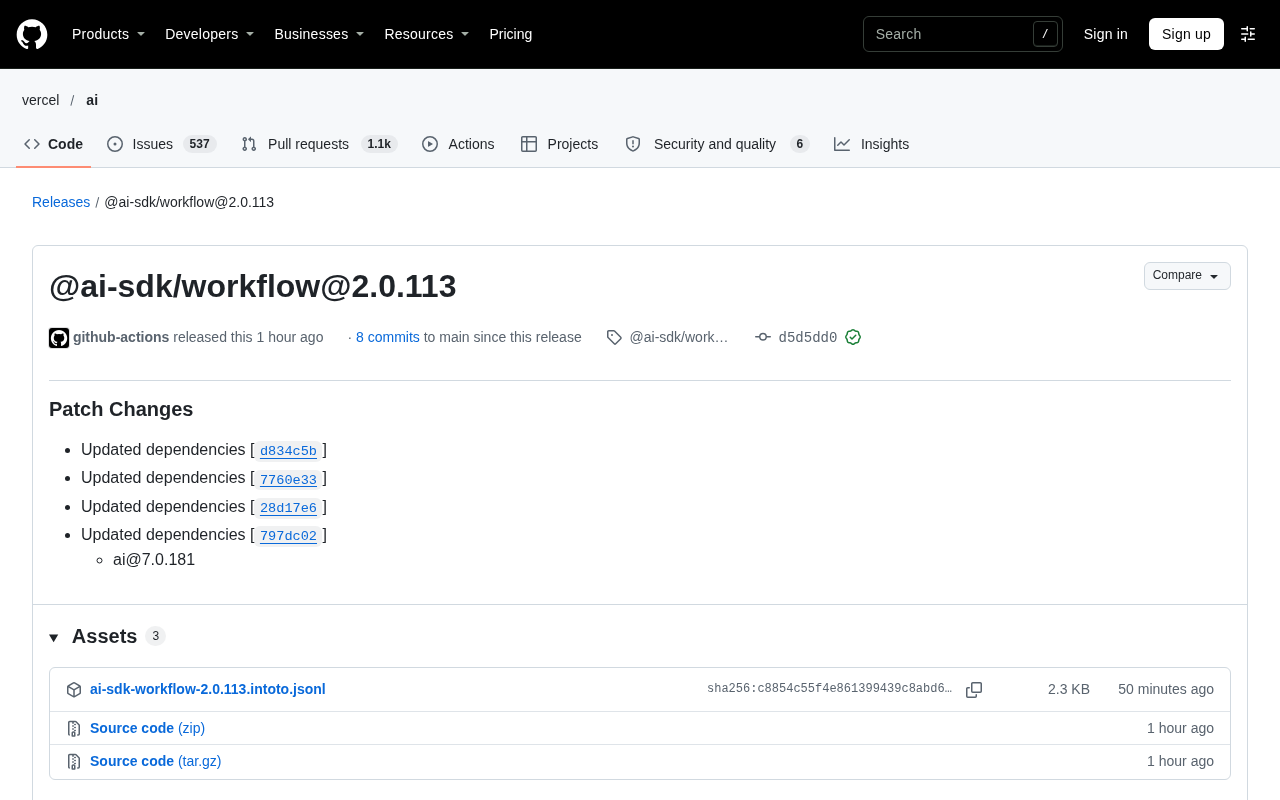
The workflow package in the AI SDK ecosystem recently shipped version 2.0.113, a typical patch update. For developers who rely heavily on AI SDK to build automation workflows, these small version iterations are often more worth watching than major releases—they determine the stability of day-to-day builds.
The Core of the Patch: Dependency Sync
According to the release notes, version 2.0.113 itself introduces no new APIs or feature changes; the patch content centers on dependency updates. The release notes list four dependency updates, each corresponding to a different commit, and sync the core dependency ai package to version 7.0.181.
This kind of "pure dependency update" patch is common in monorepo projects. As part of the AI SDK system, @ai-sdk/workflow needs to stay version-aligned with the ai core package to avoid type conflicts or runtime exceptions caused by mismatched dependency versions. Syncing ai to 7.0.181 indicates that the workflow package remains compatible with the latest patch layer of the main package.
For developers, the practical significance of such updates is that upgrading brings in the fixes and adjustments made in ai package 7.0.181 without having to manually manage dependency versions. If your project depends directly on the workflow package, a routine package manager upgrade is all it takes to complete the sync.
monorepo is a project structure that manages multiple interrelated software packages within a single code repository. In ecosystem projects like AI SDK, the core ai package and surrounding packages (such as @ai-sdk/workflow) typically live under the same monorepo, sharing build configurations, testing tools, and release processes. The benefit of this structure is that cross-package changes can be committed at once with unified version management, but it also means that whenever any package is released, the versions of the other packages it depends on must be verified as compatible. As a result, patch releases in monorepos often manifest as "dependency syncs"—where a package itself has no code changes, but the version numbers of its internal sibling dependencies are bumped to the latest to ensure version consistency across the entire ecosystem.
Semantic Versioning (SemVer) uses a three-part major.minor.patch format, representing incompatible API changes, backward-compatible feature additions, and backward-compatible bug fixes, respectively. Under the SemVer specification, incrementing the patch number theoretically means only bug fixes and security patches are included, with no changes to the public API. However, in the actual JavaScript ecosystem, patch versions sometimes also include dependency upgrades or internal refactoring, so "patch" does not absolutely equate to "zero risk." Understanding this helps developers set reasonable upgrade expectations: patch updates are usually low-risk, but still require verification through builds and tests, especially in projects with complex dependency trees or strict version locking.
What the Version Cadence Reveals About Maintenance
The version number 2.0.113 is worth noting. Under semantic versioning, an increment in the third digit means this is already the one-hundred-plus patch release of the workflow package within the 2.0 series. This frequency suggests two possibilities: first, the package is highly coupled with upstream dependencies, so every upstream patch may trigger a synchronized workflow release; second, the team has adopted a high-frequency, small-step release strategy, replacing infrequent major versions with frequent small patches.
Either way, it is a relatively friendly signal for users. High-frequency patches usually mean issues are fixed faster and dependencies are continuously maintained, rather than accumulating until the next major version.
What to Watch Out for When Upgrading
Although patch updates are theoretically low-risk, it is still advisable to confirm two things before upgrading. First, check the actual version of the ai package in your project's lockfile to ensure that after upgrading workflow, the ai version in the dependency tree matches expectations and avoid multiple versions coexisting. Second, since the patch involves multiple dependency updates, if your project has a strict dependency version locking policy, you need to update the lockfile accordingly and re-verify the build process.
From the release process perspective, this version was automatically published by github-actions, with commits carrying GitHub verified signatures and 7 commits merged into the main branch. The automated release process itself reflects the maturity of the project's maintenance—version releases are CI-driven, reducing the uncertainty introduced by manual operations.
Summary
2.0.113 is a routine patch centered on dependency sync, with no functional changes. Its value lies not in providing new capabilities, but in maintaining version consistency between the workflow package and the AI SDK core package. For developers building workflow applications on AI SDK, simply upgrade at the usual cadence and keep an eye on ai package version alignment.
In the context of the fast-iterating AI SDK ecosystem, consistently following such patch updates is fundamental work for keeping your project's dependencies healthy.
One-line Summary
AI SDK's workflow package releases patch 2.0.113, primarily syncing the ai package to 7.0.181.
Paragraph Summary
The workflow package in the AI SDK ecosystem has released version 2.0.113, a patch update centered on dependency sync with no new APIs or feature changes. The release notes show four dependency updates, syncing the core ai package to version 7.0.181 to ensure the workflow package remains compatible with the latest patch layer of the main package. The article analyzes the maintenance pattern behind this high-frequency patch release cadence, suggesting it reflects either high coupling with upstream dependencies or a high-frequency, small-step release strategy by the team—generally meaning issues get fixed faster for users. When upgrading, developers are advised to check the actual ai package version in the lockfile, ensure dependency tree version alignment, and re-verify the build process. This release was automated by github-actions and includes 7 merged commits.
Related articles

ChatGPT Plus Subscription Pitfall Guide: Go/Plus/Pro Tier Comparison and Quick Activation
A complete ChatGPT Plus subscription guide based on a Bilibili tutorial: from registering an account, comparing Go/Plus/Pro tiers, to the practical steps for quickly completing your subscription.

GPT-6.2 Sol/Astra Released! A Step-by-Step ChatGPT Plus Subscription Guide and Tier Comparison
GPT-6.2 Sol/Astra is out—here's a ChatGPT Plus subscription guide: register an account, compare Go/Plus/Pro tiers, and subscribe in a minute.

Comparing Three Channels for Subscribing to GPT Plus in China: Is Website Top-Up the Easiest?
How to subscribe to GPT Plus in China? This article compares website top-up, credit card, and mobile top-up channels—process, cost, and risk—with steps and tips to help you choose wisely.