@ai-sdk/workflow 2.0.67 Released: Dependency Updates and Patch Fixes

@ai-sdk/workflow 2.0.67 patch release syncs core dependencies with no breaking changes.
`@ai-sdk/workflow@2.0.67` is a routine maintenance patch published via GitHub Actions with a verified signature. It introduces no new features or breaking changes — the update focuses entirely on syncing dependencies to `ai@7.0.135`, `@ai-sdk/provider@4.0.26`, and `@ai-sdk/provider-utils@5.0.58` for consistency across the call chain. Developers already using this package can safely upgrade alongside the core `ai` package with no migration work required.
The @ai-sdk/workflow package in the AI SDK ecosystem has released version 2.0.67. This is a patch-level update focused primarily on syncing upstream dependencies. For developers building workflow applications with the Vercel AI SDK, these kinds of updates may be small in scope, but they often carry meaningful improvements to underlying stability and compatibility.
Release Overview
@ai-sdk/workflow@2.0.67 was published via an automated GitHub Actions workflow. The commit carries a verified signature from GitHub, with GPG key ID B5690EEEBB952194, ensuring the authenticity of the published package.
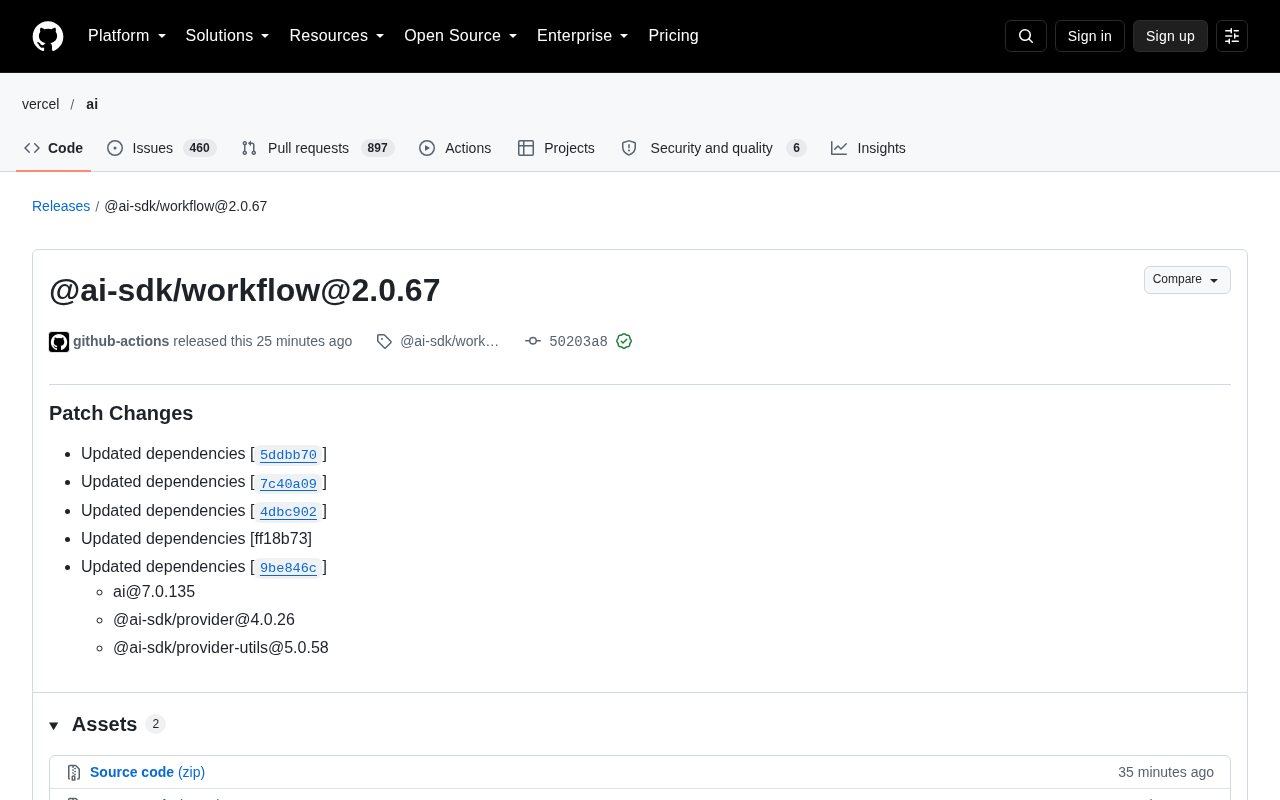
As the release notes indicate, this is a typical patch version — no breaking changes, no new features. Its value lies in keeping the package aligned with upstream dependencies.
@ai-sdk/workflow is the Vercel AI SDK package dedicated to building multi-step AI task orchestration. It allows developers to decompose complex AI applications into ordered workflow nodes, where each node can invoke different models or tools while sharing context state across the graph. Unlike direct single-call LLM interfaces, the workflow layer focuses on task orchestration logic — such as conditional branching, parallel execution, and error retries — making it easier to build structured Agent-style applications. The package relies on the ai core package for model invocation, and the @ai-sdk/provider abstraction layer for unified access to different model providers (OpenAI, Anthropic, etc.), with all three layers working together to form the complete application runtime chain.
What Changed
This release is categorized under Patch Changes and consists entirely of dependency updates. According to the release record, the following dependencies were upgraded:
ai@7.0.135@ai-sdk/provider@4.0.26@ai-sdk/provider-utils@5.0.58
These updates were triggered by multiple upstream commits, including 5ddbb70, 7c40a09, 4dbc902, ff18b73, 9be846c, and others. In other words, @ai-sdk/workflow itself has no changes to its business logic — it simply follows the iteration of the core ai package and provider-related utility libraries to stay in version alignment.
Why Dependency Updates Matter
In the highly modular JavaScript/TypeScript ecosystem, a package's functionality often depends on multiple underlying libraries working in concert. The AI SDK splits its capabilities across modules: the ai core package, the provider abstraction layer, and the provider-utils utility layer. When the underlying provider layer fixes bugs or refines its interfaces, the workflow package needs to sync up to ensure consistency and stability across the entire call chain.
For developers, keeping up with these patch updates helps avoid subtle issues caused by dependency version mismatches — such as type definition inconsistencies or behavioral differences in APIs.
Semantic versioning (SemVer) is important context for understanding updates like this. SemVer defines version numbers as MAJOR.MINOR.PATCH: a major version bump signals breaking API changes, a minor bump indicates backward-compatible new features, and a patch bump contains only backward-compatible bug fixes. @ai-sdk/workflow@2.0.67 is a patch update, meaning the underlying dependency fixes are guaranteed not to break existing consumers' code. In the JavaScript ecosystem, the ^ (caret) prefix commonly found in package.json automatically allows minor and patch upgrades, but lock files (package-lock.json or pnpm-lock.yaml) pin the exact version. So even with a loose version range configured, you'll need to explicitly run an update command to actually receive the new version.
Upgrade Recommendations
If your project already integrates @ai-sdk/workflow, upgrading to 2.0.67 is generally safe — patch versions follow SemVer conventions and won't introduce breaking changes. It's recommended to update alongside the core ai@7.0.135 package for the best compatibility experience.
The upgrade itself is straightforward: run an update command through your package manager, with no additional migration work required. For applications using workflow to build multi-step AI task orchestration, keeping dependencies reasonably up to date helps you benefit from ongoing upstream improvements in performance and stability.
Summary
@ai-sdk/workflow@2.0.67 is a low-risk maintenance update centered on dependency synchronization rather than functional changes. It reflects the AI SDK team's ongoing effort to keep all modules iterating in sync. For teams focused on AI application engineering, tracking updates like this is part of the routine work of maintaining a healthy tech stack.
Related articles

DeepSeek V4.1 Pro Enters Testing, Gemini 4 Pro Benchmark Leaked
DeepSeek V4.1 Pro enters early per-account testing and is hidden from the public selector; MiniMax M3.1 Flash preview hits TokenPlan; Gemini 4 Pro benchmarks leak with 2M token context and pricing.

Qwen 4 First Test Leaks: Performance Rivals Opus 5.5, DeepSeek V4 Series Surfaces
Early Qwen 4 test outputs leak, with front-end generation said to rival Opus 5.5; DeepSeek V4 Mini, Flash, and Pro names appear in a code repo; Ant Group's Ling-3.1-flash surfaces too. Here's the latest on model tiering and on-device lightweight models.

OpenCode Makes DeepSeek V4.1 Flash Free, AI Daily Roundup
AI daily roundup: OpenCode makes DeepSeek V4.1 Flash free, StepFun Step5 Preview and Ling 3.1 Flash open-sourced, Grok Voice 3.0 tops speech leaderboard, Matrix Game 4.0 open-sourced, and the EU opens its first AI Act enforcement probe into OpenAI and Anthropic.