@ai-sdk/workflow 2.0.87 Patch Release: The Version Strategy Behind a Dependency Chain Update

AI SDK's workflow package releases 2.0.87 patch, syncing only upstream dependencies with no feature changes.
Vercel's `@ai-sdk/workflow` releases 2.0.87, a typical patch update: no code changes in the package itself, with all three changes being dependency refreshes that sync `@ai-sdk/provider-utils@5.0.70` and `ai@7.0.155`. Released automatically by the github-actions bot with GPG signature verification, it reflects a standardized CI release pipeline. Such "empty-shell releases" are common in monorepo ecosystems, and their value lies in explicitly reflecting upstream fixes in their own patch number, giving downstream users a clear upgrade anchor rather than hiding them within semantic versioning ranges. Developers using workflow for multi-step AI tasks need no code changes but should check lockfiles to ensure patches reach the runtime. The article acknowledges that such releases carry limited information, and upstream fix details must be tracked separately in each dependency's release records.
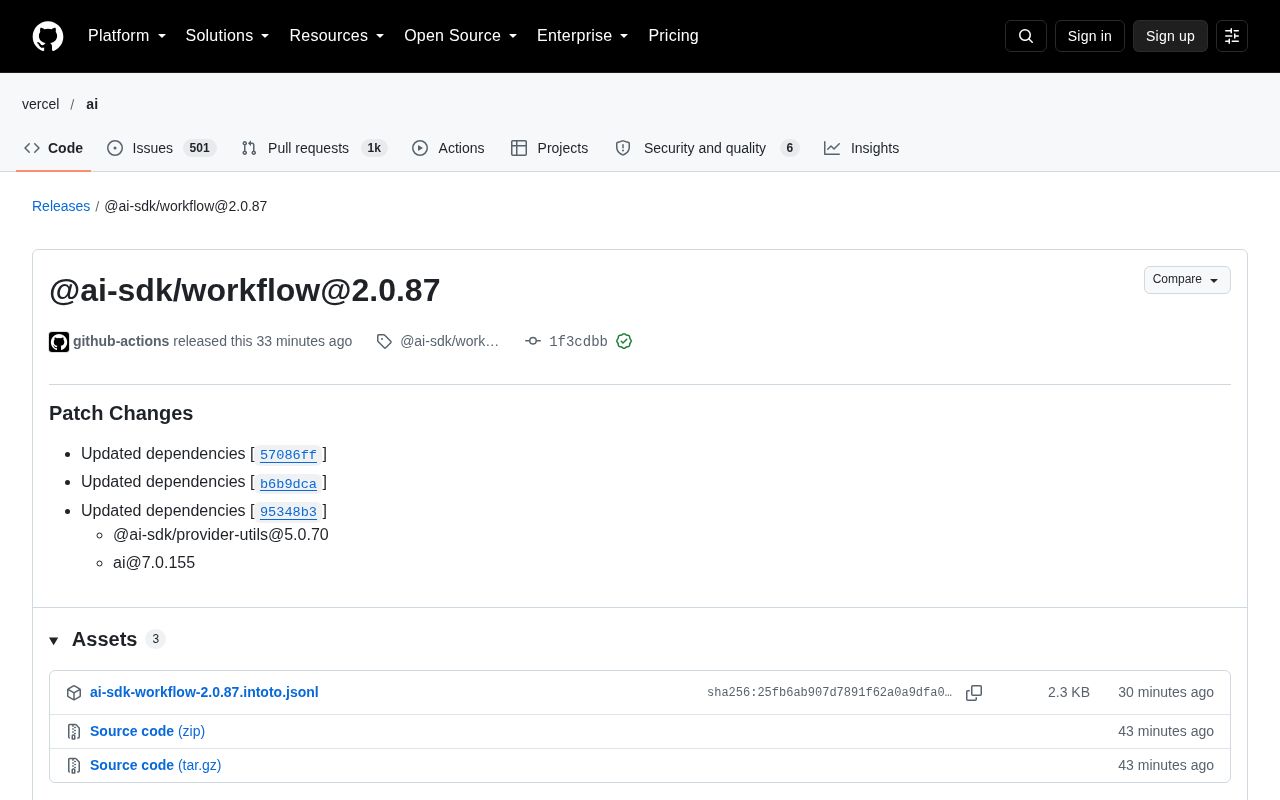
Vercel's AI SDK ecosystem has another small iteration. @ai-sdk/workflow has released version 2.0.87, and judging from the changelog, this is a typical patch update—no new features, just a cascading refresh of dependencies. For developers focused on AI application engineering, these "unremarkable" releases are precisely a window into a framework's maturity.
What This Update Actually Changed
The GitHub Releases page shows that @ai-sdk/workflow@2.0.87 is marked as Patch Changes, with all three changes pointing to Updated dependencies: commits 57086ff, b6b9dca, and 95348b3 respectively triggered upstream synchronization of @ai-sdk/provider-utils@5.0.70 and ai@7.0.155.
In other words, the workflow package itself has no code changes; its version number bumped to align with the dependency tree. This kind of "empty-shell release" is common in the JS ecosystem managed by monorepos, but it is not meaningless for users: if you have pinned the workflow version, this update effectively lets you indirectly obtain the latest patches of provider-utils and the ai core package.
The release was completed by the github-actions bot, and the commit carries a GitHub verified signature (GPG key ID: B5690EEEBB952194). The process is fully automated, indicating that the repository has established a standardized pipeline for commit signing and CI releases.
The Division of Labor Between @ai-sdk/provider-utils and the ai Core Package
To understand the significance of this dependency chain update, we first need to clarify the internal layering of the AI SDK. The ai package is the core of the entire SDK, providing unified model-facing call interfaces such as generateText, streamText, and generateObject, as well as abstraction layers for tool calling and structured output. @ai-sdk/provider-utils is the shared toolbox for provider adapters, encapsulating low-level capabilities unrelated to specific model vendors—such as HTTP request construction, streaming response parsing, error handling, and retry logic—which provider packages like OpenAI, Anthropic, and Google all reuse to reduce duplicate implementations. @ai-sdk/workflow sits at a higher layer and is responsible for multi-step orchestration. Therefore, when provider-utils fixes defects related to stream parsing or request retries, the fix propagates through the ai core to workflow—this is exactly where the real value of this "empty-shell release" lies.
Why Dependency Chain Updates Deserve Their Own Release
In the npm world, a patch version means "backward-compatible bug fixes." When upstream ai@7.0.155 or @ai-sdk/provider-utils@5.0.70 fixes issues at the provider call layer, the safest approach for workflow, as an upper-layer wrapper, is to release a version alongside it so downstream users can obtain the fix through the normal upgrade path.
Behind this is a dependency governance strategy: do not "hide" upstream fixes within the fuzzy range of semantic versioning. For teams building Agents or workflows with the AI SDK, this means behavior after npm update is more predictable—what you upgrade is not just workflow, but the entire call chain from provider-utils to the ai core.
Another detail is the cadence of version numbers. workflow had already reached the 2.0.x patch sequence, while the ai core package is at 7.0.155 and provider-utils at 5.0.70; the three packages' version lines evolve independently. This shows that the AI SDK adopts a monorepo model of per-package releases with on-demand linkage, rather than all packages sharing a single version number.
The Interaction Mechanism Between Semantic Versioning and Lockfiles
In npm's semantic versioning convention, ^2.0.87 allows installation of versions not lower than 2.0.87 within the 2.x.x range, while ~2.0.87 only allows patch bumps within 2.0.x, and the exact version 2.0.87 is fully pinned. The key point is: package-lock.json or pnpm-lock.yaml records the resolved exact version tree; as long as the lockfile does not change, npm install will not pull new patches. This means that even if upstream releases a fix, a team's actual runtime may remain on an old version until someone explicitly runs npm update or deletes the lockfile and reinstalls. CI environments typically use npm ci, which strictly follows the lockfile, further amplifying this risk of "unreachable fixes." The article recommends manually upgrading to 2.0.87, essentially reminding readers that lockfiles are an easily overlooked but directly impactful part of dependency governance.
What This Means for Developers Using the AI SDK
If you are using @ai-sdk/workflow to orchestrate multi-step AI tasks, this update does not require any code changes, but it is worth checking your lockfile. Patch versions usually enter the dependency tree automatically within the ^2.0.x range; if you use exact version pinning, manually upgrading to 2.0.87 ensures you get the latest state of upstream dependencies.
For teams wrapping the AI SDK into their own products, this type of release also serves as a reminder: the propagation speed of dependency security and bug fixes depends on the version range you allow. By explicitly reflecting upstream updates in its own patch number, workflow provides downstream users with a clear "upgrade anchor."
Version Noise or Engineering Signal
Looking at 2.0.87 alone, there is nothing exciting about it. But zooming out, a package that can automatically release dependency updates, includes signature verification, and maintains a stable changelog structure reflects the maintainers' emphasis on release discipline. In today's highly competitive AI application framework landscape, the reliability of engineering processes often determines long-term adoption more than any single feature.
Of course, it should also be acknowledged that this type of release carries limited information: the changelog only provides commit hashes and dependency version numbers, without explaining the specific content of the upstream fixes. To understand exactly what changed in ai@7.0.155 and @ai-sdk/provider-utils@5.0.70, you still need to track the release records of those two packages separately.
The Engineering Implications of GPG Signing and Automated Releases
The verified signature on the commit (GPG key ID: B5690EEEBB952194) indicates that the commit was signed by an entity holding the corresponding private key, and GitHub verifies the integrity of the signature and commit content. In automated release scenarios, this mechanism is mainly used to prove that the commit was indeed produced by a trusted CI system or its configured bot identity, rather than being forged and injected by a third party—for a package that enters the npm registry and ultimately flows into countless downstream projects, this is a basic line of defense for supply chain security. Combined with github-actions triggering and changelogs automatically generated by tools (such as changesets), the repository has formed a closed loop of "PR trigger → changeset record → automatic version bump → signed commit → publish." Tools like changesets automatically calculate version numbers and compile changelogs based on the change type (patch/minor/major) declared in the commit, which is why the three changes in this release can be neatly grouped under Patch Changes.
One-line Summary
AI SDK's workflow package releases 2.0.87 patch, syncing only upstream dependencies with no feature changes.
Paragraph Summary
Vercel's @ai-sdk/workflow has released version 2.0.87, a typical patch update: the package itself has no code changes, and all three changes are dependency refreshes, driving upstream synchronization of @ai-sdk/provider-utils@5.0.70 and ai@7.0.155. The release was automatically completed by the github-actions bot and carries GPG signature verification, reflecting a standardized CI release pipeline. The article notes that such "empty-shell releases" are common in the monorepo ecosystem, and their value lies in explicitly reflecting upstream fixes in their own patch number, providing downstream users with a clear upgrade anchor rather than hiding them within the fuzzy range of semantic versioning. For developers using workflow to orchestrate multi-step AI tasks, this update requires no code changes, but they should check their lockfiles to ensure the patch actually enters the runtime. The article also acknowledges that such releases carry limited information, and the specific content of upstream fixes needs to be tracked separately in the release records of the two dependency packages.
Related articles

T3 Code: The Open-Source AI Coding Assistant's Comeback Story
T3 Code is an open-source AI coding assistant that unifies subscriptions like Codex and Claude, with powerful remote control and parallel task management.

Never Elected, Yet Ruled New York for 30 Years: The Ultimate Case Study in the Mechanics of Power
Robert Caro's biographies reveal how unelected Robert Moses ruled New York for 30 years through legal drafting and public authorities, and how Lyndon Johnson built leverage as a "powerless" Senate Majority Leader. Unpacking the underlying logic of accumulating and sustaining power.

The CPython 3.10 Recursion Trap and Synthetic Recovery in TokenGuard, an LLM Circuit Breaker
TokenGuard's author recounts a recursion crash caused by OrderedDict.pop in CPython 3.10 and introduces v0.3.0's Loop Nudge synthetic recovery, inline DLP scanning, and other new LLM agent circuit-breaker capabilities.