@ai-sdk/workflow 2.0.91 Patch Released: AI Dependency Synced
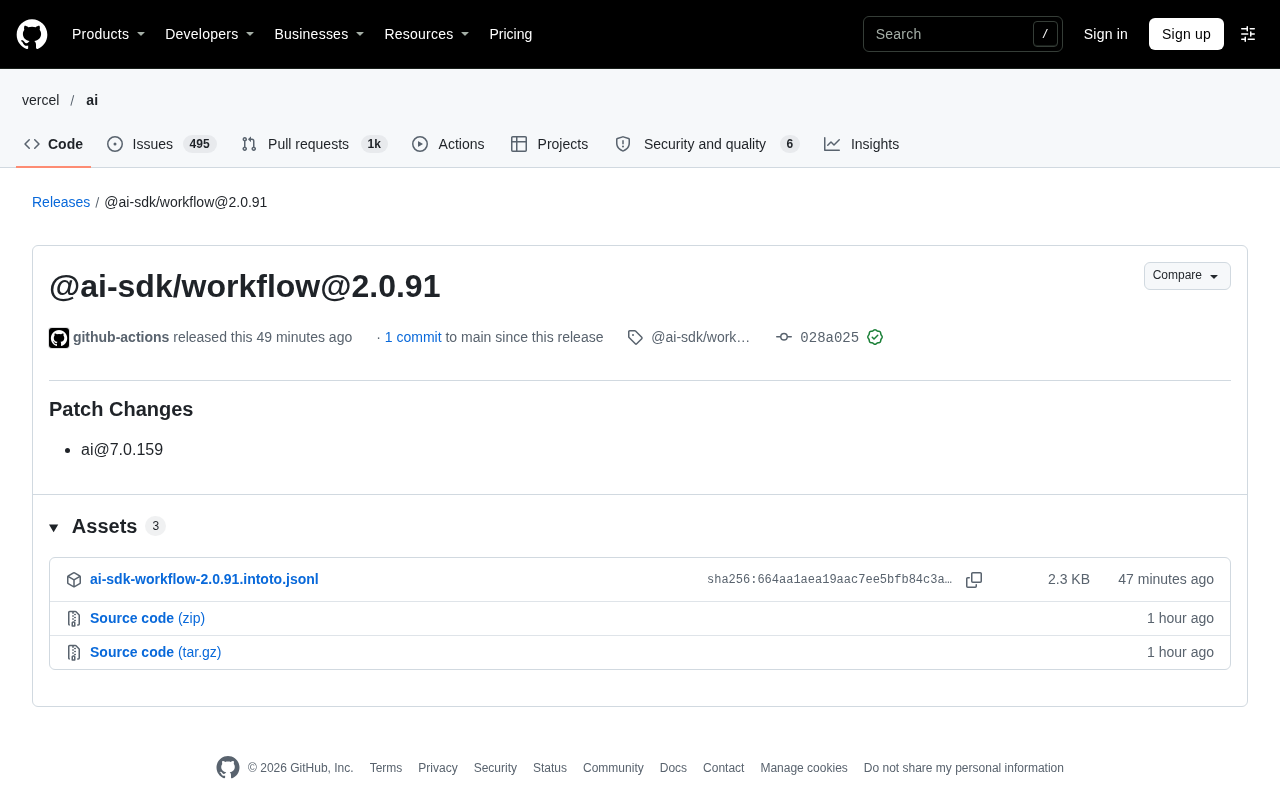
@ai-sdk/workflow releases patch 2.0.91, syncing the ai dependency to 7.0.159.
In Vercel's AI SDK ecosystem, @ai-sdk/workflow has released patch version 2.0.91, with the core change being syncing the underlying ai package to 7.0.159. The release was automatically completed by the github-actions bot, and the associated commit carries a GPG-verified signature, reflecting a CI-driven trusted release chain. The article notes that this package adopts a high-frequency, small-version strategy on the 2.x line, and the patch update is positioned as dependency alignment and fixes with no breaking changes, making it a low-risk upgrade. However, the release notes are limited and do not detail the specific changes in 7.0.159. Developers should verify against the ai package's own release records when upgrading and validate workflow behavior in a test environment to avoid issues arising from implicit dependencies between the wrapper layer and the core package.
Vercel's AI SDK ecosystem has seen another quick, incremental iteration. According to the GitHub Releases page, @ai-sdk/workflow has released version 2.0.91, a patch update (Patch Changes). The core change is syncing the ai package to 7.0.159.
Core Information of the Version Update
Positioning of the Patch Update
From the automatically generated release notes on GitHub, this version is explicitly marked as Patch Changes, meaning it contains no new features or breaking changes—mainly fixes and dependency alignment. The release was completed by the github-actions bot at 30 Oct 22:19, associated with a single commit 028a025, and that commit carries a GitHub verified signature (GPG key ID: B5690EEEBB952194), indicating the release process follows a standard automated trusted chain.
To understand the dependency statement, one needs to look at the package structure of the AI SDK: @ai-sdk/workflow is a wrapper layer for workflow orchestration, while ai is the foundational package providing core generation capabilities. When the latter is upgraded to 7.0.159, the former promptly follows with a patch release—a typical "upstream first, downstream sync" rhythm.
Semantic Versioning (SemVer) and Patch Updates
Semantic versioning divides a version number into major.minor.patch, corresponding to incompatible API changes, backward-compatible feature additions, and backward-compatible bug fixes, respectively. @ai-sdk/workflow has gone from 2.0.0 to 2.0.91, indicating that its major and minor versions have remained unchanged for a long time, with all changes confined to the patch position—a typical form of a "high-frequency, small-step" release strategy. For dependents, patch-position changes should theoretically not introduce behavioral breakage. However, because dependency resolution in the JavaScript ecosystem is based on lockfiles rather than strict contracts, different packages in the same dependency tree may pull different versions of ai, leading to "ghost-like" behavioral differences. Therefore, although patch updates carry low risk, it is still advisable to lock and review transitive dependencies via package-lock.json or pnpm-lock.yaml.
Why the Patch Version Deserves Attention
Judging by the version number alone, 2.0.91 is already far from 2.0, indicating that this package adopts a high-frequency, small-version strategy on the 2.x line. The benefit of this strategy is that fixes reach users quickly; the cost is that developers need to watch for version drift in lockfiles. For teams using workflow capabilities in production, aligning the versions of ai and @ai-sdk/workflow to the same release can avoid hidden bugs caused by behavioral differences in the core package.
Engineering Signals Behind the Automated Release
What a Bot Release Means
The publisher is shown as github-actions, meaning this release was not a manual operation but automatically triggered by the CI pipeline based on commits. Combined with the GPG-verified signature of the commit, it can be judged that the project has relatively strict integrity controls over the release chain. For downstream projects depending on this package, such releases are usually more traceable: each version can be mapped to a specific commit and signature.
GPG Signatures and Release Traceability
GPG (GNU Privacy Guard) is an encryption signing tool based on the OpenPGP standard. GitHub allows users to attach GPG signatures to commits and tags, and after verification, a "Verified" badge is displayed on the interface. The B5690EEEBB952194 mentioned in the article is the fingerprint suffix of the signing key. In automated release scenarios, the CI bot holds a trusted key and automatically signs commits, so downstream consumers can confirm that a given npm package version was indeed built from a specific commit in that project's repository and was not tampered with in intermediate steps. This forms a fundamental part of software supply chain security, complementing mechanisms such as SLSA and npm provenance. For enterprise-level dependencies, it is advisable to check the signature status when introducing them, rather than trusting only the package name and version number.
Limited Information in the Release Notes
It should be objectively noted that the change description on this release page is very brief, listing only "Patch Changes" and ai@7.0.159, without elaborating on what specific issues were fixed. Multiple resource loading errors ("There was an error while loading") on the page also affect the completeness of the information presented. Therefore, to understand what exactly changed in 7.0.159, one needs to further consult the release records of the ai package itself.
Practical Impact on Developers
Upgrade Recommendations
For projects already using @ai-sdk/workflow, this is a low-risk upgrade: patch level, no breaking-change markers, and mainly dependency synchronization. It is recommended to first confirm in a test environment whether workflow-related call behavior remains consistent after ai is upgraded from the old version to 7.0.159, and then push to production.
Points to Watch
Since this release does not come with a detailed changelog, when upgrading, do not just look at the version number of @ai-sdk/workflow; also check the specific changes in the ai package in 7.0.159. The workflow wrapper layer often has implicit dependencies on the core package's interfaces, and subtle adjustments in the core package may be amplified in workflow scenarios.
Implicit Dependencies and Coupling Risks of the Wrapper Layer
As a wrapper layer, @ai-sdk/workflow typically does not directly expose all APIs of the ai package; instead, it calls capabilities such as generation, streaming responses, and tool invocation, and layers orchestration logic on top. This relationship constitutes an implicit dependency: the workflow package does not declare which specific behaviors of the core package it depends on, only a version range. Once the core package adjusts error-throwing behavior, retry semantics, or streaming chunk boundaries in a patch version, the wrapper layer may passively inherit the new behavior without any code changes, and problems often only surface under specific workflow branches. Mitigation measures include: writing contract tests for critical workflow paths, performing diff reviews of the core package during upgrades, and pinning the exact version of ai in the lockfile.
Conclusion
@ai-sdk/workflow 2.0.91 is a standard automated patch release, with the core action being syncing the ai dependency to 7.0.159. It reflects the engineering rhythm of high-frequency iteration and CI-driven releases in the AI SDK ecosystem. For developers, the value of such versions lies not in new features but in maintaining consistency and traceability of the dependency chain.
Related articles

Mistral Large 4 Open-Sources a Trillion Parameters, Microsoft Offers Voluntary Severance to 60,000 Employees
Mistral Large 4 open-sources a trillion-parameter multimodal model with a coding agent score of 48; SanDisk earnings show AI inference reshaping NAND demand; Google Gemini adds in-app file editing, OpenAI raises Codex quotas, and Microsoft offers voluntary severance to 60,000 employees.
Mistral Large 4 Opens Its Weights: AI Morning Brief Roundup of Models and Ecosystem Trends
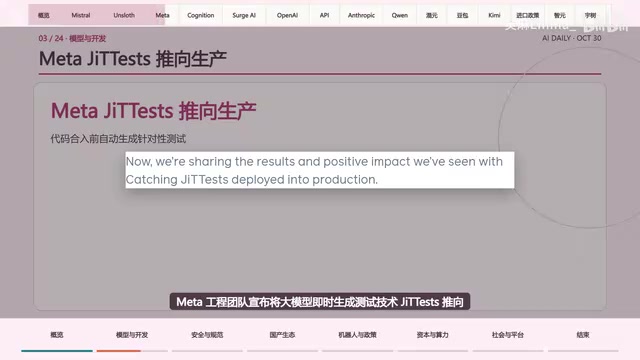
Mistral Large 4 opens its weights, a 1-trillion-parameter MoE architecture that can run locally on MacStudio; Meta's test-generation technology enters production; top tax benchmark pass rate only 10.8%; Canadian government takes a stake in Cohere; Doubao Work opens third-party model calls. This AI Morning Brief rounds up model, ecosystem, capital, and policy developments.

Mistral Large 4 Goes Open Source: A 1T-Parameter European Qwen Challenging DeepSeek
Mistral Large 4 is now open source: 1T total parameters, 52B activated, focused on coding and cybersecurity, with ~610G NVFP4 weights. We analyze its comparison with DeepSeek V4 Flash, API pricing, demo realism, and local deployment value.