AI SDK Workflow Harness 1.0.155 Patch Update Analysis

@ai-sdk/workflow-harness releases patch 1.0.155, mainly aligning with the underlying harness version.
AI SDK's @ai-sdk/workflow-harness releases patch 1.0.155, auto-published by GitHub Actions with 6 commits merged to main. It's a patch update mainly aligning the wrapper package with @ai-sdk/harness@1.0.155 rather than adding new API capabilities. The release commit is GPG-signed for traceability. Developers should verify version consistency, regenerate lockfiles in CI, and run regression tests.
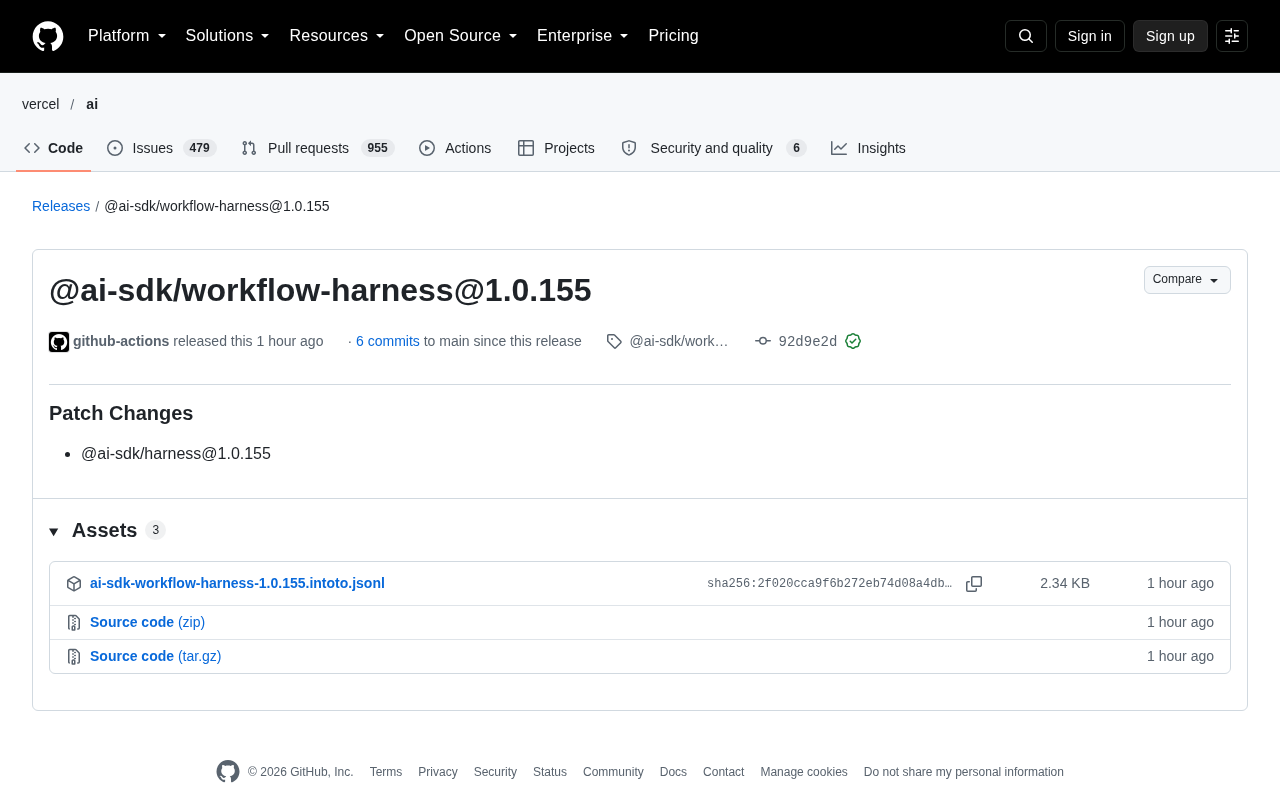
@ai-sdk/workflow-harness in the AI SDK ecosystem has released version 1.0.155. This is a patch-level iteration, published via GitHub Releases, automatically released by the github-actions bot, with a total of 6 commits merged into the main branch.
Version Positioning: What a Patch Update Means
Judging from the semantic version number, 1.0.155 is a patch version, which typically points to bug fixes, dependency synchronization, or minor internal implementation adjustments rather than new user-facing features. The release notes list only one Patch Changes entry, @ai-sdk/harness@1.0.155, indicating that the core of this update is keeping workflow-harness version-aligned with the underlying harness package.
This "synchronized version number" release pattern is common among the AI SDK series of packages managed in a monorepo: once the underlying capability package has a minor fix, the upper-layer wrapper package follows with a release to prevent consumers from encountering version mismatches during dependency resolution. For developers currently using this toolkit to build AI workflows, the main benefit of upgrading to 1.0.155 is dependency consistency and potential internal fixes, not new capabilities at the API level.
Semantic Versioning (SemVer) divides version numbers into three parts: major, minor, and patch, in the format MAJOR.MINOR.PATCH. An increment in the patch number indicates backward-compatible bug fixes, an increment in the minor number indicates backward-compatible feature additions, and an increment in the major number indicates changes that may break compatibility. This convention is widely followed by package manager ecosystems such as npm, but it is not mandatory, and some packages deviate from the spec. In monorepo scenarios, multiple packages either share the same version number (fixed/locked mode) or increment independently (independent mode). The former makes it easier for consumers to align dependencies, while the latter is more flexible. Understanding these two points helps assess the actual impact of patch releases like 1.0.155 on dependency resolution and upgrade costs.
Engineering Details of the Release Process
This release was completed automatically by GitHub Actions, and the commit carries a GitHub verified signature (GPG key ID: B5690EEEBB952194). This indicates that the release pipeline uses signature verification, making the provenance of the artifacts traceable and reducing supply chain risk. For teams introducing AI SDK-related dependencies in enterprise environments, this kind of signature verification information can serve as a reference for dependency audits.
The release page also provides 3 Assets downloads. Although the page displayed a frontend error prompt when loading the tag comparison and asset list, the patch version release itself has been completed, and developers can obtain it directly through a package manager.
GPG (GNU Privacy Guard) signatures are the authenticity verification mechanism for Git commits and tags. Developers sign commit objects with a private key, and services such as GitHub verify them with the corresponding public key. Once verification passes, a Verified badge is displayed next to the commit, along with the ID of the signing key. This mechanism proves that the commit was indeed created by the holder of the private key and that the content has not been tampered with, and it is a foundational element of software supply chain security (such as the SLSA framework). For enterprise users, the dependency audit process can check whether the release commits of key packages carry valid signatures, thereby reducing the risk of upstream compromise or artifact substitution. It should be noted that signatures guarantee provenance and integrity, which is not the same as code having undergone security review.
Practical Impact on Developers
If your project references @ai-sdk/workflow-harness through a package manager such as npm, patch updates can generally be completed seamlessly within the regular dependency upgrade process. Things to keep in mind:
- Check whether the version of
@ai-sdk/harnessin your project is aligned with 1.0.155, to avoid duplicate installations or version drift; - If you use a lockfile, it is recommended to regenerate it in CI and run the workflow-related tests;
- Since the release notes do not list specific fixes, if you have previously encountered issues related to the underlying harness, you can verify after upgrading whether they have been resolved.
From a broader perspective, the AI SDK's workflow toolchain is still iterating at high frequency. The dense appearance of patch versions indicates active maintenance, but it also reminds users to establish a stable version upgrade and regression testing strategy rather than blindly chasing the latest releases.
A lockfile (such as package-lock.json, pnpm-lock.yaml, or yarn.lock) records the exact versions and integrity hashes of the dependency tree, and it is key to ensuring consistent installation results across different environments. When upstream releases a patch version, if the lockfile is not updated, local and CI environments will still install the old version; if you upgrade directly, it may also introduce changes in transitive dependencies. Therefore, a common practice is to upgrade on a separate branch, regenerate the lockfile, and merge only after running the full test suite. In addition, when multiple packages in a monorepo share dependencies, version drift is easy to occur (the same package being installed in multiple different versions). You can investigate this with npm ls <package> or the package manager's dedupe capability, and if necessary, force version unification using the overrides/resolutions fields.
Conclusion
1.0.155 is a patch release centered on version alignment, completed by an automated pipeline and accompanied by signature verification. It does not bring significant feature changes, but it has practical significance for dependency consistency and supply chain traceability.
One-line Summary
@ai-sdk/workflow-harness releases patch version 1.0.155, primarily for alignment with the underlying harness version.
Paragraph Summary
The @ai-sdk/workflow-harness package in the AI SDK ecosystem has released patch version 1.0.155, automatically published by GitHub Actions, with 6 commits merged into the main branch. As a patch update, the core change is keeping the upper-layer wrapper package version-aligned with the underlying @ai-sdk/harness@1.0.155, rather than introducing new API capabilities. The release commit carries GPG signature verification, making artifact provenance traceable and valuable for supply chain audits. The article suggests that developers check whether the @ai-sdk/harness version is consistent when upgrading, regenerate the lockfile in CI, and run workflow-related regression tests. Overall, this is a seamless update focused on dependency consistency, reflecting that the toolchain is still in a phase of high-frequency iteration.
Related articles

Agent Skills Beginner's Guide: From Concepts to Multi-Agent Collaboration in Practice
A comprehensive guide to Agent Skills: core concepts, components, the importance of Description, standardization, beginner learning paths, and multi-agent collaboration.

One Neuron Detects Both Cats and Cars? We Reproduced It and Found a New Explanation
The cat-car neuron reinterpreted: researcher Cammarata argues it distinguishes pointy from round, not cats from cars. We reproduced the experiment and found the new explanation holds on most inputs—but cars are the exception. The interpretability debate continues on language models.

MCP Server + Python Assistant: A MicroStation Design Efficiency Revolution
Explore the early preview of the MCP Server and Python Assistant in MicroStation 2026: custom tools in five minutes, intelligent sheet index checks, and how AI is reshaping drawing workflows to unleash design creativity.