@ai-sdk/workflow-harness 1.0.177 Patch Update Analysis
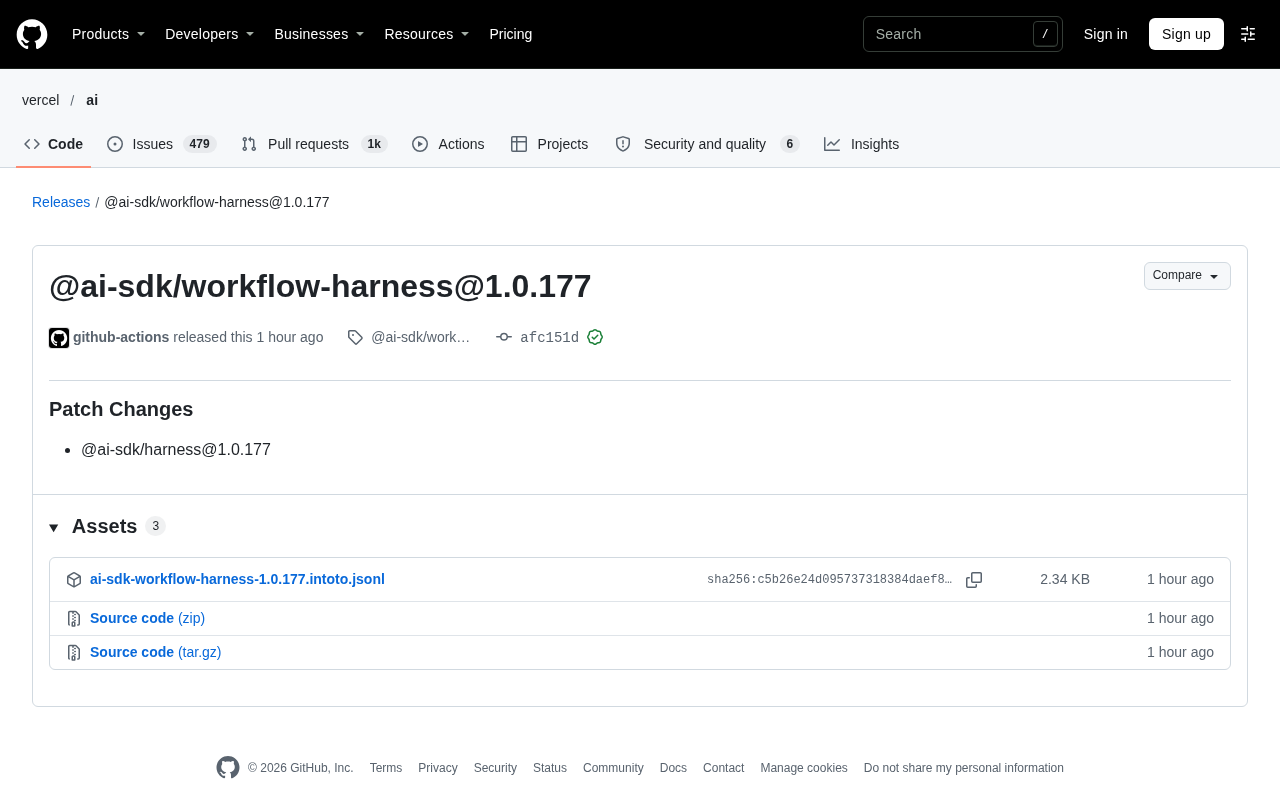
AI SDK workflow testing package releases patch 1.0.177 with automated signed release; harness must be upgraded in sync.
In the AI SDK ecosystem, @ai-sdk/workflow-harness releases patch version 1.0.177, automatically triggered by GitHub Actions and carrying a GitHub verified signature—a regular patch release cadence rather than a major feature change. The release also updates the companion @ai-sdk/harness@1.0.177, and the two must stay version-aligned to avoid interface mismatches. The article notes that the 1.0.x series should not contain breaking changes per SemVer conventions, so upgrade cost is low, but the release record does not disclose specific fixes. Therefore, it is still recommended to run existing test cases in the development environment first and confirm consistent behavior before pushing to production dependencies. For these high-frequency patch-released foundation components, small-step follow-up using dependency update tools with CI testing is usually safer than staying on an old version for a long time.
The @ai-sdk/workflow-harness package in the AI SDK ecosystem has released version 1.0.177, a patch-level update. For developers relying on the AI SDK to build agent workflows, understanding the positioning of these small version iterations helps determine when to upgrade and how to assess risk.
Background and Positioning of the Release
@ai-sdk/workflow-harness is the component in the AI SDK family responsible for workflow orchestration and testing. According to the GitHub release records, 1.0.177 was created by the automated release process github-actions, and the commit carries a GitHub verified signature. It follows the regular patch release cadence rather than representing a major feature change.
Patch versions semantically usually point to bug fixes, dependency synchronization, or internal refactoring. This release notes Patch Changes and also updates the companion @ai-sdk/harness@1.0.177. This means the two packages stay version-aligned, and developers need to pay attention to whether their dependency relationship is adjusted in sync when upgrading.
Semantic Versioning (SemVer) is key background for understanding this type of release. SemVer stipulates that version numbers take the form major.minor.patch: a major version change indicates incompatible API modifications, a minor version increase indicates backward-compatible new features, and a patch number increase represents backward-compatible bug fixes. 1.0.177 stays on the 1.0.x branch, meaning by convention there should be no breaking changes. In practice, however, patch versions can still indirectly change behavior through dependency upgrades or internal refactoring, so "no expected breaking changes" does not equal "zero risk."
What to Watch For in the Patch Update
Automated Release and Signature Verification
This version was automatically triggered for release by GitHub Actions, and the commit records show it has passed GitHub's verified signature mechanism, including GPG key information. This release approach is increasingly common in open-source projects, and its value lies in ensuring the traceability of release artifacts and reducing the risk of inconsistency caused by manual operations.
For enterprise users, signature verification can serve as part of supply chain security. Checking the commit signature status before adopting a new version is a low-cost but effective protective habit.
GPG signatures and GitHub verified signatures are two specific mechanisms in supply chain security. GPG (GNU Privacy Guard) is based on asymmetric encryption: the committer generates a signature on the commit content with a private key, and anyone can use the corresponding public key to verify that the commit was indeed created by the holder of that key and has not been tampered with. GitHub's verified signature mechanism builds on this by recording the signature status and displaying a Verified badge next to the commit. For packages automatically released through CI, signatures are usually completed by bot accounts or dedicated keys, and their significance lies in confirming that the artifact was generated by a trusted release pipeline rather than by human impersonation.
Companion Package Updated in Sync
The release records explicitly list that @ai-sdk/harness@1.0.177 was also updated with this release. Workflow testing-related packages and the main harness package usually need version alignment; otherwise, interface mismatches may occur. When upgrading @ai-sdk/workflow-harness, developers should also check the version of @ai-sdk/harness to avoid workflow execution anomalies caused by version misalignment.
Monorepo and fixed version strategy explain why the two packages need to be upgraded together. The AI SDK ecosystem very likely uses a monorepo to manage multiple interdependent packages, and during release, tools such as changesets are used to bump version numbers in a unified way. If @ai-sdk/workflow-harness and @ai-sdk/harness have a peer dependency or runtime contract, version misalignment may throw errors during module resolution or interface calls. Therefore, when upgrading, treat the two as a whole and check whether the actual versions resolved in the lockfile are consistent.
Practical Impact on Developers
The upgrade cost of a patch version is usually low, but that does not mean you can upgrade blindly. Based on the release information, you can judge from the following points:
- Version semantics: 1.0.177 belongs to the 1.0.x series and does not cross a minor version number, indicating there is no expectation of breaking changes.
- Dependency linkage: The harness-related packages need to be upgraded together; upgrading only one package may introduce hidden incompatibilities.
- Release channel: Released through an automated process with a signature, the source has relatively high credibility.
If the project has high stability requirements for workflow testing, it is advisable to run existing test cases in the development environment before upgrading, and only push to production dependencies after confirming consistent behavior.
How to Follow Subsequent Versions
For projects with such high-frequency patch releases, manually tracking every version is unrealistic. A more practical approach is to pay attention to version notifications from the package manager, or use dependency update tools to automatically create upgrade PRs, and then decide whether to merge based on CI test results. For workflow foundation components like @ai-sdk/workflow-harness, keeping up with minor versions is usually safer than staying on an old version for a long time, because accumulated patch fixes often involve handling edge cases.
It should be noted that this release record does not disclose the specific fixes or change details, so it is impossible to determine whether there are changes affecting specific usage scenarios. The safer strategy for developers when upgrading is to rely on actual test results.
Related articles

Seven Years of Evolution: How Far Has the Foldable Come From the First Generation?
From the first foldable to today's latest models, what has seven years changed? Shallower creases, higher brightness, thinner bodies, and smoother software migration—has the foldable crossed the chasm from enthusiasts to ordinary users? This article discusses the question based on a video comparison.

When Did Humans Start Eating Salt? A 10,000-Year History of Salt
When did humans start eating salt? From salt use at the dawn of agriculture 11,000 years ago to ancient seawater evaporation and rock salt mining, and on to the salt trade, salt taxes, and Gandhi's Salt March, this article traces salt's key role in human civilization.
Microsoft Paza Research: How African Language Speech Recognition Breaks Through Architecture and Data Bottlenecks
Microsoft's Paza research evaluates 53 speech models across 39 African languages, revealing architecture choice matters more than pre-training coverage, 200-300 hours is the practical data threshold, and language typology deeply influences recognition performance.