AI SDK Workflow Harness Releases 1.0.186 Patch Update

@ai-sdk/workflow-harness releases patch 1.0.186, auto-built and pushed by CI, aligned with the harness version.
@ai-sdk/workflow-harness in the AI SDK ecosystem has released patch 1.0.186, automatically built and pushed to the main branch by GitHub Actions. The commit record contains only 1 commit marked as Patch Changes, linked to @ai-sdk/harness@1.0.186. The article notes that a patch increment typically corresponds to bug fixes, minor internal adjustments, or dependency sync rather than new features—a "silent improvement" for developers building agents or workflow orchestration with the AI SDK, requiring no business code changes. The two packages keep aligned version numbers, reflecting tight release coupling; upgrades should keep versions aligned. Since the release page lacks detailed change notes, it's recommended to assess upgrade necessity through commit diffs, running existing workflow cases locally or in CI, and checking indirectly introduced harness versions in the dependency tree.
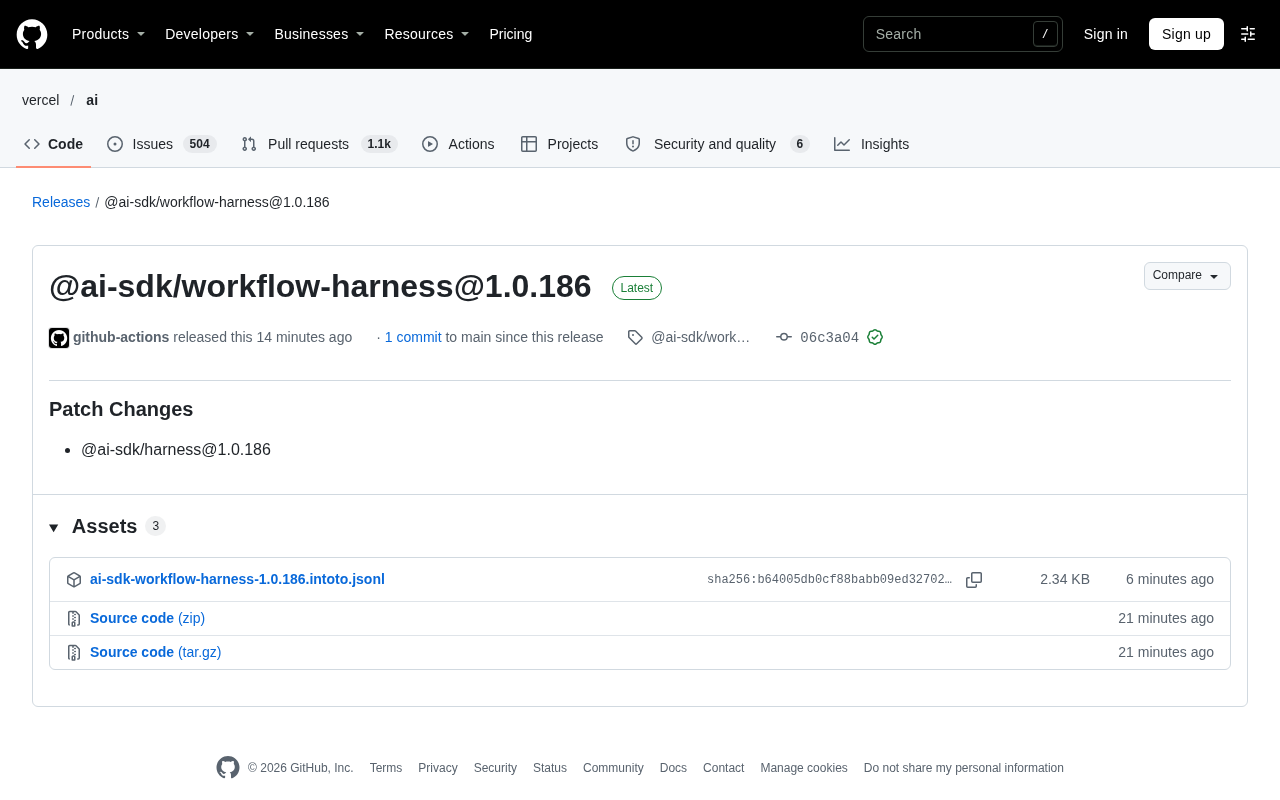
@ai-sdk/workflow-harness in the AI SDK ecosystem has released version 1.0.186. This is a patch-level update, automatically built and pushed to the main branch by GitHub Actions. The commit record contains only 1 commit, with the message "Patch Changes" and linked to @ai-sdk/harness@1.0.186.
What This Update Means
Based on the release page information, 1.0.186 is a typical patch release (Patch Changes). Under semantic versioning conventions, an increment in the patch number typically corresponds to bug fixes, minor internal logic adjustments, or dependency synchronization—not new features. The release was completed by the github-actions bot, indicating that the repository has established an automated release pipeline with a version iteration cadence driven by CI.
For developers using the AI SDK to build agents or workflow orchestration capabilities, such updates are more like "silent improvements": no business code changes are required, but it's worth paying attention to whether builds and tests still pass when upgrading dependencies. Since this release comes without detailed change notes, the actual impact scope needs to be confirmed by diffing the before and after versions.
Semantic Versioning (SemVer) is the most commonly used version numbering convention in the npm ecosystem, with the format major.minor.patch (e.g., 1.0.186). According to the spec: a major version increment indicates incompatible API changes; a minor version increment indicates new backward-compatible functionality; a patch increment indicates backward-compatible bug fixes. Therefore, changes from 1.0.185 to 1.0.186 should theoretically not break existing callers. It's worth noting that SemVer is a convention rather than a mandate—in practice, some packages release behavioral adjustments under patch numbers, which is why the article recommends confirming actual impact through diffs and tests. In dependency declarations, ^1.0.186 allows automatic upgrades to the latest 1.x version, while ~1.0.186 only allows patch upgrades within 1.0.x. Teams can use this to control the granularity of automatic updates.
GitHub Actions-driven automated releases are typically implemented with tools like Changesets: developers attach change description files when submitting PRs, and after merging, the bot aggregates these files, automatically increments the version number, generates the CHANGELOG, tags the release, and publishes to the npm registry. The advantage of such pipelines is a stable release cadence with fewer manual errors; the trade-off is that the amount of information on the release page depends on whether change descriptions are maintained. When the commit message is simply "Patch Changes," it indicates that this release was likely generated by the bot batch-consuming changesets, with human-readable notes omitted. For investigation, you can start from the commit corresponding to the release tag, use git diff v1.0.185 v1.0.186 to view the actual changes, or use npm's npm diff command to compare the contents of the two published packages.
The Role of @ai-sdk/harness
This patch sync involves @ai-sdk/harness. In the AI SDK's organization, the harness typically handles runtime hosting and assembly responsibilities, providing foundational capabilities for upper-layer workflow execution. @ai-sdk/workflow-harness, on the other hand, is closer to the workflow use case, connecting model calls, step orchestration, and execution context together.
The two packages maintain consistent version numbers, reflecting a tight release coupling between them. When upgrading, developers should ensure these two packages stay version-aligned to avoid interface mismatches caused by mixing different versions.
How to Follow Such Automated Releases
A practical problem with automated releases is low information density. This release page itself does not list specific change items—only the patch change type and corresponding commit. To assess whether an upgrade is necessary, developers are advised to take the following approaches:
- Locate the corresponding commit in the repository's commit history to view the actual changed files and logic
- Run existing workflow test cases locally or in CI to verify whether behavior meets expectations
- Check whether
@ai-sdk/harnessis indirectly introduced in the dependency tree to avoid version conflicts
Summary
1.0.186 is a routine patch release whose value lies not in new features but in maintaining the stable evolution of the workflow toolchain. For teams building complex agent systems on the AI SDK, establishing a routine follow-up mechanism for such minor version updates is more meaningful than chasing individual changes.
Related articles

AI Writes Your Code—Do You Still Need to Learn Git? Five Reasons
AI coding agents handle Git operations automatically—is it still necessary to learn Git? Five reasons: team communication, reviewing agent PRs, monitoring code changes, fallback when AI goes down, and the joy of learning—plus how the focus of learning Git is shifting in the agent era.

Anthropic Reportedly Prices IPO at $83 Per Share, Valuing Company at $1.5 Trillion
Anthropic reportedly prices IPO at $83 per share, above the expected range, with a fully diluted valuation of $1.5 trillion. This article analyzes the signal significance of the pricing and its impact on the AI industry's financing environment.

Open-Source Code Hosting Platform Codeberg Suffers Outage, Sparking Debate in Developer Community
Open-source code hosting platform Codeberg.org suffered an outage, sparking Hacker News debate over nonprofit platform stability and open-source infrastructure dependency risks.