AI SDK Workflow Harness Toolkit 1.0.173 Released: A Patch Update

@ai-sdk/workflow-harness releases patch 1.0.173 solely to sync the harness dependency version.
The article explains the release of @ai-sdk/workflow-harness 1.0.173. This patch was auto-published by the GitHub Actions bot with GPG-signed commit verification, and the core change is merely syncing the @ai-sdk/harness@1.0.173 dependency—a common monorepo version-following strategy. The author notes such patches usually don't involve breaking API changes, so developers generally need not modify business code; the asset loading errors on the Release page are more likely a GitHub rendering issue, and npm registry info should be authoritative. For fast-iterating AI SDK packages, lock the major version, test regularly in CI, upgrade proactively only for features or security advisories, and include signatures in supply chain audits.
Title
AI SDK Workflow Harness Toolkit 1.0.173 Released: A Patch Update
Meta Description
AI SDK workflow toolkit @ai-sdk/workflow-harness releases patch version 1.0.173, syncing the @ai-sdk/harness dependency, auto-published by GitHub Actions with signature verification. This article explains the changes, the version-following strategy, and upgrade advice for developers.
Article Content
The @ai-sdk/workflow-harness in the AI SDK ecosystem has released version 1.0.173. This is a patch update driven by an automated pipeline, with the core change focused on synchronizing the version of the dependency package @ai-sdk/harness. For developers following the AI programming toolchain, the signal behind the version number is more noteworthy than the update content itself.
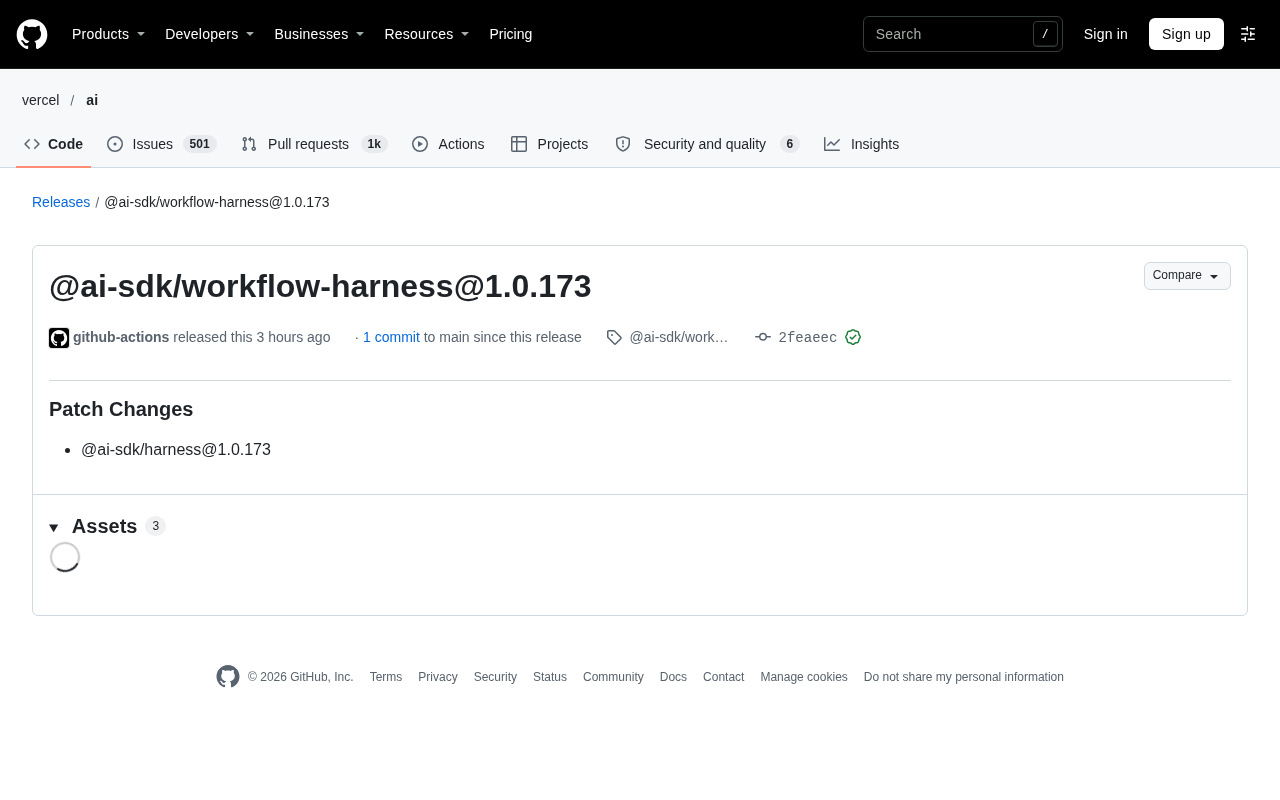
Release Overview: Automation and Signature Verification
According to the GitHub Release page, this version was published by the github-actions bot at 01:24 AM on November 3, corresponding to a commit on the main branch (commit hash 2feaeec). The commit carries a GitHub-verified signature with GPG key ID B5690EEEBB952194, indicating that integrity verification of the release pipeline is enabled.
This release pattern is common in mature open-source projects: version numbers are advanced automatically by the CI pipeline with minimal human intervention. It reflects the degree of engineering maturity rather than a functional breakthrough.
Monorepo and Version-Following Strategy
A monorepo refers to managing multiple interrelated packages in a single code repository, with common tools including pnpm workspaces, Turborepo, and Nx. In an ecosystem like AI SDK that consists of multiple packages, @ai-sdk/harness and @ai-sdk/workflow-harness are likely part of the same monorepo, sharing the build pipeline and release process. Toolchains (such as changesets) can write change records for multiple packages in a single commit and advance version numbers uniformly, resulting in the phenomenon where "sub-package version numbers always align with the main package." The advantage of this approach is clear dependency combinations and avoidance of version mismatches; the downside is that the Release record of an individual package becomes a pipeline artifact, making it difficult to reconstruct the actual scope of changes when reading it, requiring reference to the upstream main package's changelog or commit history.
Changes: Patch-Level Dependency Sync
The change type marked in the Release notes is Patch Changes, with the specific content being @ai-sdk/harness@1.0.173. In other words, the workflow-harness package itself has no independent feature description; its update is to stay version-aligned with the harness main package.
This "version-following" strategy is quite common in monorepo-managed SDKs. The benefit is clear version semantics—as long as you see that workflow-harness and harness share the same version number, you can determine that the two are in a matched state; the cost is that looking at a single package's Release page alone makes it hard to tell what actually changed.
Semantic Versioning and Patch Updates
The npm ecosystem generally follows the Semantic Versioning (SemVer) specification, with version numbers in the form major.minor.patch. An increment in the patch position (e.g., 1.0.172 → 1.0.173) by convention includes only backward-compatible bug fixes and should not introduce new features or breaking changes; a minor increment indicates backward-compatible new features; only a major increment allows incompatible API adjustments. This is also the basis for judging in this article that "this update most likely does not require modifying business code." However, SemVer is only a community convention rather than a mandatory constraint, and some packages may carry behavioral changes even in patch versions. Therefore, for production dependencies, locking version ranges (e.g., ~1.0.173 accepts only patch updates, ^1.0.173 accepts minor updates) combined with CI regression testing is more reliable than simply trusting the version number.
Practical Impact on Developers
If you use @ai-sdk/workflow-harness in your project, this update most likely does not require modifying business code. Patch versions typically include only internal fixes or dependency adjustments and do not involve breaking API changes.
But there is one detail worth noting: the Assets section of the Release page shows 3 asset files, and several error messages ("There was an error while loading") appeared during page loading. From the screenshot, this looks more like a GitHub page rendering issue rather than missing release packages. Before actually downloading and installing, it is advisable to refer to the package information on the npm registry.
GPG Signatures and Supply Chain Traceability
GPG (GNU Privacy Guard) is an encryption and signing tool based on the OpenPGP standard. GitHub supports signing commits and tags with GPG keys, and after verification passes, a "Verified" badge is displayed next to the commit. The key ID (such as B5690EEEBB952194) is a short identifier of the public key, which can be used to look up the corresponding public key and its ownership on key servers. For teams concerned about supply chain security, "whether commits or release tags carry valid signatures" can be incorporated into automated checks, for example, verifying the signature status of the release source in CI; combined with npm-side provenance attestations (recording the build source and repository address) and lockfile verification, this forms a traceable chain from source commit to release artifact. It should be noted that signatures only prove the release source and integrity, and do not mean the code has undergone a security audit.
How to Keep Up with Such High-Frequency Releases
Packages related to AI SDK iterate quickly, and patch versions like 1.0.173 will continue to appear. For most teams, tracking each Release page is too costly; a more practical approach is to lock the major version number (1.x), run tests regularly in CI, and upgrade proactively only when feature requirements or security advisories arise.
For teams that need to audit the release source, GitHub verified signatures and GPG key IDs are metadata that can be incorporated into supply chain checks. Although this release is an automated artifact, the signature chain is complete and meets traceability requirements.
Overall, 1.0.173 is a routine patch release with limited information value. Its value lies in maintaining the version-matching relationship rather than introducing new capabilities.
One-line Summary
@ai-sdk/workflow-harness releases patch 1.0.173 solely to sync the harness dependency version.
Paragraph Summary
The article explains the release information for @ai-sdk/workflow-harness version 1.0.173. This patch was automatically published by the GitHub Actions bot, with the commit carrying GPG signature verification, and the core change is merely syncing the @ai-sdk/harness@1.0.173 dependency, a version-following strategy common in monorepos. The author notes that such patch versions typically do not involve breaking API changes, so developers generally do not need to modify business code; the asset loading errors on the Release page are more likely a GitHub rendering issue, and npm registry information should be taken as authoritative. For high-frequency-iterating AI SDK packages, it is recommended to lock the major version, run tests regularly in CI, upgrade proactively only for feature requirements or security advisories, and incorporate signature information into supply chain audits.
Related articles

AI Can Read Neural Network Weights Directly: Do Models Already Exceed Expectations?
A Reddit developer experiment shows language models can directly read neural network weights and infer their function. Astra, Opus 5.5, and Muse Spark 1.3 all passed the test, sparking discussion on model generalization and training sources.

India's Microdrama Market Explodes: EloElo Secures $80M Investment from NBCUniversal
EloElo secures $80M from NBCUniversal to boost StoryTV, its microdrama platform with over 33M monthly active users, as India's microdrama market draws global capital.

Acoustic Detection of Multi-Rotor UAVs: Fusing Handcrafted Features with Pre-Trained Embeddings
Study reveals data leakage from random splits in UAV acoustic detection, proposes source-disjoint protocol with stacked ensemble of handcrafted features and YAMNet embeddings, achieving 95.29% accuracy for low-cost drone detection.