AI SDK xAI 2.0.102 Update: The Ecosystem Signals Behind a Dependency Upgrade

@ai-sdk/xai 2.0.102 is a pure patch update that only synchronizes upstream dependencies, with no API changes.
@ai-sdk/xai has released patch version 2.0.102, introducing no new features or breaking changes; the only substantive change is the tandem upgrade of @ai-sdk/openai-compatible@1.0.61 and @ai-sdk/provider-utils@3.0.44. The article notes that this adapter package does not directly depend on the official xAI SDK but is built on the openai-compatible intermediate layer, sharing common logic such as stream parsing and tool calling from provider-utils. This layered design lowers the cost of adding new providers, but it also lets upstream changes propagate down the dependency tree, with indirect risks concentrated in streaming output and tool call parameter serialization. The version was automatically published by github-actions, reflecting AI SDK's fast, small-step maintenance cadence. Developers are advised to run integration tests when upgrading; production environments should pin versions, while experimental phases can follow patches to get upstream fixes.
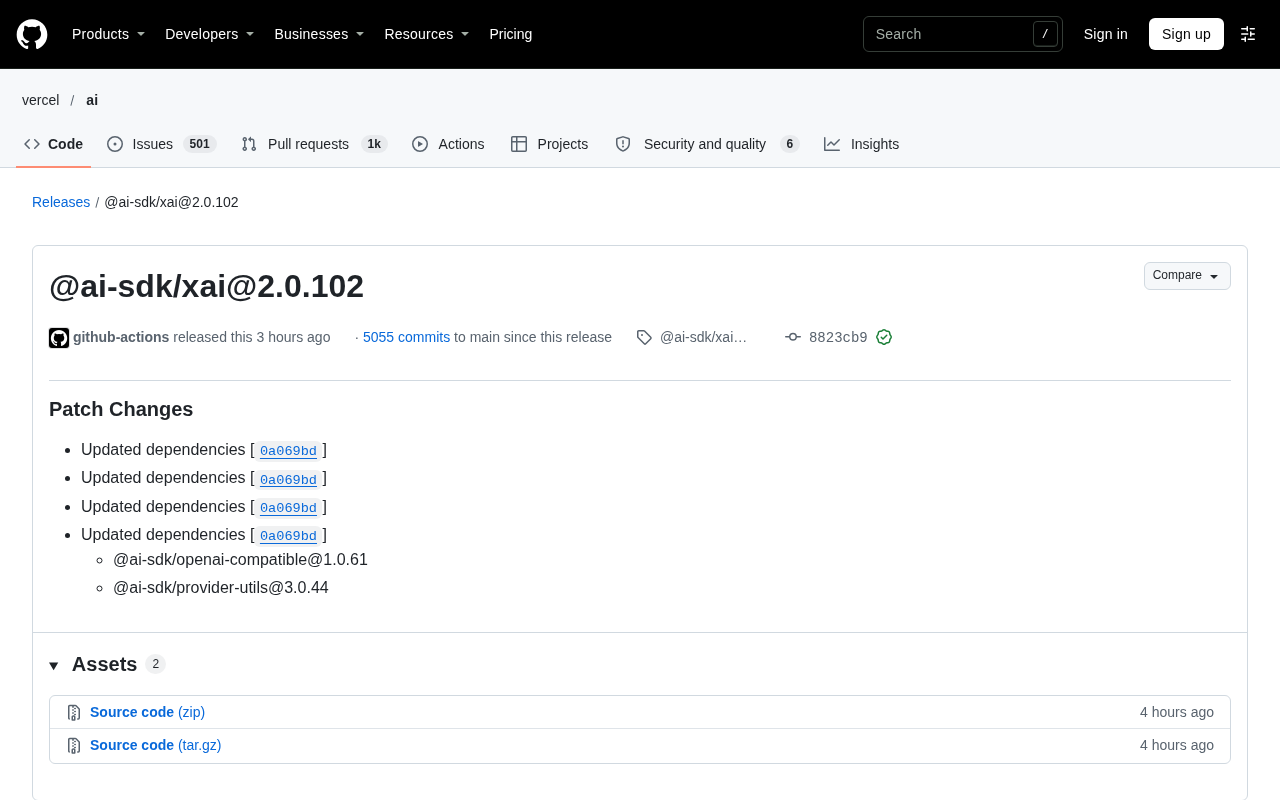
The xAI adapter package for Vercel's AI SDK, @ai-sdk/xai, has released version 2.0.102. Judging from the GitHub release record, this is a typical patch update: no new feature announcements, no breaking change notes, and the only substantive change centers on synchronizing the dependency chain. For developers who use AI SDK to build applications day to day, this kind of version often goes unnoticed—but it happens to expose an easily underestimated link in the AI toolchain: the version coupling between the adapter layer and the underlying protocol.
Breaking Down the Patch: A Chain-Reaction Dependency Update
According to the GitHub release page, all change entries for @ai-sdk/xai@2.0.102 point to the same commit (0a069bd), appearing as multiple "Updated dependencies" records. Specifically, this update upgraded two key packages in tandem: @ai-sdk/openai-compatible@1.0.61 and @ai-sdk/provider-utils@3.0.44.
This dependency structure is worth noting. The xAI adapter package does not directly depend on an official xAI SDK; instead, it is built on top of the openai-compatible layer. In other words, AI SDK treats xAI's API as a compatible implementation of the OpenAI interface specification, handling common logic such as request construction, streaming responses, and error mapping through the shared provider-utils. This design greatly reduces the marginal cost of adding new model providers, but it also means that any change to the upstream provider-utils will propagate down the dependency tree.
Why "Just Upgrading Dependencies" Still Deserves Attention
provider-utils is the foundational package in AI SDK that carries provider-agnostic logic, covering cross-cutting concerns such as stream parsing, tool calling formats, and token counting. A minor version bump may have fixed parsing issues under certain edge conditions, or it may have adjusted default retry or timeout policies. The release record does not detail the specific differences, but for teams currently using xAI models, running the existing integration tests after upgrading is still a prudent move.
openai-compatible is an abstraction layer in the AI SDK ecosystem that encapsulates the HTTP protocol details of the OpenAI Chat Completions style (such as request body structure, SSE streaming response format, and error code semantics). Many third-party providers (including xAI, DeepSeekAd, Together, etc.) design their APIs to imitate or be compatible with the OpenAI specification, so they can reuse the same client logic. The benefit of this approach is avoiding repeated implementation of stream parsing and retry mechanisms for each provider, but the cost is that the compatibility layer cannot cover provider-specific extension fields, which require additional adaptation.
provider-utils, on the other hand, is a lower-level toolkit that provides general capabilities unrelated to any specific provider: chunked parsing and reassembly of SSE streams, incremental serialization of function calling parameters, cumulative counting of usage tokens, and default policies for request timeouts and retries. It is shared by all provider adapter packages, so a tiny version change may simultaneously affect the integration behavior of multiple providers—which is also the main source of indirect dependency risk.
AI SDK's Maintenance Strategy as Seen from Its Release Cadence
This release was automatically published by the github-actions bot, and the commit history shows 5055 commits from the mainline. Automated publishing combined with high-frequency patches reflects a "small steps, fast iteration" maintenance model adopted by the AI SDK team: feature iterations go through minor versions, while dependency synchronization and historical issue fixes go through patch versions, minimizing the time window from upstream changes to downstream availability.
The Engineering Trade-offs Behind Automated Publishing
Bot-driven releases mean repeatable processes and fewer human errors, but they also require the dependency updates themselves to be safe enough. AI SDK isolates most provider differences through the openai-compatible intermediate layer, so that adapter packages like xAI can, in most cases, simply follow the upstream version number. The cost is that when multiple adapter packages share the same set of provider-utils, a single upstream change may affect the integration code of multiple providers at once, making regression test coverage critical.
github-actions bot releases are usually driven by tools like changesets or semantic-release: whenever a PR merged into the main branch includes dependency updates, the tool automatically calculates the version number, generates a changelog, and publishes to npm. This workflow is especially common in monorepos, because manually synchronizing the version numbers of dozens of packages is highly error-prone. AI SDK uses a monorepo structure to manage the @ai-sdk/* series of packages, with shared dependency versions constrained uniformly by the root-level lockfile, so a single upstream provider-utils release can trigger a chain of patch releases across all downstream adapter packages.
Practical Impact on Developers
If you call xAI models through AI SDK in your project, 2.0.102 is a version you can upgrade to directly. It introduces no API-level changes, and the risk mainly comes from indirect dependencies. After upgrading, it is recommended to focus on verifying the integrity of streaming output and the parameter serialization of tool calls—these two areas are most susceptible to provider-utils version changes.
Pin Versions or Follow Updates
For production environments, pinning @ai-sdk/xai to a verified version and locking transitive dependencies via the lockfile is the more conservative choice. For projects still in rapid experimentation, following patch updates allows you to get upstream fixes earlier. Neither strategy is inherently right or wrong; it depends on the team's tolerance for dependency changes and the maturity of its testing infrastructure.
This update itself carries limited information, but it hints at a broader fact: the toolchain for AI applications is forming a layered structure—model providers, compatibility protocol layers, and SDK adapter layers each evolve independently, bound to one another through version constraints. Understanding this dependency relationship has more long-term value than memorizing any particular patch version number.
One-line Summary
@ai-sdk/xai 2.0.102 is a pure patch update that only synchronizes upstream dependencies, with no API changes.
Paragraph Summary
@ai-sdk/xai has released patch version 2.0.102, introducing no new features or breaking changes; the only substantive change is the tandem upgrade of @ai-sdk/openai-compatible@1.0.61 and @ai-sdk/provider-utils@3.0.44. The article notes that this adapter package does not directly depend on the official xAI SDK but is built on the openai-compatible intermediate layer, sharing common logic such as stream parsing and tool calling from provider-utils. This layered design lowers the cost of adding new providers, but it also lets upstream changes propagate down the dependency tree, with indirect risks concentrated in streaming output and tool call parameter serialization. The version was automatically published by github-actions, reflecting AI SDK's fast, small-step maintenance cadence. Developers are advised to run integration tests when upgrading; production environments should pin versions, while experimental phases can follow patches to get upstream fixes.
Related articles

Qwen 3.8 Beats Opus at Coding—But Can Your Mac Run It?
Open-source Qwen 3.8 beats Opus 4.6 at coding at just 18GB, but how much Mac memory do you need? 24GB crashes; 32GB is the sweet spot. Full config guide inside.

Claude Code + Agent: Building a Fully Automated AI Testing Loop
Bilibili course breakdown: how test developers can use Claude Code terminal-based Agents to build a fully automated AI testing loop. Compares permission boundaries of terminal vs. device Agents, explains why enterprise projects choose Claude Code over Open Claude-type tools, and outlines the Node.js environment setup and DeepSeek model integration path.

Working with AI Agents Requires Nerves of Steel
The more autonomous AI agents become, the heavier the user's psychological burden. Drawing from a Hacker News discussion, this article analyzes black-box anxiety, behavior drift, and monitoring fatigue in agent collaboration, and offers practical approaches like sandbox isolation, permission control, and task granularity management to reduce cognitive load.