@ai-sdk/xai 2.0.98 Released: Dependency Updates and Patch Fixes

Vercel AI SDK's xAI Provider releases patch 2.0.98 with internal dependency syncs and no new features.
The `@ai-sdk/xai` package in the Vercel AI SDK has released patch version 2.0.98, syncing upstream shared dependencies `@ai-sdk/provider-utils` and `@ai-sdk/openai-compatible` to their latest versions. Published automatically via GitHub Actions, this update includes no new features or behavioral changes. Notably, xAI's Grok models integrate through an OpenAI-compatible interface layer, reducing migration costs when switching providers. This low-risk patch is safe to adopt and helps maintain a healthy dependency chain.
Vercel's open-source AI SDK project recently released version 2.0.98 of @ai-sdk/xai. This is a patch-level update focused on syncing internal dependency versions — a maintenance release. For developers integrating xAI (Grok series models) using this SDK, this update doesn't introduce new features, but it's worth understanding the underlying dependency management logic.
What's in This Update
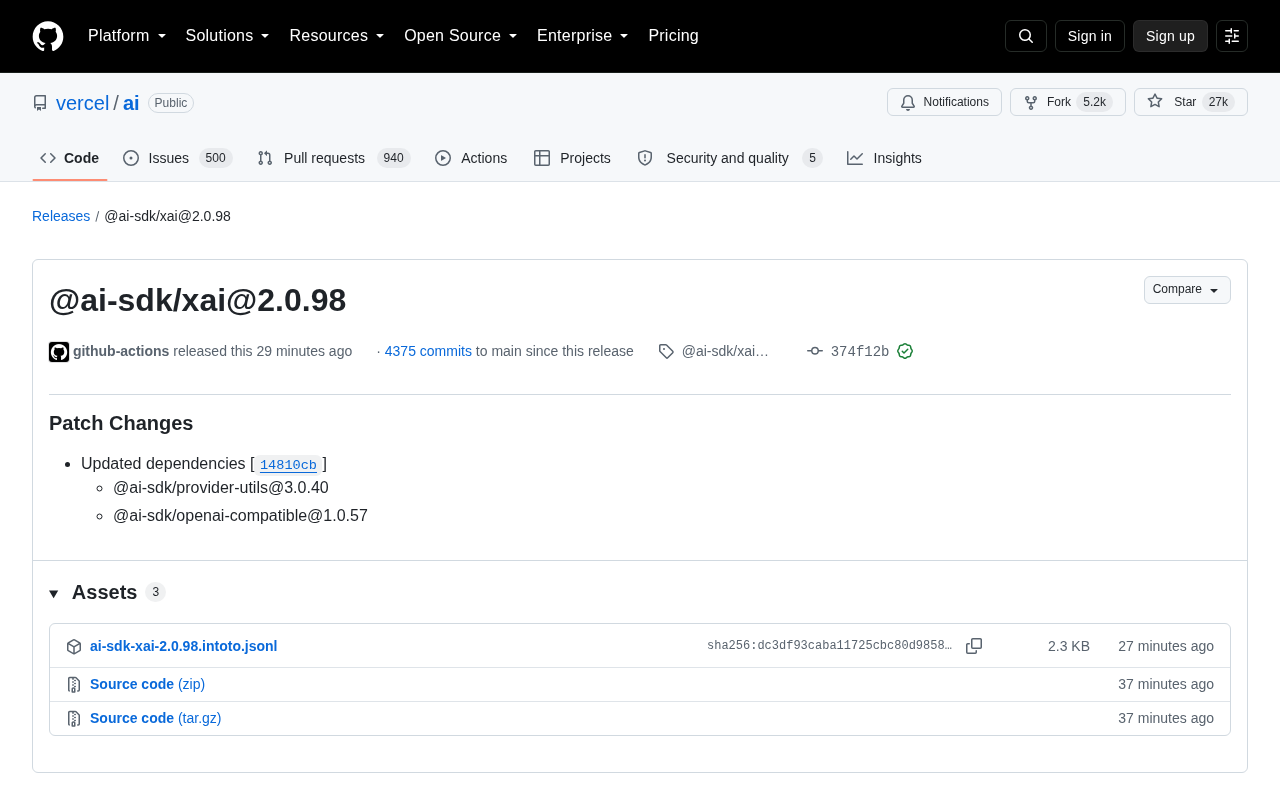
According to the GitHub Releases page, @ai-sdk/xai@2.0.98 falls under Patch Changes, with the core content being the synchronization of two upstream dependency packages:
@ai-sdk/provider-utils@3.0.40@ai-sdk/openai-compatible@1.0.57
This release was published automatically via GitHub Actions at commit hash 374f12b and passed GitHub's verified signing check. The version increment pattern reflects the AI SDK's adherence to Semantic Versioning (SemVer) — patch versions are reserved for backward-compatible bug fixes and dependency syncs, and should never introduce breaking changes.
Why Dependency Updates Matter
In modern AI application development, SDKs are becoming increasingly modular. @ai-sdk/xai serves as a Provider adapter layer within the Vercel AI SDK, and it depends on provider-utils (a shared utility library) and openai-compatible (an OpenAI-compatible interface layer).
The @ai-sdk/openai-compatible dependency is particularly noteworthy — it indicates that xAI's Grok models are integrated via an OpenAI-compatible API specification. This means developers can reuse much of the same interface logic when switching between model providers, significantly reducing migration overhead. When the compatibility layer is upgraded, the xAI Provider needs to sync accordingly to ensure consistent interface behavior between the two.
For developers, staying current with these patch updates helps avoid potential compatibility issues caused by mismatched dependency versions — especially in production environments that rely on lockfiles.
Semantic Versioning (SemVer) defines version numbers as a three-part
MAJOR.MINOR.PATCHstructure: Major version changes indicate breaking, incompatible API changes; Minor version changes introduce new backward-compatible features; Patch version changes are limited to backward-compatible bug fixes or dependency syncs and should not affect external behavior. In large monorepos like the Vercel AI SDK — which manages dozens of Provider packages in a single repository — whenever a shared base library (such asprovider-utils) releases an update, all packages that depend on it need to publish a corresponding patch version to "declare" that their dependency range has been updated. This cascading version sync is common in automated CI/CD pipelines and does not imply any logical changes within the individual Provider packages themselves.
Vercel AI SDK's Ecosystem Position
The Vercel AI SDK is a widely adopted TypeScript library for AI development, with approximately 27,000 GitHub stars and 5,200 forks, backed by an active community. Its design goal is to provide developers with a unified interface that abstracts away API differences across various LLM providers (such as OpenAI, Anthropic, xAI, and others).
By maintaining separate Provider packages for each vendor (like @ai-sdk/xai in this update), the SDK achieves clean decoupling. Developers simply install the relevant Provider and can access xAI's Grok models through a unified calling convention, without needing to worry about the underlying HTTP implementation details.
The Vercel AI SDK uses a monorepo architecture, orchestrated with Turborepo, with all Provider packages (
@ai-sdk/openai,@ai-sdk/anthropic,@ai-sdk/xai, etc.) managed under a single repository. Its core abstraction layer defines standard interface protocols such asLanguageModelV1, and each Provider package simply needs to implement this interface to plug seamlessly into the SDK's unified invocation pipeline. This architecture means that switching model providers at the code level often requires nothing more than replacing the Provider instance initialization — without touching higher-level business logic like streaming output, Tool Calling, or structured data generation. This significantly reduces the risk of vendor lock-in.
Upgrade Recommendations for Developers
For projects already using this SDK, patch updates like this are generally safe to adopt with minimal risk. It's recommended to run your existing test suite after upgrading to confirm that call behavior remains unchanged. If you're using a package manager's version locking mechanism, updating the lockfile will pull in the latest dependency tree.
It's worth noting that this release does not announce any new features or specific performance improvements — its value lies primarily in maintaining a healthy and consistent dependency chain. For teams prioritizing stability, following the official patch cadence with incremental upgrades is a sound practice for ensuring the long-term reliability of AI applications.
Related articles

Random Pruning of the DPO Computation Graph: 1.4x Training Speedup and Lower Peak Memory
DPO training too slow and memory-hungry? This paper proposes a random pruning framework for the DPO computation graph, sampling independently across position, sequence, and branch dimensions; branch pruning achieves a 1.426x step-time speedup and cuts training time by about 30%, with in-depth attribution of memory and time gains.

Why Does JEPA Underperform MLM in Longitudinal EHR Representation Learning?
New study compares JEPA and MLM for longitudinal EHR representation learning on MIMIC-IV: three JEPA variants train stably without collapse but underperform MLM; target size, not heterogeneity, drives prediction error.

Transfer Learning + Visible Light Communication: A New Approach to Energy-Efficient Indoor Positioning
A study proposes a transfer learning-based visible light communication indoor positioning method, achieving 47% accuracy improvement on the BOSCH factory dataset, 67.5% model efficiency under high noise, and introducing the ME composite metric for energy-efficient positioning in energy-constrained industrial IoT scenarios.