@ai-sdk/zai 2.0.22 Released: Aligning the provider-utils Dependency Chain
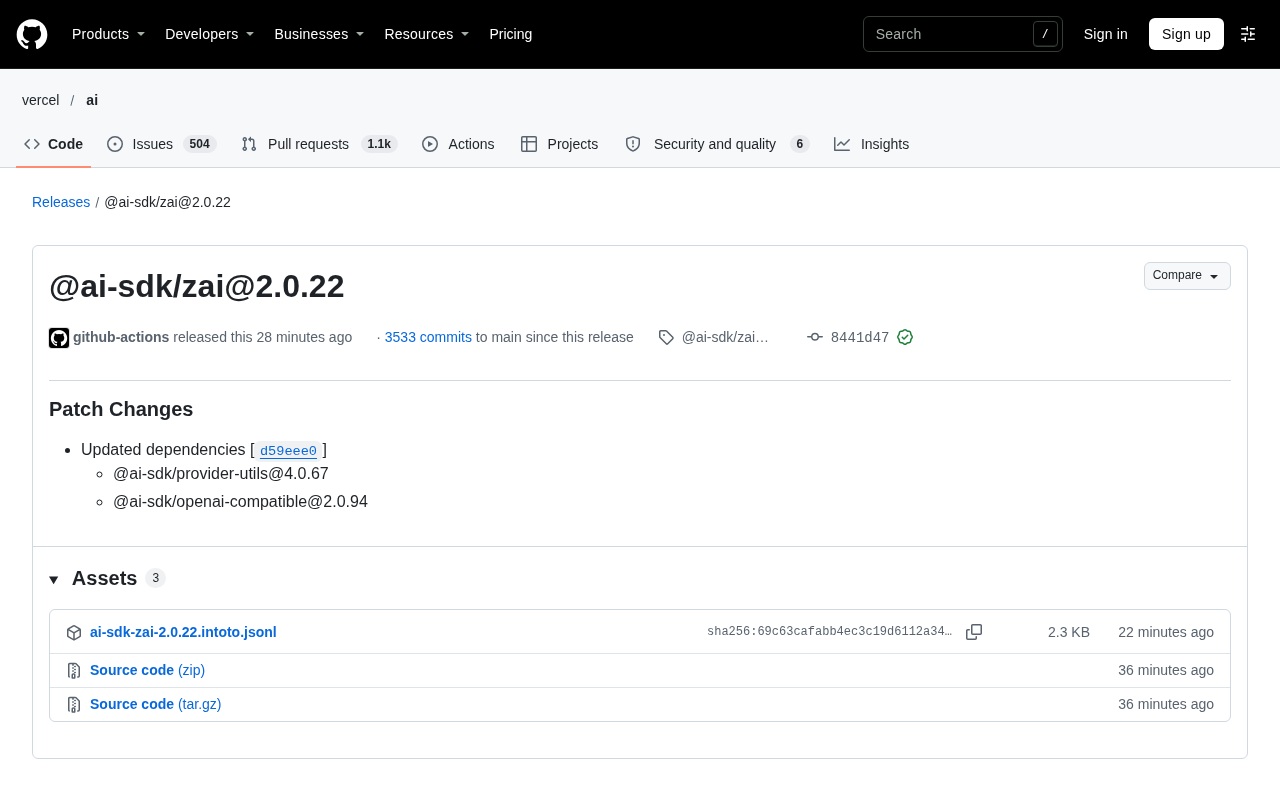
@ai-sdk/zai 2.0.22 is a pure patch update, only aligning upstream dependencies to deliver stability fixes.
@ai-sdk/zai released patch version 2.0.22, only updating the two underlying dependencies @ai-sdk/provider-utils and @ai-sdk/openai-compatible, with no changes to its own code logic. provider-utils is the shared utility layer for all providers in AI SDK, handling message conversion, streaming parsing, and other foundational capabilities; openai-compatible provides an integration template compatible with OpenAI's API. This change is essentially dependency alignment, delivering upstream edge-case fixes to end users. No business code changes are required for the upgrade, but be aware that shared dependencies may be hoisted uniformly—check lock files and run integration tests. The frequent patch releases reflect the high-frequency iteration cadence of the AI SDK mainline; regularly checking changelogs helps preemptively avoid issues.
A Quiet Patch Release
In the Vercel AI SDK ecosystem, @ai-sdk/zai is a relatively low-key package—it connects Z.ai's model capabilities to AI SDK's unified calling interface. When GitHub Actions pushed the @ai-sdk/zai@2.0.22 version, the release notes contained almost no new features, just a single Patch Changes entry: updating two dependencies, @ai-sdk/provider-utils@4.0.67 and @ai-sdk/openai-compatible@2.0.94.
This type of release is easy for readers to skip, but it reveals exactly how AI SDK collaboration works: individual provider packages don't evolve independently—they follow the rhythm of the underlying shared libraries.
The Dependency Chain Behind the Patch
@ai-sdk/provider-utils is the shared utility layer for all providers in AI SDK, handling message conversion, streaming response parsing, request header processing, and other foundational capabilities. @ai-sdk/openai-compatible provides a provider implementation template compatible with OpenAI's API specification—nearly all model integrations based on Chat Completions-style APIs reuse it.
The change in this @ai-sdk/zai release is essentially a dependency alignment: syncing its references to the utility layer and compatibility layer to the latest patch versions. The [d59eee0] specifically noted in the release record is the commit hash of this upstream change, indicating that the zai package itself has no code logic changes—it's simply following upstream forward.
@ai-sdk/provider-utils is the officially maintained shared toolkit for AI SDK, originally extracted as an abstraction layer from duplicate implementations within each provider. It encapsulates functions like postJsonToApi (unified HTTP request handling and error parsing), parseStream (breaking SSE streams into incremental chunks), and convertToCoreMessages (message format normalization). Any provider that follows AI SDK's LanguageModelV1 interface will indirectly depend on this utility layer.
@ai-sdk/openai-compatible is a "template provider" that parameterizes OpenAI Chat Completions request construction and response parsing logic, allowing downstream packages to complete integration by simply passing in baseURL, headers, and model mappings. Z.ai's API is highly similar to OpenAI in message format, so @ai-sdk/zai directly reuses this template rather than implementing from scratch.
Why Dependency Updates Warrant a Separate Release
From an engineering perspective, provider-utils patches often fix edge cases: missing fields, abnormal termination of streaming chunks, request body serialization details, etc. For downstream users, this typically means more stable calling behavior without changing business code.
The zai package chose to release separately rather than waiting to merge with the next feature update, indicating that the AI SDK team prefers to deliver dependency fixes to end users as quickly as possible. For developers integrating Z.ai models into production environments, upgrading to this version is a low-cost stability gain.
Under Semantic Versioning (SemVer), patch versions promise no breaking changes—only backward-compatible fixes. Patches to @ai-sdk/provider-utils typically involve edge case handling in streaming parsing—for example, when SSE data chunks returned by the server are truncated by TCP fragmentation, the parser needs to correctly buffer and reassemble; or when the finish_reason field may be missing in certain models, the utility layer provides default values to prevent downstream exceptions.
These fixes are invisible to end users but directly affect calling stability. Separate releases allow projects with deeper dependency chains to precisely lock to known stable utility layer versions via lock files, without the uncertainty of upgrading alongside feature releases.
Practical Impact on Developers
The upgrade itself involves no configuration changes and no new exports. What needs attention is dependency tree consistency: if other provider packages are installed in the project, the versions of provider-utils and openai-compatible may be hoisted to the patch versions specified here. Checking package-lock.json or pnpm-lock.yaml can confirm the final resolution results.
For teams that only want upstream fixes without introducing new behavior, this version is a suitable choice; if you're waiting for zai's own model parameters or interface extensions, you'll need to watch for subsequent minor updates.
In npm's flattened dependency tree, multiple packages may declare the same semver range for @ai-sdk/provider-utils (e.g., ^4.0.0). When @ai-sdk/zai bumps its dependency to 4.0.67, the package manager may resolve the entire project's provider-utils to that version, thereby affecting the actual runtime behavior of other provider packages. pnpm uses symlinks and strict version isolation, while npm and yarn tend to hoist to the highest version satisfying all ranges.
Therefore, after upgrading, it's recommended to run npm ls @ai-sdk/provider-utils or check the resolution field in pnpm-lock.yaml to confirm no unexpected versions were resolved. If the project uses strict peerDependencies mode, you should also watch whether version upper bounds declared by other provider packages are exceeded.
Observing the Release Cadence
Looking at the release records, the repository had accumulated 3533 commits by the time this package was released, indicating that the AI SDK mainline is in a state of continuous high-frequency iteration. The frequent patch version changes in provider packages are a direct manifestation of this iteration pattern—the more stable the underlying utility layer, the fewer pitfalls in upper-layer integrations.
Take this update as a reminder: in projects that depend on AI SDK, regularly checking provider package changelogs is often more effective at preemptively avoiding problems than heads-down debugging.
FAQ
Do I need to change any code? No. This release only updates dependency versions; the public API remains unchanged.
Will upgrading affect other providers? Shared dependencies will be hoisted uniformly. It's recommended to run an integration test after upgrading to confirm.
Where can I see the change details? The release page provides the upstream commit link d59eee0, which you can use to track the specific changes in provider-utils.
Related articles

DevWorkflow 5.0: From Idea to Launch with the AI Five-Step Method
DevWorkflow 5.0 is a Claude Code plugin that uses a five-step process to take AI-assisted development from idea to launch. It asks you before every decision, preventing AI from adding tables and fields on its own, keeping docs and code consistent, and stopping merges before tests are written. Supports multiple platforms and languages, for individual developers and small teams.

How Do Hermes Agent's .md Files Work? A Breakdown of the Core Mechanism
Explaining Hermes Agent's .hermes directory mechanism: user.md stores personal info, memory.md records details worth remembering, soul.md defines the Agent's personality. Learn how these pure Markdown files keep the Agent consistent across sessions.

UN "Killer Robot" Talks Stall Again: Why Autonomous Weapons Regulation Is Hard to Break Through
UN Geneva talks on autonomous weapons ("killer robots") ended a week of consultations with little progress; delegates only agreed to "begin discussing options." This article analyzes the definitional disputes, conflicting security demands, and limits of multilateral mechanisms behind the stalemate.