@ai-sdk/zai@2.0.4 Released: A Deep Dive into This Dependency-Update Patch

Vercel AI SDK's Zhipu model provider zai releases patch 2.0.4, syncing two upstream dependencies.
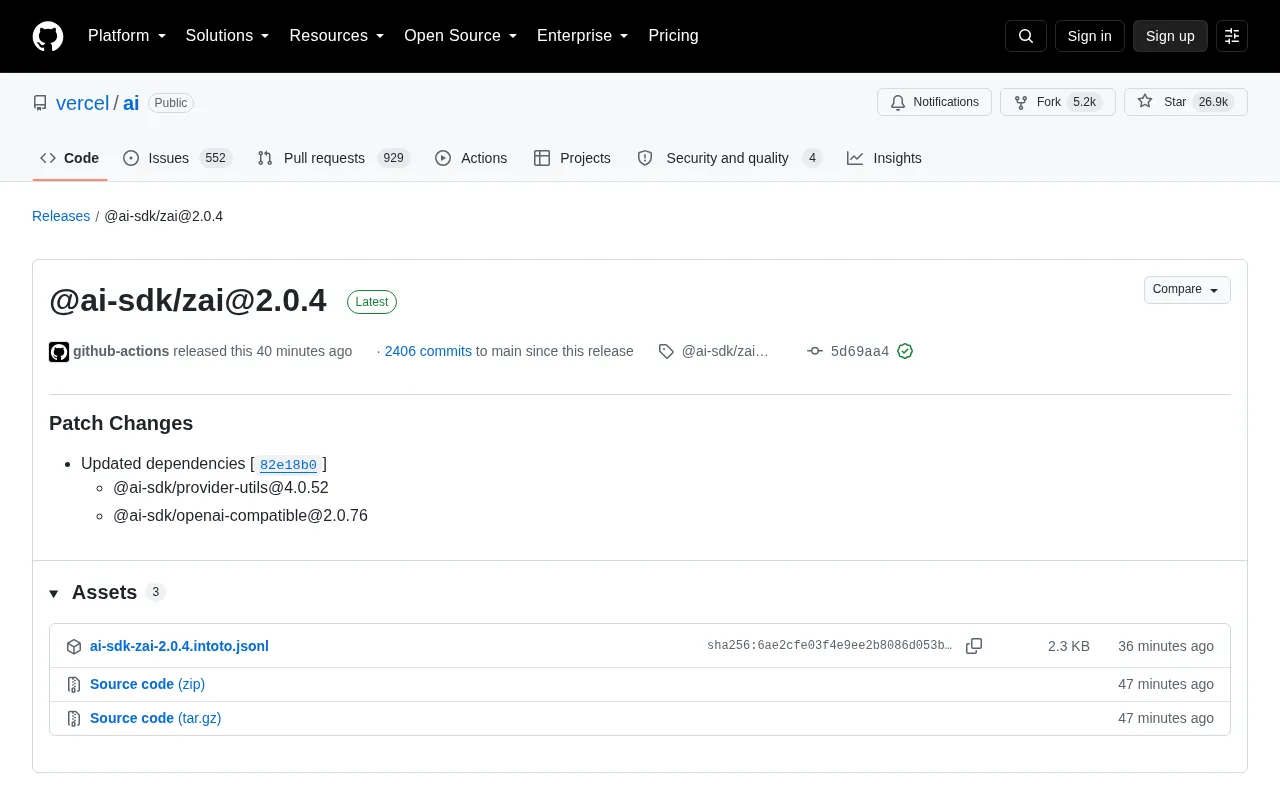
`@ai-sdk/zai@2.0.4` is a patch-level update for the Zhipu (z.ai) LLM provider within the Vercel AI SDK ecosystem, following SemVer with no breaking changes or new features. The core change syncs two upstream dependencies: `@ai-sdk/provider-utils@4.0.52` and `@ai-sdk/openai-compatible@2.0.76`. The `zai` provider connects Zhipu's models via an OpenAI-compatible interface, letting developers switch model providers at minimal cost. Published via GitHub Actions with GPG signing, this upgrade is low-risk and recommended.
Vercel's AI SDK ecosystem has received another minor iteration. @ai-sdk/zai@2.0.4 has been officially released as a patch version, with changes focused entirely on dependency updates. While it's a lightweight release, understanding what changed still has practical value for developers who rely on this provider.
Release Overview
This release of @ai-sdk/zai@2.0.4 is a classic patch-level update that follows Semantic Versioning (SemVer) conventions — meaning it contains no breaking changes and introduces no new public API features. Its purpose is to fix issues or sync underlying dependencies.
The release was published via GitHub Actions automation and signed with a verified GPG key (key ID: B5690EEEBB952194), ensuring the authenticity of the published artifact. This is a common supply chain security practice in modern open-source projects.
Semantic Versioning (SemVer) is a widely adopted versioning convention formatted as MAJOR.MINOR.PATCH. When only the patch version increments, it signals that only backward-compatible bug fixes were made. A minor version bump indicates new backward-compatible features, while a major version bump means breaking, incompatible changes. The core value of this convention is that dependents can quickly assess upgrade risk based on the version number alone — patch updates can almost always be applied without concern, while major version upgrades require careful review of migration guides. GPG signature verification serves as a supply chain security safeguard: by signing artifacts with the publisher's private key, users can verify that a package genuinely comes from a trusted source, guarding against "poisoning" attacks — a practice gaining increasing attention in the npm ecosystem.
Core Changes: Dependency Updates
According to the changelog, the core of this update is syncing two upstream dependency packages:
@ai-sdk/provider-utils@4.0.52@ai-sdk/openai-compatible@2.0.76
provider-utils is a shared utility library used across AI SDK providers, handling common logic such as request construction, response parsing, and error handling. openai-compatible, meanwhile, indicates that the zai provider is implemented using an OpenAI-compatible interface. This design allows z.ai's model services to reuse the standard calling logic from the OpenAI ecosystem, significantly reducing the cost of integration.
Dependency updates typically originate from bug fixes or performance improvements in upstream packages. For a patch release, staying in sync with upstream changes is a necessary step to maintain stability and compatibility.
The "OpenAI-compatible layer" represented by @ai-sdk/openai-compatible is a significant phenomenon in today's LLM API ecosystem. Because OpenAI's Chat Completions API (/v1/chat/completions) has become the de facto industry standard, numerous model providers — including Zhipu, DeepSeekAd, Moonshot, and many others — offer APIs compatible with this spec. This allows client code originally written for OpenAI to work with different vendors simply by swapping the baseURL and API key. Vercel AI SDK leverages this by consolidating all OpenAI-protocol-compatible providers under the @ai-sdk/openai-compatible package. Individual vendor providers (like @ai-sdk/zai) only need minor customizations on top of this foundation — such as model lists and special parameter mappings — dramatically reducing duplicated development work.
Practical Impact for Developers
For projects currently using @ai-sdk/zai, upgrading to 2.0.4 is generally safe and recommended. Patch versions don't change how existing code calls the API, so developers only need to update the version number to receive the underlying fixes.
It's worth noting the significance of the zai provider itself. It provides access to Zhipu's (z.ai) large language models, and through the OpenAI compatibility layer, developers can call models from different vendors under the unified abstraction of Vercel AI SDK — without writing separate adapter code for each provider's API. This is precisely the value of AI SDK as a "unified layer": the cost of switching model providers is reduced to a minimum.
The Continuous Evolution of the Vercel AI SDK Ecosystem
The project's activity level speaks to its standing in the community: as of this release, Vercel's AI repository has accumulated over 26.9k stars and 5.2k forks, with more than 2,405 commits on the main branch. The frequent release cadence reflects the team's ability to respond quickly to the multi-model ecosystem.
As the number of LLM providers continues to grow, AI SDK manages them through independently versioned packages for each provider (like @ai-sdk/zai in this article), enabling a modular update cadence. A minor version bump in a single provider doesn't cascade to the entire SDK — this decoupled design is particularly friendly for dependency management in large projects.
Summary
@ai-sdk/zai@2.0.4 is a patch update focused on dependency synchronization, with no functional changes or breaking modifications — making the upgrade risk extremely low. For developers relying on Zhipu's models or using Vercel AI SDK, promptly applying these kinds of patches ensures you benefit from the latest stability improvements from upstream. These seemingly unremarkable version iterations are, in fact, the everyday hallmark of a healthy open-source project.
Related articles

Zero-Cost Local Jarvis: Open-Source Voice Cloning and Task Automation in Practice
AI Workshop shows how to build a zero-cost local Jarvis with Ollama and Voice Studio: local model switching, open-source voice cloning, file retrieval, and tool-calling tests, with setup steps and hardware trade-offs.

Mistral Large 4 Released: 1T-Parameter MoE Tops Western Open-Source Leaderboard
Mistral releases its flagship Mistral Large 4: a 1T-parameter MoE architecture activating only 49B parameters at inference, trained from scratch on 3,800 Grace Blackwell GPUs, topping the Western open-weight leaderboard with third-party endorsements in law, finance, and cybersecurity.

Mistral Large 4 Review: Can Europe's Strongest Open-Source Model Challenge the US and China?
Mistral Large 4 (L-Charm) review: trillion-parameter MoE, standout cybersecurity benchmarks but behind Kimi K3 in software engineering, 3,800 GPUs, a key step for European sovereign AI.