@ai-sdk/zai 3.0.12 Released: Dependency Update Patch
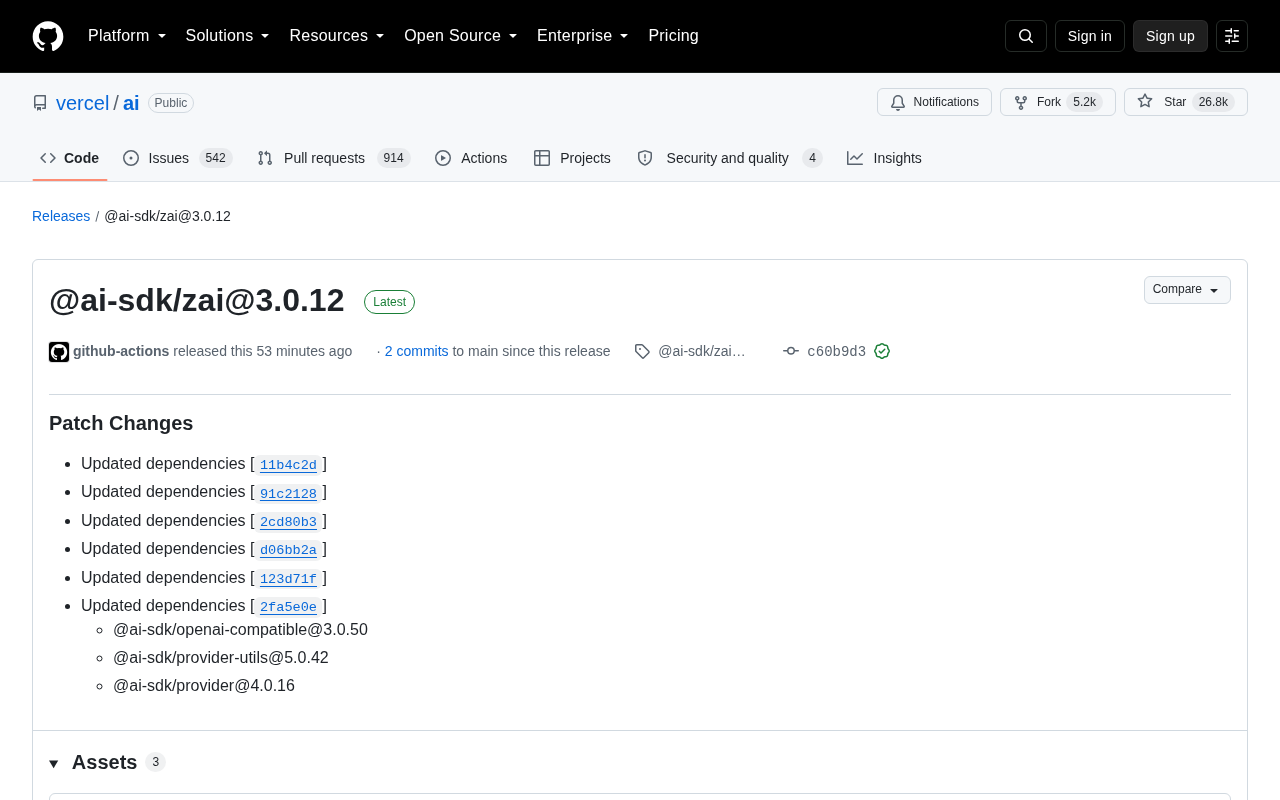
@ai-sdk/zai 3.0.12 patches upstream dependency updates for the ZhipuAI provider in Vercel AI SDK.
`@ai-sdk/zai` 3.0.12 is a maintenance-focused patch release with no new features, updating three core upstream dependencies: `@ai-sdk/openai-compatible@3.0.50`, `@ai-sdk/provider-utils@5.0.42`, and `@ai-sdk/provider@4.0.16`. This provider is the official ZhipuAI (GLM-series) integration point in the Vercel AI SDK ecosystem. The article warns developers not to overlook patch releases, as dependency updates often carry upstream bug fixes and type definition changes that can cause compatibility issues — especially in Monorepo environments.
Vercel's popular open-source AI SDK recently released @ai-sdk/zai version 3.0.12. This is a patch release focused primarily on dependency updates, with no new features introduced. That said, for developers building applications on top of this provider, staying in sync with these updates is important for maintaining stability and security in the underlying dependency stack.
What's in This Release
According to the official Release Notes, @ai-sdk/zai@3.0.12 is a typical patch release, with changes limited to dependency updates. The following core packages were bumped:
@ai-sdk/openai-compatible@3.0.50@ai-sdk/provider-utils@5.0.42@ai-sdk/provider@4.0.16
These are foundational components within the AI SDK ecosystem. @ai-sdk/openai-compatible provides support for OpenAI-compatible interfaces, while @ai-sdk/provider and @ai-sdk/provider-utils serve as the abstraction layer and utility toolkit for various model providers. Since @ai-sdk/zai — the provider dedicated to integrating ZhipuAI (Z.ai) models — relies heavily on these upstream packages, it naturally follows suit whenever the underlying components are updated.
Why Patch Releases Still Matter
Developers often overlook patch releases, but dependency-update patches frequently carry critical bug fixes, type definition adjustments, or security patches. This zai provider release links to multiple upstream commits via Updated dependencies, meaning upstream fixes propagate down to the provider layer.
For projects integrating ZhipuAI models via the AI SDK, keeping the provider in sync with core package versions is especially important. Version mismatches can lead to type incompatibilities, unexpected API call failures, and other issues — particularly in Monorepo setups or projects with strict version pinning. When upgrading, it's a good practice to check the versions of the @ai-sdk/provider family of packages as well, to avoid compatibility gaps.
In Monorepo engineering practice, dependency version mismatches are a common but hard-to-diagnose class of problem. AI SDK packages are deeply coupled through TypeScript's type system. If @ai-sdk/provider's type definitions change — such as adding a required field or adjusting a union type — while a provider layer still depends on the old version, compilation or runtime errors that are difficult to trace can emerge. Projects using pnpm, yarn workspaces, or similar package managers need to be particularly vigilant about phantom dependencies — where sub-packages inadvertently resolve to different versions of upstream packages, resulting in multiple instances of the same type in a single process and causing runtime anomalies like failed instanceof checks. For infrastructure packages like these, it's recommended to pin versions precisely in the lockfile and add dependency consistency validation steps to your CI pipeline.
The AI SDK Ecosystem and zai's Role in It
Vercel's AI SDK is one of the most popular AI application development frameworks in the TypeScript/JavaScript ecosystem, with over 26,000 GitHub Stars and more than 5,000 forks. The SDK uses a modular provider architecture, splitting different model service providers into independently maintained packages.
The benefit of this design is that individual model providers — such as OpenAI, Anthropic, Google, and in this case ZhipuAI — can iterate on their own packages without waiting for a major SDK release. @ai-sdk/zai is the integration point for ZhipuAI models in this system, allowing developers to call GLM-series models and others using a unified API style.
The AI SDK's provider architecture is built on a unified abstract interface design — all provider packages implement the same standard protocols such as LanguageModelV1. This enables developers to swap out the underlying model provider by simply replacing the provider instance, without modifying any business logic. ZhipuAI is one of China's leading large model companies, with its GLM series (e.g., GLM-4, GLM-4V) positioned as GPT-4 counterparts, offering capabilities such as text generation and multimodal understanding. @ai-sdk/zai achieves its integration by reusing the @ai-sdk/openai-compatible layer, which means any API endpoint compatible with the OpenAI Chat Completions format can theoretically be integrated into the AI SDK ecosystem via this abstraction — significantly lowering the integration cost for domestic model providers.
Upgrade Recommendations
For teams already running @ai-sdk/zai in production, here's how to evaluate whether to upgrade:
- If your current version is running stably with no related issues, incorporate this update into your regular maintenance cycle;
- If you've encountered issues related to OpenAI-compatible interfaces, this dependency update may already include the relevant fix — worth trying first;
- When upgrading, sync
@ai-sdk/provider,@ai-sdk/provider-utils, and@ai-sdk/openai-compatibleto the versions specified in the release notes to ensure a consistent dependency tree.
Overall, this is a low-risk, maintenance-oriented routine release. For developers actively using the AI SDK, keeping up with these patches helps reduce long-term technical debt.
Related articles
Automattic Executives Signed Reciprocal Severance Agreements During Mullenweg's Brief Ouster
Automattic's CFO and General Counsel signed reciprocal severance agreements during Matt Mullenweg's brief ouster, covering one year's salary and accelerated equity vesting, raising corporate governance concerns.
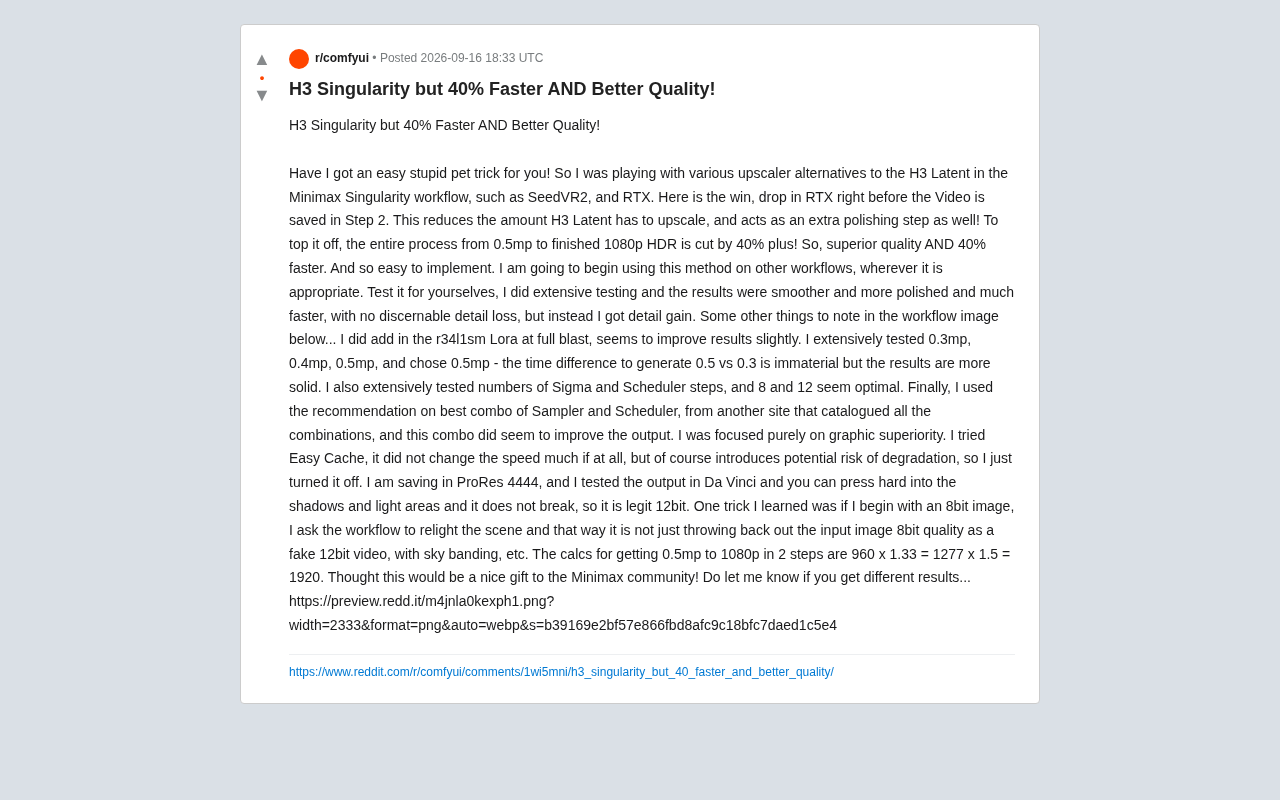
H3 Singularity Optimization: 40% Speed Boost With Better Image Quality
A Reddit user's Minimax Singularity workflow tip: insert an RTX upsampler before H3 Latent for 40%+ speed gains and better quality. Covers parameters, 12-bit output, and more.
Glyph: A Multi-Strategy Agent System for Automated Enterprise Data Catalog Annotation
Glyph is a multi-strategy LLM agent system for enterprise data catalogs that automates column description generation and sensitivity ontology tagging, grounding outputs in pipeline source code to improve accuracy.