@ai-sdk/zai@3.0.13 Released: A Deep Dive into This Dependency-Sync Patch
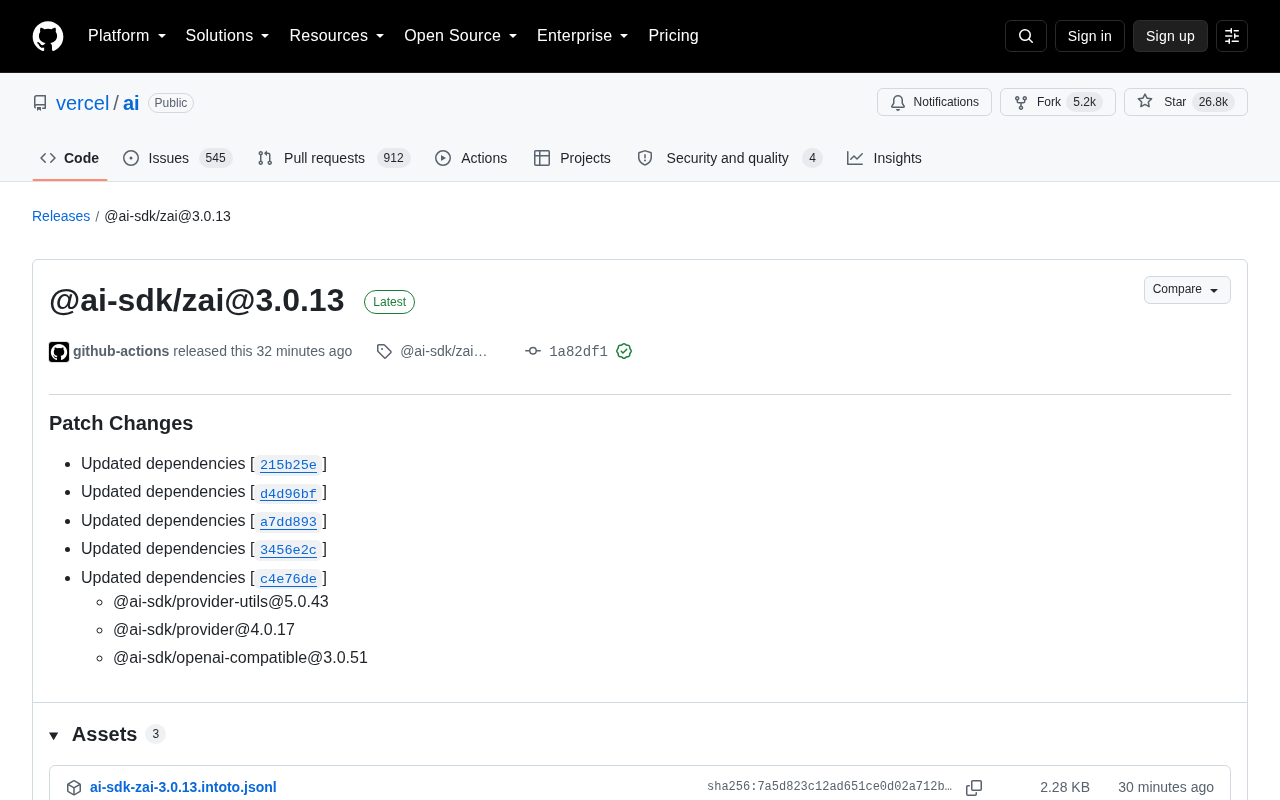
@ai-sdk/zai 3.0.13 patches upstream dependency syncs with no breaking changes.
`@ai-sdk/zai@3.0.13` is a routine patch update for the Vercel AI SDK provider package used to integrate Z.ai (Zhipu) models. There are no new features or breaking changes — the core update syncs three upstream dependencies: `@ai-sdk/provider@4.0.17`, `@ai-sdk/provider-utils@5.0.43`, and `@ai-sdk/openai-compatible@3.0.51`. Since Z.ai offers an OpenAI-compatible API, the package builds on the `@ai-sdk/openai-compatible` adapter layer. The release was auto-triggered by github-actions and GPG-signed. It's a low-risk upgrade, though running a full test suite afterward is still recommended given the high major version numbers of the underlying packages.
The @ai-sdk/zai package in the Vercel AI SDK ecosystem recently released version 3.0.13. This is a patch-level update focused on syncing internal dependencies, with no major feature changes. For developers using Vercel AI SDK to integrate Z.ai (Zhipu) models, these small updates still matter — they directly affect runtime stability and compatibility.
Version Overview: A Typical Patch Release
According to the GitHub Releases page, @ai-sdk/zai@3.0.13 was published automatically by github-actions and signed with a verified GitHub signature (GPG key ID: B5690EEEBB952194), ensuring the integrity and authenticity of the release artifact.
The version number 3.0.13 indicates this is the 13th patch in the 3.0.x series. Under Semantic Versioning (SemVer), an increment in the third digit typically signals backward-compatible bug fixes or internal dependency adjustments — not breaking changes. Developers can therefore upgrade with reasonable confidence.
A note on SemVer: Semantic Versioning is the widely adopted versioning convention in the Node.js ecosystem, following the format
MAJOR.MINOR.PATCH. A major version bump introduces breaking changes; a minor bump adds backward-compatible features; a patch bump covers backward-compatible fixes or internal adjustments. Worth noting:@ai-sdk/provideris already at 4.x and@ai-sdk/provider-utilsat 5.x, meaning both have undergone significant breaking refactors in the past. If your project locks these packages across a major version boundary, you should carefully review their changelogs before upgrading — don't rely solely on@ai-sdk/zai's patch number to assess risk.
Core Changes: Dependency Sync Upgrades
The main content of this release is captured under Patch Changes, focusing on syncing upstream dependency versions. The updated packages include:
@ai-sdk/provider-utils@5.0.43@ai-sdk/provider@4.0.17@ai-sdk/openai-compatible@3.0.51
These packages form the foundational infrastructure of the Vercel AI SDK. @ai-sdk/openai-compatible is particularly significant — it provides an adapter layer for third-party models that implement the OpenAI interface specification. Since Z.ai and many other Chinese LLM providers offer OpenAI-compatible APIs, @ai-sdk/zai is built directly on top of this compatibility layer.
The release notes also reference several upstream commit hashes (215b25e, d4d96bf, a7dd893, 3456e2c, c4e76de), indicating this update consolidates multiple incremental upstream changes into a single synchronized release.
Why
@ai-sdk/openai-compatiblematters: When OpenAI released its Chat Completions API, it defined a specification covering request formats, streaming responses (SSE), error codes, and more. Due to OpenAI's dominant position in the industry, many model providers — including Zhipu GLM, Moonshot, DeepSeek, and others — have chosen to implement this specification, allowing developers to switch underlying models without major code changes.@ai-sdk/openai-compatibleencapsulates this de facto standard, handling auth injection, request serialization, streaming data parsing, and function calling format conversion.@ai-sdk/zaithen only needs to configure Z.ai-specific endpoint URLs and parameters on top of this, dramatically reducing integration overhead. This explains why changes to the underlying compatibility layer cascade updates across all dependent provider packages.
What This Means for Developers
For real-world projects, the value of patch updates like this lies in "keeping pace with the ecosystem." When @ai-sdk/provider or @ai-sdk/openai-compatible fixes a request handling, error handling, or type definition issue, upstream provider packages like zai need to follow suit so end users can benefit from those fixes.
For developers using this package, here's what to know:
How to Upgrade
Simply run the update via your package manager:
npm install @ai-sdk/zai@3.0.13
# or
pnpm add @ai-sdk/zai@3.0.13
Things to Watch Out For
Since this update also bumps several related dependencies, it's recommended to run your full test suite after upgrading to confirm that provider-layer call behavior remains consistent. While patch versions are theoretically backward-compatible, the underlying provider package is already at 4.x and provider-utils at 5.x — projects spanning major version boundaries should still verify overall dependency tree consistency.
The Release Cadence of the Vercel AI SDK Ecosystem
This update to @ai-sdk/zai reflects the "core + multi-provider" architecture that Vercel AI SDK has adopted. The SDK abstracts model providers into independent packages, each one (zai, openai, anthropic, etc.) depending on a shared provider and utility layer. This design significantly lowers the cost of onboarding new models, and means that every improvement to the underlying layers quickly benefits all providers.
This high-frequency, automated release pattern (triggered by github-actions in this case) is characteristic of active open source projects. Vercel AI SDK currently has over 26.8k stars and 5.2k forks on GitHub — a strong signal of community activity — and frequent patch releases are part of how it maintains its competitive edge.
Summary
@ai-sdk/zai@3.0.13 is a routine patch update centered on dependency synchronization, with no new features or breaking changes. For projects relying on Z.ai model integrations, this is a low-risk, recommended upgrade. While the update itself carries limited new information, it serves as a reminder: in a rapidly evolving AI toolchain, keeping an eye on underlying dependency versions is itself part of good engineering practice.
Related articles
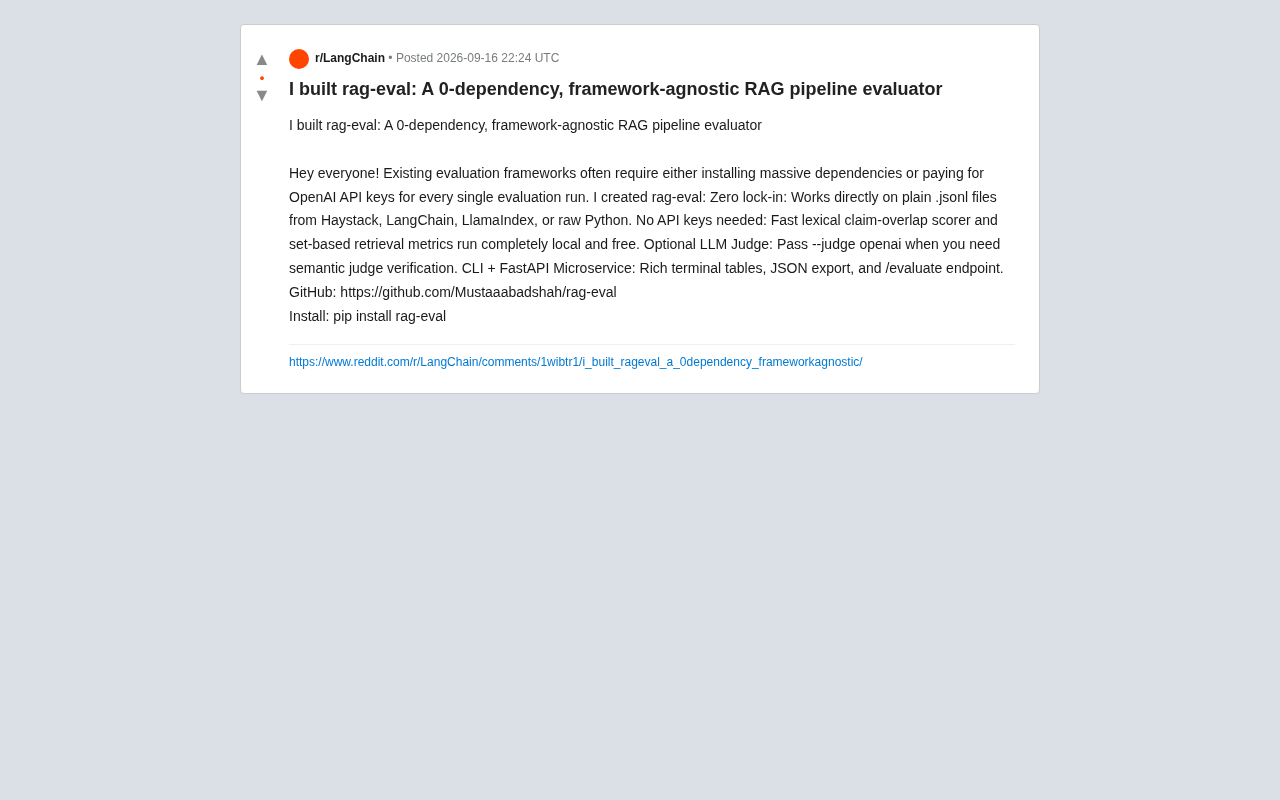
rag-eval: A Zero-Dependency, No-API-Key RAG Evaluation Tool
rag-eval is a zero-dependency, framework-agnostic open-source RAG pipeline evaluation tool. It supports free local lexical and retrieval metrics with no API keys required, and offers optional LLM Judge for semantic validation. Compatible with Haystack, LangChain, and LlamaIndex.
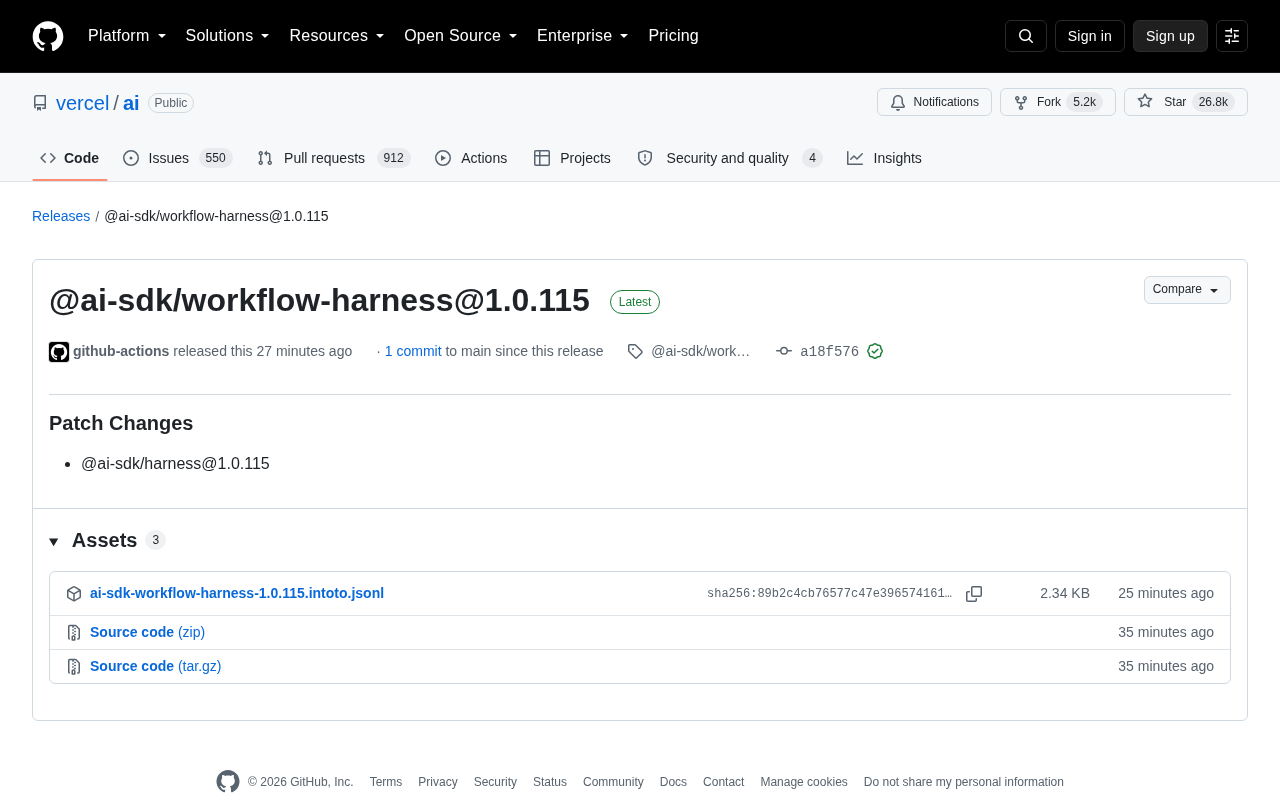
Vercel AI SDK Releases workflow-harness 1.0.115 Patch Update
Vercel AI SDK releases @ai-sdk/workflow-harness 1.0.115 patch update, syncing the @ai-sdk/harness dependency. Learn about the update, release mechanism, and what it means for developers.
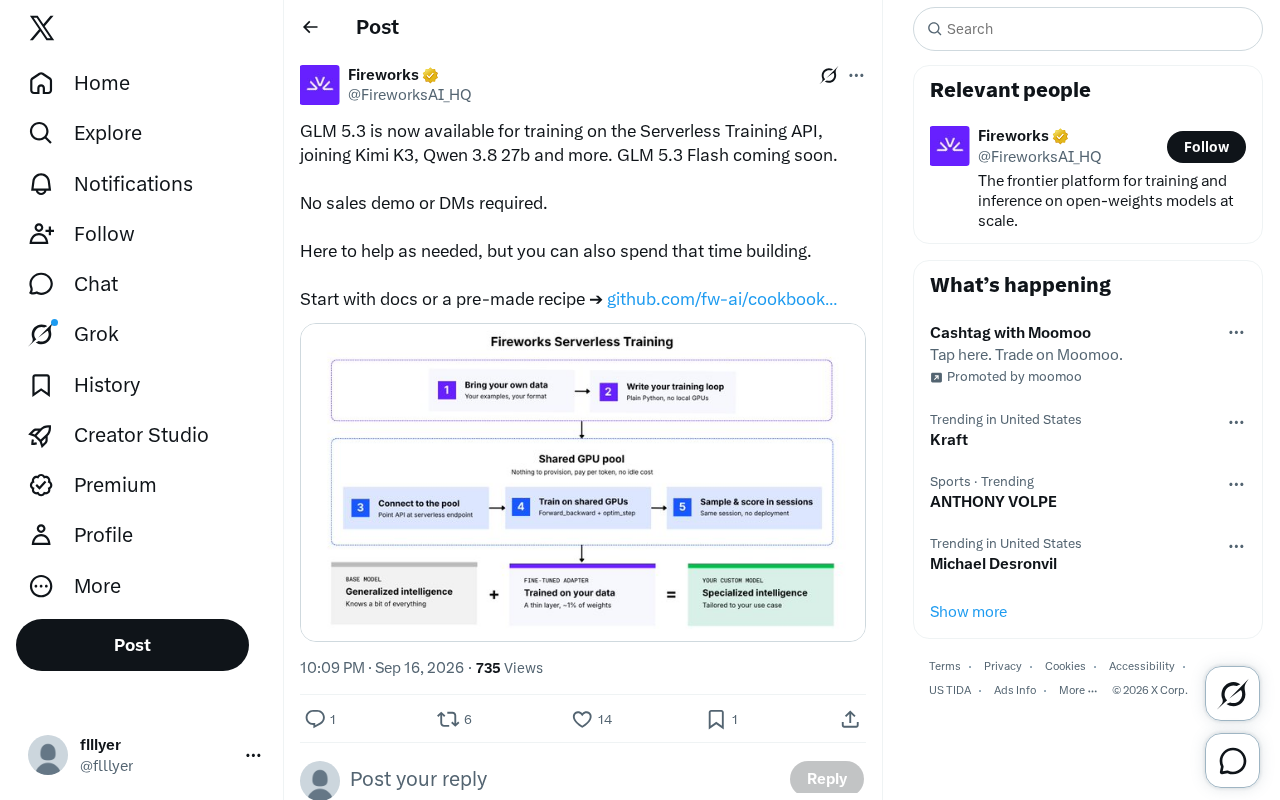
GLM 5.3 Now Available on Serverless Training API — No Sales Process Required
GLM 5.3 is now available on Serverless Training API alongside Kimi K3 and Qwen 3.8 27b. No sales process needed — start fine-tuning directly via docs or pre-made recipes.