@ai-sdk/zai@3.0.15 Released: Vercel AI SDK Dependency Update Explained

@ai-sdk/zai@3.0.15 released with upstream dependency syncs — no breaking changes, safe to upgrade.
Vercel AI SDK has released `@ai-sdk/zai@3.0.15`, a patch update for the Z.ai (Zhipu) model provider package. This release contains no new features or breaking changes — its core purpose is to sync two foundational dependencies: `@ai-sdk/provider-utils@5.0.45` and `@ai-sdk/openai-compatible@3.0.53`, inheriting upstream fixes in request formatting, streaming response handling, and error handling. This cascading patch pattern is typical of Vercel AI SDK's monorepo and changesets workflow. Developers using this provider can upgrade smoothly and are advised to confirm dependency version alignment and run existing tests.
Vercel's AI SDK ecosystem continues to evolve. The @ai-sdk/zai@3.0.15 patch release has just landed. This update focuses primarily on syncing upstream dependencies — a minor version bump, but one that carries real significance for developers relying on this provider to maintain a stable environment.
What's in This Release
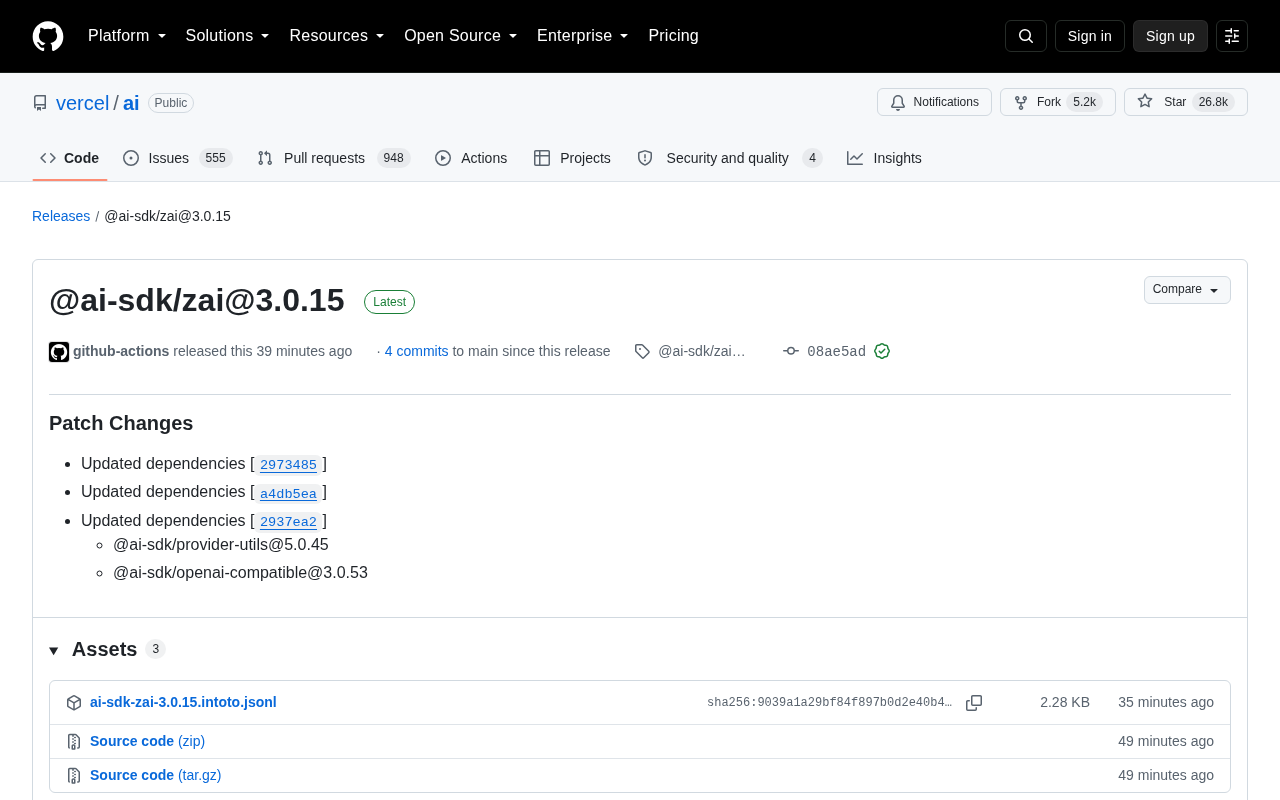
@ai-sdk/zai is the provider package within Vercel AI SDK that targets Z.ai (Zhipu) models, enabling developers to call the corresponding LLM services through a unified SDK interface. Version 3.0.15 was automatically published by GitHub Actions and is a classic Patch Changes update.
According to the release notes, no new features were introduced. The core change is a version sync of the following dependencies:
@ai-sdk/provider-utils@5.0.45@ai-sdk/openai-compatible@3.0.53
This means the underlying utility library and OpenAI-compatible layer that @ai-sdk/zai depends on have been updated, inheriting fixes and improvements from those upstream packages.
Why Dependency Updates Matter
For a provider package, dependency updates may seem trivial — but they directly affect the stability of the entire call chain. @ai-sdk/openai-compatible serves as a shared foundation for many model providers that are compatible with the OpenAI API format. Its upgrades often include fixes related to request formatting, streaming response handling, error handling, and more.
@ai-sdk/provider-utils, on the other hand, provides the common utility functions needed for provider implementations. When these two foundational packages are updated, upstream providers that depend on them — like zai — need to sync accordingly, ensuring consistent behavior and avoiding potential compatibility issues caused by version mismatches.
This kind of "upstream change, downstream sync" cascading patch release is a hallmark of Vercel AI SDK's monorepo and changesets management approach. When you upgrade the main SDK, you typically get the latest patches for these provider packages as well.
Vercel AI SDK uses a monorepo (single repository) combined with the changesets tool for version management. A monorepo means all provider packages, utility libraries, and core layers within the SDK are developed together in one repository, enabling atomic cross-package changes and unified testing. Changesets is a changelog management tool where developers declare the scope of their changes (patch/minor/major) when submitting a PR, and the CI pipeline automatically aggregates those declarations at release time, updates version numbers, and generates changelogs. Together, when a base package like provider-utils fixes a bug, maintainers only need to mark a patch change for that package — the CI pipeline automatically identifies all dependent packages (like zai) and triggers their corresponding patch releases, without any manual intervention. This is the technical foundation that makes cascading patch releases work efficiently.
Practical Impact for Developers
If your project is using @ai-sdk/zai to call related model services, this upgrade is safe to apply. As a pure patch release, it contains no breaking changes — in theory, you can upgrade smoothly without modifying any business logic.
Recommended steps:
- Update to
3.0.15within the range allowed by your lockfile - Confirm that
@ai-sdk/provider-utilsand@ai-sdk/openai-compatibleare also updated to their corresponding versions - Run your existing test suite to verify that call behavior remains unchanged
For production projects that prioritize stability, keeping up with patch releases like this helps reduce the risk of latent bugs — especially in scenarios that are sensitive to underlying implementation details, such as streaming output and tool calling.
A Signal of AI SDK Ecosystem Health
Vercel AI SDK currently has over 26.8k stars and 5.2k forks on GitHub, making it one of the most popular AI application development frameworks in the Web/Node ecosystem. Frequent patch releases are themselves a signal of project health — they reflect the maintenance team's ability to respond quickly to upstream dependency changes and their ongoing commitment to consistency across multiple providers.
For teams looking to integrate multiple LLMs in a TypeScript/JavaScript environment, choosing an actively maintained SDK with a comprehensive provider ecosystem significantly reduces the cost of integrating different model services. Provider packages like zai are precisely the building blocks of this "unified interface + multiple backends" architecture.
@ai-sdk/openai-compatible plays the role of an "adapter layer" in the Vercel AI SDK provider architecture. Since OpenAI's Chat Completions API format has become the de facto industry standard, many model service providers — including Zhipu, DeepSeekAd, Groq, and others — offer interfaces compatible with this format. The openai-compatible package encapsulates the common logic for this protocol: request construction, streaming SSE parsing (Server-Sent Events), Function Calling / Tool Use, and more. Individual providers only need to configure their endpoint and authentication on top of this foundation to integrate quickly, without implementing a full HTTP communication layer from scratch. This layered design significantly lowers the cost of adding new providers — and it also means any fix to the underlying protocol layer automatically benefits all provider packages that depend on it.
Summary
@ai-sdk/zai@3.0.15 is a patch update focused on dependency synchronization — no new features, no breaking changes. Its primary value lies in keeping the environment consistent by following improvements in the upstream provider-utils and openai-compatible packages. Developers using this provider can upgrade with confidence. This release also reflects the broader engineering culture of Vercel AI SDK: high-frequency iteration with a strong focus on stability.
Related articles

AI Reverse-Engineers Monitor Firmware in 15 Minutes — Has the Hacking Barrier Been Flattened?
A security researcher used AI to reverse-engineer Dell monitor firmware in 15 minutes—entropy analysis, key extraction, MD5 verification—revealing encryption design flaws.

Mistral Voxtral 3: Real-Time Voice at 4 Cents per Minute, Challenging OpenAI
Mistral Voxtral 3 cuts real-time voice agent costs to 4 cents per minute, bundling three speech recognition models, a speech generation model, and a real-time voice toolkit, supporting 50+ languages and self-hosting. This article analyzes its pricing structure, sub-second response performance, and its strategic divergence from OpenAI and Gemini on data privacy versus out-of-the-box convenience.

WebMCP: Every Website as Its Own MCP Server, So AI Agents No Longer Rely on Screenshots
WebMCP lets websites expose tools via the document.modelcontext API, becoming directly callable MCP servers. This article explains its architecture, the Claude Code remote-debugging demo, Chrome's current support stage, and its impact on the agent ecosystem.