@ai-sdk/zai 3.0.26 Released: A Deep Dive into This Dependency-Sync Patch Update

@ai-sdk/zai 3.0.26 is a low-risk patch release that syncs three upstream AI SDK dependencies.
`@ai-sdk/zai@3.0.26` is a pure dependency-sync patch update for the Vercel AI SDK provider package used to integrate Zhipu AI (Z.ai/GLM series) models, introducing no functional changes. The update bumps `@ai-sdk/provider-utils` to 5.0.55, `@ai-sdk/provider` to 4.0.23, and `@ai-sdk/openai-compatible` to 3.0.64 to keep pace with the AI SDK toolchain. As the package reuses the OpenAI compatibility layer, this "dependency propagation" update pattern is expected. It's a low-risk upgrade — projects tracking the latest AI SDK versions should sync to avoid conflicts, while stable projects can upgrade at their convenience. A regression test after upgrading is recommended.
The @ai-sdk/zai package in the AI SDK ecosystem has released version 3.0.26 as a patch update. This is a classic dependency synchronization release with no new features introduced. However, for developers using this provider to integrate Z.ai (Zhipu AI) models, understanding the changes can help you decide whether an upgrade is warranted.
What's New in This Update
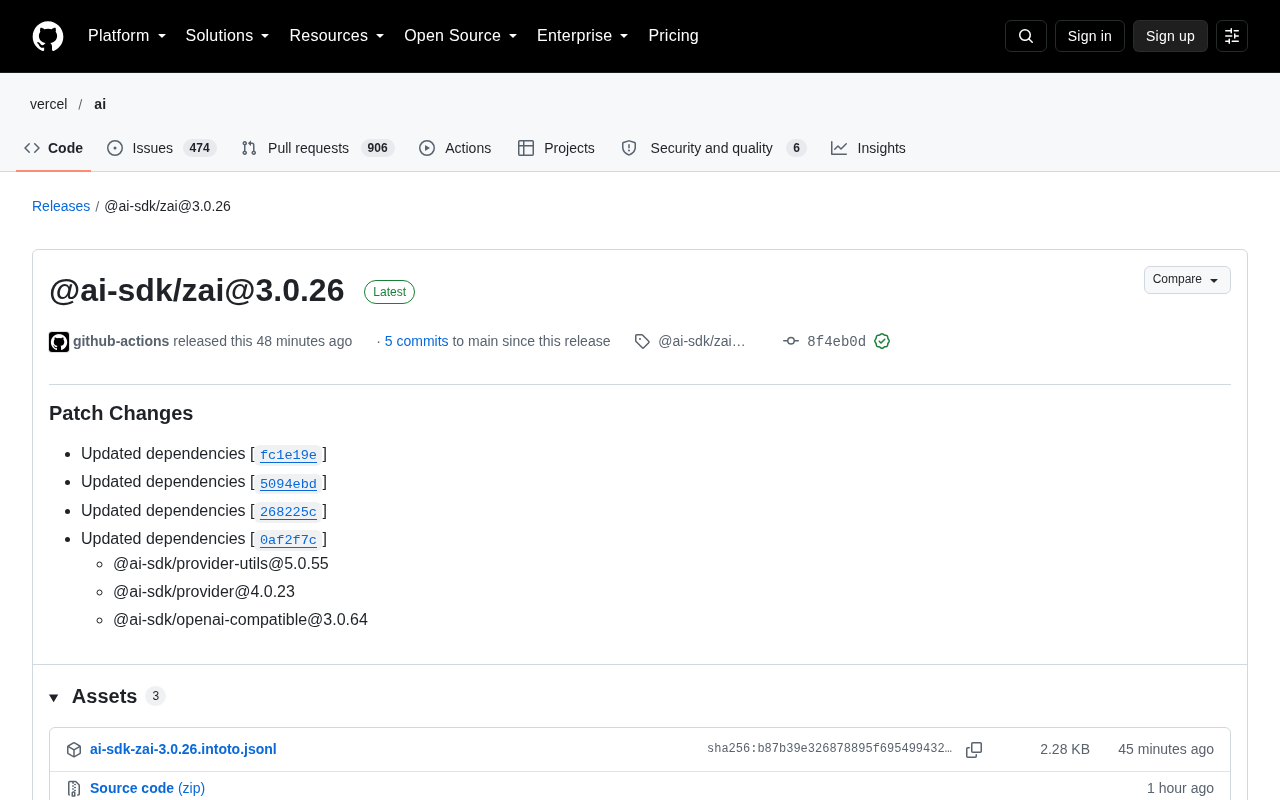
According to the GitHub Releases page, @ai-sdk/zai@3.0.26 was automatically published by github-actions as a Patch Change. This release contains no functional modifications — the core changes are limited to syncing upstream dependency versions:
@ai-sdk/provider-utilsupgraded to 5.0.55@ai-sdk/providerupgraded to 4.0.23@ai-sdk/openai-compatibleupgraded to 3.0.64
These dependency updates were introduced through multiple commits (e.g., fc1e19e, 5094ebd, 268225c, 0af2f7c). The release commit carries a verified signature from GitHub, ensuring the trustworthiness of the release source.
Understanding the Role of @ai-sdk/zai
@ai-sdk/zai is a provider package within the Vercel AI SDK ecosystem, enabling developers to call Zhipu AI (Z.ai / GLM series) models through a unified AI SDK interface. It relies on @ai-sdk/openai-compatible as a compatibility layer, meaning its underlying implementation reuses the OpenAI-compatible request and response format.
The advantage of this architectural design is that when the AI SDK's core provider abstraction or the OpenAI compatibility layer receives updates, individual model provider packages simply need to bump their dependency versions to inherit those improvements — no need to re-implement the underlying logic. Version 3.0.26 is a textbook example of this "dependency propagation" style of update.
The Vercel AI SDK's provider system uses a layered design: at the base, @ai-sdk/provider defines the standard interfaces and type contracts; in the middle, @ai-sdk/provider-utils provides shared utility functions (such as streaming parsing and error handling); above that sits @ai-sdk/openai-compatible as a protocol-specific compatibility adapter; and finally, individual model provider packages (like @ai-sdk/zai, @ai-sdk/anthropic, etc.) build on top of these foundations. This layered structure allows the SDK to support dozens of model service providers with relatively low maintenance overhead, and developers can switch between providers by simply swapping the provider instance without touching business logic.
What Does a Patch Version Signify?
Under Semantic Versioning (SemVer), a patch increment (3.0.25 → 3.0.26) typically represents backward-compatible fixes or internal changes. Since this update only involves syncing dependency versions without altering @ai-sdk/zai's own public API, it qualifies as a low-risk upgrade for existing codebases.
That said, updates to dependency packages often carry implicit bug fixes, type definition adjustments, or compatibility improvements. For production projects, it's advisable to run a regression test suite after upgrading to confirm that interactions with Zhipu AI models remain consistent.
The SemVer specification defines a version number as a three-part MAJOR.MINOR.PATCH structure: a major version change signals breaking, incompatible changes; a minor version change indicates backward-compatible new features; and a patch change represents only backward-compatible bug fixes or internal adjustments. In the npm ecosystem, range declarations like ^3.0.25 will automatically accept patch and minor upgrades, so most projects will automatically receive 3.0.26 when running npm update without manually editing package.json. Understanding this convention helps developers make informed decisions when managing version upgrade strategies.
Should You Upgrade?
Whether to upgrade depends on your specific situation:
- Projects tracking the main AI SDK line: If you're also using newer versions of
@ai-sdk/provideror@ai-sdk/openai-compatible, upgrading@ai-sdk/zaito 3.0.26 helps avoid potential conflicts from mismatched dependency versions. - Stable, running projects: If your current version works without issues, this patch update isn't mandatory — you can upgrade at a convenient time.
- Monorepos using pnpm/npm workspaces: When dependency propagation updates occur, it's especially recommended to upgrade all related packages to matching versions to reduce lockfile conflicts.
Summary
@ai-sdk/zai@3.0.26 is a pure dependency-sync patch release, with its core value being alignment with the AI SDK's underlying provider toolchain. For most developers, this type of update can be applied seamlessly. That said, it's still worth checking the changelogs for upstream @ai-sdk/provider-utils and @ai-sdk/openai-compatible to understand what improvements have been inherited through the dependency chain.
Related articles

Random Pruning of the DPO Computation Graph: 1.4x Training Speedup and Lower Peak Memory
DPO training too slow and memory-hungry? This paper proposes a random pruning framework for the DPO computation graph, sampling independently across position, sequence, and branch dimensions; branch pruning achieves a 1.426x step-time speedup and cuts training time by about 30%, with in-depth attribution of memory and time gains.

Why Does JEPA Underperform MLM in Longitudinal EHR Representation Learning?
New study compares JEPA and MLM for longitudinal EHR representation learning on MIMIC-IV: three JEPA variants train stably without collapse but underperform MLM; target size, not heterogeneity, drives prediction error.

Transfer Learning + Visible Light Communication: A New Approach to Energy-Efficient Indoor Positioning
A study proposes a transfer learning-based visible light communication indoor positioning method, achieving 47% accuracy improvement on the BOSCH factory dataset, 67.5% model efficiency under high noise, and introducing the ME composite metric for energy-efficient positioning in energy-constrained industrial IoT scenarios.